

Lemon law for leased cars in California may protect drivers whose leased vehicles experience repeated warranty-covered problems that the manufacturer cannot repair after a reasonable number of attempts. You do not have to own or finance your vehicle to potentially have rights under California Lemon Law.
If your leased vehicle keeps going back to the dealership for the same problem, has spent weeks in the repair shop, or continues to experience mechanical, electrical, software, or safety issues after warranty repairs, it may be worth taking a closer look at your repair history.
California Lemon Law can apply to qualifying new vehicles that are leased in California and covered by the manufacturer’s original new-vehicle warranty.
Does Lemon Law Apply to Leased Cars in California?
Yes. California Lemon Law can apply to leased cars.
Qualifying lessees may have Lemon Law protections even though they do not own the vehicle outright.
If a manufacturer or its authorized repair facility is unable to repair a warranty-covered problem after a reasonable number of repair opportunities, the consumer may have options under California Lemon Law.
Depending on the facts of the claim and how the matter is resolved, those options may include a manufacturer buyback or a cash-and-keep settlement.
Whether your leased vehicle may qualify depends on factors such as:
- What problems the vehicle has experienced
- Whether the problems are covered by the manufacturer’s warranty
- Whether the problems substantially affect the vehicle’s use, value, or safety
- How many repair attempts have been made
- Whether the same or similar problem keeps returning
- How many days the vehicle has been out of service
- When the problems and repairs occurred
- The vehicle’s mileage
- The complete repair history
There is no one-size-fits-all answer, which is why the entire repair history should be reviewed.
How Does Lemon Law for Leased Cars Work in California?
California’s Lemon Law is part of the Song-Beverly Consumer Warranty Act.
Generally, when a manufacturer provides a warranty, it has an obligation to repair covered problems. If a qualifying vehicle continues to experience a substantial warranty problem after the manufacturer has been given a reasonable opportunity to repair it, the consumer may have rights under California Lemon Law.
For someone leasing a vehicle, the analysis often starts with several important questions.
Is the Problem Covered by the Manufacturer’s Warranty?
The repair history should involve problems covered by an applicable manufacturer warranty.
A manufacturer’s original vehicle warranty is different from a third-party service contract, maintenance plan, or other optional coverage.
Does the Problem Affect the Vehicle’s Use, Value, or Safety?
Not every inconvenience will necessarily support a Lemon Law claim.
Generally, the defect or nonconformity must substantially impair the vehicle’s use, value, or safety.
Has the Manufacturer Had a Reasonable Opportunity to Fix It?
California does not have one repair number that automatically determines every Lemon Law case.
The seriousness of the problem, number of repair visits, days out of service, and whether the problem continues after attempted repairs can all be relevant.
California’s Department of Consumer Affairs states that a manufacturer is allowed a reasonable number of repair attempts and generally notes at least two repair attempts when discussing qualification. However, the exact number needed can depend on the circumstances.
What Problems Can Qualify Under Lemon Law for Leased Cars?
A leased vehicle does not have to become completely undrivable before California Lemon Law may become relevant.
A wide variety of warranty-covered defects can potentially substantially affect a vehicle’s use, value, or safety.
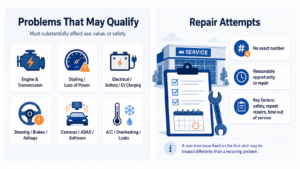
Depending on the circumstances, problems may include:
- Engine defects
- Transmission problems
- Vehicle stalling
- Loss of power
- Acceleration problems
- Repeated check-engine lights
- Electrical system failures
- Battery problems
- Electric vehicle charging failures
- High-voltage battery issues
- Steering problems
- Brake problems
- Airbag or restraint-system warnings
- Driver-assistance system failures
- Backup camera or safety camera problems
- Repeated overheating
- Fuel-system problems
- Serious water leaks
- Persistent air-conditioning failures
- Vehicle startup problems
- Repeated software failures
- Recurring dashboard warning messages
- Problems causing the vehicle to enter reduced-power or “limp” mode
Whether any particular issue qualifies depends on the severity of the problem, repair history, warranty coverage, and other circumstances.
For example, a warning message that appears once and is successfully repaired during the first service visit may be evaluated very differently from a vehicle that repeatedly loses power while driving despite multiple repair attempts.
How Many Repair Attempts Are Needed for Lemon Law for Leased Cars?
One of the most common questions consumers ask is:
“How many times does my car need to go to the dealership before it becomes a lemon?”
There is no single repair number that automatically makes every vehicle a lemon.
California generally looks at whether the manufacturer has been given a reasonable number of opportunities to repair the problem.
What is reasonable can depend on factors such as:
- The seriousness of the defect
- Whether the problem affects vehicle safety
- Whether the same problem continues to return
- What repair attempts have already been made
- How long the vehicle has been unavailable
- Whether the dealership has been able to diagnose the problem
- Whether previous repairs failed to correct the underlying condition
California also has a Lemon Law presumption that provides specific benchmarks in certain circumstances.
What Is California’s 18-Month/18,000-Mile Lemon Law Presumption?
California has a legal presumption that can help determine whether a manufacturer has been given a reasonable number of opportunities to repair the vehicle.
The presumption generally concerns qualifying problems occurring during the first 18 months after delivery or the first 18,000 miles, whichever comes first.
Depending on the circumstances, the presumption may apply when:
- The manufacturer or its authorized repair facility has made four or more attempts to repair the same problem, and the problem continues;
- The manufacturer or its authorized repair facility has made two or more attempts to repair the same problem when the problem could cause death or serious bodily injury if the vehicle is driven, and the problem continues; or
- The vehicle has been out of service for warranty repairs for more than 30 total days.
The 30 days do not have to occur consecutively.
Does My Leased Car Have to Meet the 18-Month/18,000-Mile Rule?
No.
This is an important distinction.
The 18-month/18,000-mile provision is a legal presumption. It is not the entire California Lemon Law.
A vehicle that does not fall within those exact numbers may still potentially qualify depending on the warranty, repair history, defects, repair opportunities, and other circumstances.
California’s Department of Consumer Affairs explains that Lemon Law protections can apply throughout the duration of the manufacturer’s original warranty period.
For example, a significant covered problem may first develop after the vehicle passes 18,000 miles but while the manufacturer’s original warranty is still in effect.
Do not automatically assume that your vehicle cannot qualify simply because it has more than 18,000 miles or because more than 18 months have passed since delivery.
Does the 30-Day Lemon Law Rule Apply to Leased Cars?
Yes. The amount of time a leased vehicle spends out of service for warranty repairs can be an important part of a California Lemon Law analysis.
Under California’s Lemon Law presumption, having a vehicle out of service for warranty repairs for more than 30 cumulative days may satisfy one of the presumption’s benchmarks when the applicable requirements are met.
Those days do not need to occur during one single repair visit.
For example:
- First repair visit: 8 days
- Second repair visit: 6 days
- Third repair visit: 12 days
- Fourth repair visit: 7 days
Total: 33 days out of service
For someone leasing a vehicle, a long repair history can be especially frustrating because monthly lease payments may continue while the vehicle remains at the dealership.
However, reaching 30 days does not automatically mean that every vehicle qualifies for a Lemon Law buyback.
The timing, warranty coverage, nature of the repairs, reason for the vehicle being out of service, and complete repair history still matter.
Do All 30 Days Have to Be for the Same Problem?
Not necessarily.
The 30-day portion of California’s Lemon Law presumption concerns time out of service for repairs of problems covered by the warranty.
That is different from the portion of the presumption involving repeated attempts to fix the same problem.
A vehicle’s complete warranty repair history can therefore be important.
For example, one vehicle may experience:
- Battery failures
- Electrical warnings
- Starting problems
- Camera faults
- Driver-assistance warnings
- Software failures
The dealership may describe these as separate complaints on different repair orders even though some of them may involve related vehicle systems.
This is one reason you should preserve every repair order, not only the ones that use exactly the same wording.
What If the Dealership Says “Could Not Duplicate”?
Do not throw away that repair order.
A dealership writing “could not duplicate,” “cannot duplicate,” “no problem found,” or similar language does not necessarily mean that the repair visit is irrelevant.
Many vehicle problems are intermittent.
For example:
- A warning light may disappear before a technician inspects the vehicle.
- The vehicle may lose power only under certain driving conditions.
- An electrical problem may occur randomly.
- A camera system may malfunction intermittently.
- An infotainment system may freeze only occasionally.
- A vehicle may fail to start one day and operate normally the next.
If you presented the vehicle to an authorized repair facility and clearly described the problem, that visit can still be an important part of the repair history.
Before leaving the dealership, check the repair order to make sure your actual complaint is written correctly.
For example:
Too vague:
“Customer requests vehicle inspection.”
More useful:
“Customer states vehicle loses acceleration while driving at freeway speeds and warning message appears on dashboard.”
Specific descriptions can help create a clearer record if the problem happens again.
What If the Dealership Keeps Performing Software Updates?
Software-related repairs are increasingly common because modern vehicles rely heavily on computers, sensors, cameras, electronic control modules, and connected technology.
A dealership may attempt to address a complaint by:
- Updating software
- Reprogramming a module
- Resetting a system
- Installing a manufacturer update
- Clearing diagnostic trouble codes
- Recalibrating a camera or sensor
- Replacing an electronic control module
A software update can be a legitimate repair attempt.
But there is another important question:
Did the repair actually fix the problem?
If the same warning, loss of power, electrical malfunction, camera failure, charging issue, or other problem continues after repeated updates or resets, those additional repair visits may be relevant when evaluating the overall repair history.
What If the Dealership Replaces a Different Part Every Time?
Consumers sometimes assume that repeated repairs do not matter because the dealership replaced a different component during each visit.
That is not necessarily the right way to look at the repair history.
Consider a vehicle whose driver repeatedly reports:
- Loss of acceleration
- Reduced power
- Check-engine warnings
- Hesitation while driving
During different repair visits, the dealership might:
- Update the vehicle software;
- Replace a sensor;
- Replace a control module;
- Repair wiring; and
- Replace another component.
Although the dealership tried different solutions, the driver’s underlying complaint may have remained substantially the same.
Looking at the consumer’s symptoms—not merely the name of the part replaced—can be important when reviewing repeated repair attempts.
Can Electric and Hybrid Leased Vehicles Qualify Under California Lemon Law?
Yes. California Lemon Law is not limited to gasoline-powered vehicles.
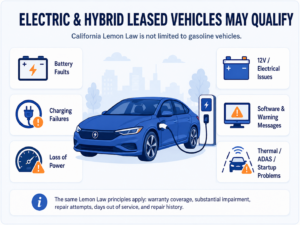
Qualifying leased electric and hybrid vehicles may potentially have Lemon Law claims involving problems such as:
- High-voltage battery faults
- Charging failures
- Loss of propulsion
- Reduced-power mode
- 12-volt battery failures
- Electrical system faults
- Software problems
- Repeated warning messages
- Thermal-management problems
- Vehicle startup failures
- Regenerative braking issues
- Driver-assistance system malfunctions
The same general principles apply: warranty coverage, substantial impairment, repair opportunities, days out of service, and the complete repair history all matter.
Can Air-Conditioning Problems Qualify Under California Lemon Law?
Potentially.
Air-conditioning problems should not automatically be dismissed as minor, particularly when the problem repeatedly returns or significantly affects the usability of the vehicle.
Whether an A/C problem may contribute to a Lemon Law claim depends on factors such as:
- How severe the failure is
- How many repair attempts were made
- Whether the problem keeps returning
- How long the vehicle remained out of service
- What parts or systems failed
- Whether the condition substantially impairs the vehicle’s use or value
A single A/C repair that successfully resolves the issue may be evaluated differently from an air-conditioning system that repeatedly stops cooling despite multiple warranty repair attempts.
What Documents Should I Keep for a Leased Car Lemon Law Claim?
Good documentation can make it much easier to evaluate a potential lemon law for leased cars claim.
Try to keep the following documents together.
1. Your Lease Agreement
Your lease agreement may contain important information such as:
- Lease date
- Vehicle information
- Monthly payment
- Amount paid at signing
- Capitalized cost
- Lease term
- Leasing or finance company
- Other financial terms
2. Every Repair Order
Keep paperwork from every warranty repair visit.
That includes visits where:
- No parts were replaced
- The dealership could not duplicate the problem
- The vehicle was inspected but no problem was found
- Software was updated
- Diagnostic codes were cleared
- Parts were ordered
- Parts were backordered
- Repairs were delayed
- You were told that the vehicle was “operating as designed”
Do not assume that a repair order is unimportant simply because the dealership did not complete a physical repair.
3. Drop-Off and Pick-Up Dates
Track when your vehicle was:
- Dropped off
- Diagnosed
- Repaired
- Ready for pickup
- Actually picked up
These dates can help establish how many total days the vehicle was unavailable because of warranty repairs.
4. Mileage
Keep track of the mileage listed on every repair order.
The mileage listed on an early qualifying repair visit can become particularly important if a Lemon Law buyback is later evaluated.
5. Photos and Videos
If the problem is intermittent, photographs and videos may help document what happened.
When it is safe to do so, consider documenting:
- Dashboard warnings
- Check-engine lights
- Charging errors
- Infotainment failures
- Camera failures
- Fluid leaks
- Startup failures
- Error messages
- Unusual noises
- Other visible symptoms
6. Manufacturer and Dealership Communications
Save relevant:
- Emails
- Text messages
- Manufacturer case numbers
- Dealership messages
- Warranty correspondence
- Service appointment confirmations
- Repair-status updates
A clear chronological record can help show what happened from the first problem through the most recent repair attempt.
Can a Leased Car Get a Lemon Law Buyback?
Potentially, yes.
A leased vehicle may potentially qualify for a manufacturer buyback when the applicable California Lemon Law requirements are met.
Leasing the vehicle does not automatically prevent a consumer from pursuing a Lemon Law claim.
A leased-vehicle buyback can involve several parties and financial considerations, including:
- The lessee
- The manufacturer
- The leasing or finance company
- Lease payments already made
- Amounts paid at signing
- Applicable mileage deductions
- Certain related expenses
The exact calculation and outcome depend on the vehicle’s repair history, lease terms, mileage, warranty coverage, and other facts.
What Is a Cash-and-Keep Lemon Law Settlement?
A cash-and-keep settlement is another way some Lemon Law claims may be resolved.
As the name suggests, a cash-and-keep settlement generally means the consumer receives a monetary settlement while keeping the vehicle rather than having the manufacturer take it back as part of a buyback.
For someone with a leased vehicle, the consumer generally continues to be responsible for the lease and its terms unless the settlement specifically provides otherwise.
A cash-and-keep settlement is a negotiated resolution. It is not automatically guaranteed simply because a vehicle may qualify under California Lemon Law.
Whether this type of settlement is offered—and whether it makes sense for a particular consumer—can depend on factors such as:
- The severity of the problems
- The repair history
- Whether the problem has been repaired
- The vehicle’s mileage
- The remaining lease term
- The manufacturer’s offer
- Whether the consumer is comfortable continuing to drive or lease the vehicle
Consumers should carefully review the terms before accepting a cash-and-keep settlement.
Buyback vs. Cash-and-Keep: What Is the Difference?
The biggest difference is generally what happens to the vehicle.
Manufacturer Buyback
With a manufacturer buyback, the vehicle is taken back as part of resolving the Lemon Law claim.
For a leased vehicle, the leasing company may also be involved because the consumer does not hold title to the vehicle.
Cash-and-Keep Settlement
With a cash-and-keep settlement, the consumer generally receives a monetary settlement and keeps the vehicle—or, in the case of a lease, continues with the vehicle and lease unless the settlement provides otherwise.
This may appeal to someone whose vehicle is currently operating well despite its past repair history.
However, it may be less appealing when the consumer has lost confidence in the vehicle or the problems remain unresolved.
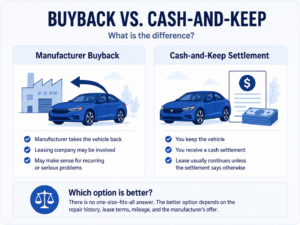
Which Option Is Better?
There is no single answer.
A buyback may make more sense for someone who does not want to continue with a vehicle that has experienced serious or recurring problems.
A cash-and-keep settlement may be worth considering when the consumer wants to continue driving the vehicle and is comfortable with the terms of the proposed settlement.
The better option depends on the individual facts, repair history, lease terms, and manufacturer’s offer.
Is There a Mileage Deduction on a Leased Car Lemon Law Buyback?
There may be.
California law permits a manufacturer to apply a mileage-based deduction based on the consumer’s use of the vehicle before the first relevant repair attempt for the qualifying problem.
The statutory calculation uses 120,000 miles as its denominator.
In simplified terms, the calculation considers the mileage accumulated before the vehicle was first brought to the manufacturer or its authorized repair facility for correction of the qualifying problem.
This is why early repair orders can be especially important.
For example, if the first relevant repair occurred at relatively low mileage, the calculation can look very different from a vehicle where the first relevant repair occurred much later.
Do not assume that all mileage accumulated throughout the entire lease will necessarily be treated the same way.
The mileage surrounding the first relevant repair attempt can matter.
Should I Keep Making My Lease Payments During a Lemon Law Claim?
Consumers should be cautious about simply stopping lease payments because they believe their vehicle is a lemon.
A potential Lemon Law claim does not automatically cancel the lease agreement.
Missing payments could create separate contractual, financial, or credit issues.
Unless you have received legal advice specifically addressing your situation, it is generally important to continue complying with your lease obligations while your Lemon Law rights are being evaluated.
What If My Lease Is Almost Over?
If your lease is approaching its return date and your vehicle has a significant repair history, do not assume that the repair history no longer matters.
Timing can become particularly important when a leased vehicle is close to being returned.
Before the lease ends, preserve copies of:
- Your complete lease agreement
- All repair orders
- Lease-end notices
- Vehicle inspection documents
- Odometer records
- Payment records
- Manufacturer correspondence
- Dealership communications
- Vehicle-return documents
If your vehicle has experienced repeated warranty repairs or substantial time out of service, consider having the repair history reviewed before simply returning the vehicle and assuming the issue is finished.
Should I Contact the Manufacturer or Just the Dealership?
The dealership typically performs warranty repairs, but the manufacturer is generally the party involved in resolving a qualifying California Lemon Law claim.
Continue bringing warranty problems to an authorized repair facility and documenting every visit.
It may also be appropriate to contact the manufacturer directly, particularly when:
- The same problem repeatedly returns
- Several repair attempts have failed
- The dealership cannot diagnose the issue
- The vehicle has been unavailable for an extended period
- Parts are repeatedly unavailable
- The dealership repeatedly says it cannot duplicate the problem
If you contact the manufacturer, keep the case number and copies of any emails, letters, or other correspondence.
Also review your warranty booklet or owner’s materials for applicable manufacturer notification procedures.
Are There New California Lemon Law Procedures in 2026?
Yes.
California has implemented new Lemon Law procedures following AB 1755 and SB 26, so consumers should be cautious about relying on older articles that describe the process as though every manufacturer follows exactly the same procedure.
California’s Department of Consumer Affairs explains that manufacturers now have different procedural paths for resolving Lemon Law disputes.
Some manufacturers have elected to follow the newer AB 1755/SB 26 procedures, while others may remain subject to existing California Lemon Law procedures or participate in a state-certified arbitration program.
For manufacturers subject to the newer process, written notice and specific deadlines before filing a lawsuit can be particularly important.
Because the applicable process may depend on the manufacturer, consumers with a potential claim should make sure they are following the procedures that apply to their vehicle.
What Should I Do If My Leased Car Keeps Having Problems?
If your leased vehicle continues experiencing warranty-covered problems, focus on building a clear repair record.
Step 1: Bring the Vehicle to an Authorized Repair Facility
Give the manufacturer a documented opportunity to diagnose and repair the problem.
Step 2: Describe the Symptoms Clearly
Be specific.
Tell the service advisor:
- What happened
- When it happened
- How often it happens
- Whether warning lights appeared
- Whether the vehicle lost power
- Whether the vehicle stalled
- Whether the problem affects driving
- Whether you believe there is a safety concern
Step 3: Get a Repair Order Every Time
Ask for paperwork documenting each visit, even when no repair is completed.
Step 4: Review the Repair Order Before You Leave
Check that it accurately lists:
- Your complaint
- Vehicle mileage
- Drop-off date
- Pickup date
- Diagnosis
- Repairs performed
Step 5: Track the Total Days Out of Service
Keep your own timeline rather than relying solely on memory.
Step 6: Preserve Photos and Videos
Intermittent problems can be easier to document when you have photographs or videos showing the condition.
Step 7: Keep All Repair Orders Together
One repair order rarely tells the entire story.
The chronological pattern can reveal:
- Repeated complaints
- Failed repair attempts
- Recurring warning lights
- Related problems
- Long repair delays
- Significant days out of service
Step 8: Have the Repair History Reviewed
If the same or similar problems keep returning, or your leased vehicle has spent significant time in the shop, a California Lemon Law attorney can review the complete history and help determine whether you may have a potential claim.
Frequently Asked Questions About Lemon Law for Leased Cars
Does Lemon Law Apply to Leased Cars in California?
Yes.
California Lemon Law can apply to qualifying new vehicles leased in California and covered by the manufacturer’s original new-vehicle warranty.
You do not have to own or finance the vehicle to potentially have Lemon Law rights.
The vehicle must still meet the other requirements of the law, including having a qualifying warranty problem and giving the manufacturer a reasonable opportunity to repair it.
How Many Times Does My Leased Car Need to Be Repaired Before It Is a Lemon?
There is no universal number that automatically makes every vehicle a lemon.
California considers whether the manufacturer had a reasonable number of repair opportunities.
The state’s Lemon Law presumption provides certain benchmarks during the first 18 months or 18,000 miles, whichever occurs first.
Depending on the circumstances, those benchmarks may include:
- Four or more attempts to repair the same continuing problem;
- Two or more attempts to repair the same problem when driving the vehicle with the problem could cause death or serious bodily injury; or
- More than 30 cumulative days out of service for warranty repairs.
A vehicle may potentially qualify even without satisfying one of those specific presumption benchmarks.
Does My Leased Car Automatically Become a Lemon After 30 Days in the Shop?
No.
More than 30 cumulative days out of service can be an important factor under California’s Lemon Law presumption, but a vehicle does not automatically become a lemon simply because it reaches day 31.
Warranty coverage, timing, the problems being repaired, and the complete repair history still need to be reviewed.
The 30 days do not have to be consecutive.
Do the Repair Attempts Have to Be for the Exact Same Problem?
Not always.
The four-repair benchmark under California’s Lemon Law presumption specifically concerns repeated attempts to repair the same problem.
However, the complete repair history may also involve multiple warranty-covered problems and significant cumulative time out of service.
Related symptoms can also be described differently from one repair order to another.
For example, “loss of power,” “reduced acceleration,” “check-engine light,” and “limp mode” could potentially involve the same underlying vehicle system even though the descriptions are different.
What If the Dealership Says It Cannot Duplicate the Problem?
Keep the repair order.
Intermittent vehicle problems can be difficult to reproduce during a dealership inspection.
A “could not duplicate” entry does not necessarily mean that the problem never occurred.
Make sure your repair order accurately documents what you reported, and continue reporting the problem if it happens again.
Photos and videos may also be useful when it is safe to capture the condition.
What If the Dealership Says My Vehicle Is “Operating as Designed”?
Keep that repair order as well.
If the problem continues and substantially affects the vehicle’s use, value, or safety, continue documenting it.
One dealership conclusion does not necessarily determine whether the complete repair history may support a California Lemon Law claim.
What If the Problem Was Fixed but Keeps Coming Back?
A recurring problem can be particularly important.
Bring the vehicle back to an authorized dealership when the issue returns and make sure the new repair order clearly documents the same or similar symptoms.
Do not assume that an earlier repair visit becomes irrelevant simply because the problem temporarily disappeared.
The pattern of attempted repairs and recurring symptoms can be important when evaluating whether the manufacturer had a reasonable opportunity to fix the vehicle.
What If My Vehicle Has Several Different Problems?
Multiple substantial warranty problems may still be relevant.
A vehicle could experience several issues affecting different systems, or apparently different symptoms could share a common underlying cause.
Reviewing the complete repair history can help determine whether there is a significant overall pattern.
What If the Dealership Is Waiting for Parts?
Parts delays can cause a vehicle to remain out of service for a significant amount of time.
Keep records showing:
- When the vehicle was dropped off
- When the part was ordered
- Whether the part was backordered
- When the part arrived
- When the repair was completed
- When the vehicle became available for pickup
The amount of time the vehicle remains unavailable for warranty repairs can be relevant when evaluating a potential Lemon Law claim.
What If I Received a Loaner or Rental Car While My Vehicle Was Being Repaired?
Receiving a rental or loaner does not necessarily mean that your own vehicle was not out of service.
Continue tracking how long your leased vehicle remains at the dealership.
Keep copies of rental agreements, loaner paperwork, towing records, and repair orders.
Does My Vehicle Have to Be Dangerous to Qualify?
Not necessarily.
California Lemon Law generally concerns problems that substantially impair a vehicle’s use, value, or safety.
Safety is one consideration, but it is not the only one.
A significant defect may potentially affect the vehicle’s use or value even if it has not caused an accident or created an immediate danger.
Can My Leased EV Qualify for Lemon Law?
Potentially, yes.
A qualifying electric vehicle may have a Lemon Law claim involving issues such as:
- Charging failures
- Battery faults
- Loss of propulsion
- Repeated electrical warnings
- Software malfunctions
- 12-volt battery failures
- Reduced-power conditions
- Thermal-management issues
- Vehicle startup failures
Electric vehicles and hybrids are still covered by manufacturer warranties, and their repair histories can be evaluated under the same general California Lemon Law principles.
Can My Leased Car Qualify Even If It Is Driving Normally Right Now?
Potentially.
Intermittent problems may disappear temporarily and then return.
The vehicle does not necessarily have to be malfunctioning on the exact day you contact a Lemon Law attorney.
The complete history may be more important, including:
- What problems were reported
- How many repair visits occurred
- What repairs were attempted
- How long the vehicle was unavailable
- Whether the condition returned after repairs
Can I Pursue Lemon Law If My Lease Is Almost Over?
Potentially.
An approaching lease-end date does not automatically erase a significant warranty repair history.
However, timing can matter.
If your vehicle has repeated unresolved problems and your lease is about to end, preserve all records and consider having the repair history reviewed before returning the vehicle.
What If the Manufacturer Already Denied My Lemon Law Request?
A manufacturer’s denial does not necessarily determine whether you have a potential Lemon Law claim.
Keep:
- The denial letter or email
- Manufacturer case number
- Repair orders
- Any settlement offers
- Related correspondence
A California Lemon Law attorney can independently review the repair history and applicable law.
Can I Get a Buyback for a Leased Vehicle?
Potentially.
Leased vehicles can be eligible for California Lemon Law protections, and a manufacturer buyback may be one possible resolution depending on the facts.
Because the leasing company typically holds title to the vehicle, the process may involve the manufacturer, lessee, and leasing or finance company.
The repair history, lease agreement, mileage, and other financial information should be reviewed before determining how a potential buyback may work.
Can I Get a Cash-and-Keep Settlement on a Leased Vehicle?
Possibly.
Some Lemon Law claims may be resolved through a cash-and-keep settlement, where the consumer receives an agreed monetary payment without the vehicle being bought back.
For a leased vehicle, the consumer generally remains responsible for the lease unless the agreement says otherwise.
A cash-and-keep settlement is negotiated and is not automatically guaranteed under California Lemon Law.
Whether it is available and whether it makes sense depends on the facts of the claim and the terms being offered.
Is a Buyback or Cash-and-Keep Better?
It depends on your situation.
A consumer who has lost confidence in a vehicle because of serious or recurring problems may prefer to explore a buyback.
Someone whose vehicle is currently operating properly and who wants to continue with the vehicle may be more interested in considering a cash-and-keep settlement if one is offered.
Factors to consider may include:
- Whether the problem is still occurring
- Severity of the defect
- Remaining lease term
- Vehicle mileage
- Repair history
- Amount being offered
- Whether you feel comfortable continuing to drive the vehicle
A Lemon Law attorney can help explain how the available options compare based on your particular case.
Do I Have to Pay a California Lemon Law Attorney Upfront?
California Lemon Law contains provisions allowing a prevailing consumer to recover reasonably incurred attorney’s fees and costs from the manufacturer as provided by law.
Individual firms may structure their representation differently, so consumers should review the retainer agreement and understand how fees and costs are handled before hiring an attorney.
Lemon Law for Leased Cars: The Bottom Line
Lemon law for leased cars can provide important protections to California consumers dealing with repeated warranty-covered vehicle problems.
You do not need to own or finance the vehicle to potentially have California Lemon Law rights.
If your leased vehicle has:
- Been to the dealership repeatedly for the same or similar problem;
- Spent weeks in the repair shop;
- Continued experiencing problems after repairs;
- Had repeated warning lights or electrical failures;
- Experienced engine, transmission, charging, braking, steering, software, or other significant problems; or
- Had a defect substantially affecting its use, value, or safety,
it may be time to have the repair history reviewed.
Depending on the facts of the claim and how the matter is resolved, a manufacturer buyback or cash-and-keep settlement may be an option.
The most important thing you can do is preserve your documentation.
Keep your:
- Lease agreement
- Repair orders
- Current mileage
- Photos and videos
- Dealership communications
- Manufacturer communications
- Rental or loaner records
- Towing records
Those documents can help tell the complete story of what happened with your vehicle.
Think Your Leased Car May Be a Lemon? Contact Our California Lemon Law Firm
If your leased vehicle keeps going back to the dealership but the problem still has not been fixed, you may have rights under California Lemon Law.
Our California Lemon Law team can review your repair orders, lease agreement, warranty problems, repair attempts, mileage, and total days out of service to help determine whether you may have a potential Lemon Law claim.
We can also explain how potential resolutions such as a manufacturer buyback or cash-and-keep settlement may apply to your particular situation.
Get a Free Lemon Law Case Evaluation
Call or text Cha Cha Cha Law at (213) 351-3513 or submit a website inquiry to have your repair history reviewed.
If available, please have the following documents ready:
- Your lease agreement
- All dealership repair orders
- Photos or videos showing the problems
- Relevant communications with the dealership or manufacturer
Repeated repairs? Weeks in the dealership? The same problem keeps coming back? Contact our California Lemon Law team today to find out what options may be available.
This article is for general informational purposes only and does not constitute legal advice. Every Lemon Law case is different. Eligibility, procedures, deadlines, and potential resolutions depend on the specific facts of the case and applicable California law.