


Returning a new car in California is not always as simple as taking it back to the dealership and asking for a refund. California does not have a general three-day cooling-off period for new vehicles, so buyers usually cannot return a brand-new car simply because they changed their mind.

The situation can be different, however, when the reason you want to return the vehicle is because something is already wrong with it.
A warning light may appear only days after purchase. The transmission may start jerking. An electric vehicle may have charging problems. The car may stall, lose power, or need to be brought back to the dealership almost immediately.
At that point, the issue may no longer be about simply “returning” a car. It may become a question involving the manufacturer’s warranty and California Lemon Law.
This is especially important in 2026 because California’s Combating Auto Retail Scams Act, or CARS Act, becomes operative on October 1, 2026. The new law adds protections involving dealership pricing, add-ons, sales representations, and certain used-car cancellations. But it does not create a general three-day right to return a new car.
At Cha Cha Cha Law, we focus on California Lemon Law. We often hear from people who purchased or leased a new vehicle only a few weeks ago and are already wondering what they should do because something does not seem right.
Returning a New Car in California: Understanding the Basic Rules
One of the most common misunderstandings about buying a vehicle is the idea that every buyer gets three days to change their mind.
That is generally not true for new vehicles in California.
If you buy a brand-new vehicle and simply decide later that you do not like the color, monthly payment, size, or driving experience, California law generally does not give you an automatic right to bring the vehicle back within three days.
There is an important difference between buyer’s remorse and a vehicle that is actually experiencing problems.
For example, these are very different situations:
I bought the car yesterday and realized I would rather have a different model.
and:
I bought the car last week and it has already stalled twice.
The second situation may involve warranty rights and, if the problems continue, potentially California Lemon Law.
Returning a New Car in California When Problems Start Right Away
It can be especially frustrating when a vehicle starts having problems almost immediately after you buy it.
People often expect a brand-new car to be reliable, so seeing a warning light or returning to the service department within the first few weeks can be alarming.
An early defect does not automatically make a vehicle a lemon. California Lemon Law looks at more than just when the problem first appeared.
The overall repair history matters.
Relevant factors can include whether the defect is covered by the manufacturer’s warranty, how serious the problem is, whether it affects the vehicle’s use, value, or safety, how many repair opportunities the manufacturer has had, whether the problem keeps coming back, and how long the vehicle has been out of service.
For example, imagine a driver purchases a new SUV.
Three weeks later, the vehicle suddenly loses power and displays a warning light. The driver brings it to an authorized dealership, where technicians perform a software update.
A week later, the same problem happens again.
That does not automatically mean the SUV qualifies as a lemon. But now there is the beginning of a documented repair history.
If the defect continues, those early visits may become much more important.
Why Repair Records Matter So Much
Repair orders can tell the story of what has happened with a vehicle.
Someone may say that their transmission has been acting strangely for several months, but without repair records, it can be difficult to determine when the concern was first reported or what the dealership tried to repair.
Compare that to a vehicle owner whose records show:
- A transmission complaint at 1,200 miles
- Another transmission complaint at 2,500 miles
- A third repair visit at 3,800 miles
- A part replacement
- The same hesitation returning afterward
That history gives a much clearer picture.
It still does not automatically mean the vehicle is a lemon. But the documentation makes it easier to understand how often the problem occurred, what was done, and whether the repair attempts actually solved the issue.
This is why it is important to keep every repair order, including paperwork from visits where the dealership says it could not reproduce the problem.
A repair order that says “cannot duplicate concern” may still show that the issue was reported and that the vehicle was presented for inspection.
How to Document Problems With a New Car
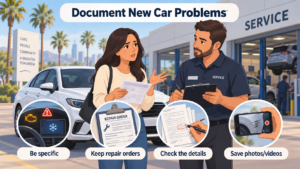
When a problem appears, try to explain it as clearly as possible to the dealership.
Instead of saying:
“The car feels weird,”
describe exactly what happens.
For example:
“The vehicle hesitates and loses power when accelerating.”
or:
“The infotainment screen freezes and goes black while driving.”
or:
“The check-engine light comes on and the vehicle begins shaking.”
Clear descriptions can make the repair order more useful later.
When you pick the vehicle up, review the paperwork and make sure it reasonably reflects the problem you reported.
Useful information may include:
- The date the vehicle was brought in
- Mileage
- Your complaint
- The dealership’s diagnosis
- Repairs performed
- Parts replaced
- The date the vehicle was returned
If a problem happens only occasionally, photos or videos may also be helpful when they can be taken safely.
The goal is simply to keep a clear record of legitimate problems if they continue.
Common New-Car Problems That May Lead to Lemon Law Concerns
California Lemon Law is not limited to engine failures or one particular type of defect.
Depending on the circumstances, warranty problems may involve:
- Engine problems
- Stalling or shutting off
- Loss of power
- Transmission hesitation or jerking
- Repeated warning lights
- Steering problems
- Brake concerns
- Electrical failures
- EV battery problems
- Charging problems
- Hybrid system problems
- Infotainment failures
- Backup camera problems
- Driver-assistance or safety-system warnings
- Air-conditioning problems
- Repeated abnormal noises
- Other warranty-covered defects
The existence of one of these issues does not automatically mean the vehicle qualifies under California Lemon Law.
The seriousness of the defect, warranty coverage, repair attempts, and amount of time the vehicle has spent out of service can all matter.
How California Lemon Law Looks at Repair Attempts
There is no single repair number that automatically determines every California Lemon Law case.
California law generally looks at whether the manufacturer has had a reasonable number of opportunities to repair the problem.
What is reasonable can depend on the type of defect.
A serious safety problem may be evaluated differently from a minor convenience issue.
California also has a legal presumption that may apply under certain circumstances during the first 18 months after delivery or 18,000 miles, whichever comes first.
That presumption may apply in certain situations involving:
- Two or more repair attempts for the same problem that is likely to cause death or serious bodily injury
- Four or more repair attempts for the same problem
- More than 30 cumulative calendar days out of service for repairs
These numbers are not automatic rules that make every vehicle a lemon.
They are part of a rebuttable legal presumption and come with additional requirements.
A vehicle may still need an individual review even if it does not fit neatly into those numbers.
Returning a New Car in California and the New CARS Act
The California Combating Auto Retail Scams Act, commonly called the CARS Act, deals primarily with the vehicle transaction itself.
Its main provisions become operative on October 1, 2026.
The law adds protections relating to areas such as:
- Vehicle price disclosures
- Dealer advertising
- Financing and lease representations
- Optional add-ons
- Certain add-ons that provide no meaningful benefit
- Cancellation rights for qualifying used vehicles
- Dealer recordkeeping
The CARS Act is important because it gives consumers more protections during the process of buying or leasing a vehicle.
But it serves a different purpose from California Lemon Law.
A simple way to think about the difference is:
The CARS Act focuses mainly on how the vehicle was sold.
California Lemon Law focuses mainly on problems with the vehicle itself.
For example, if a dealership advertises a vehicle at one price but unexpected products or charges appear in the final transaction, that may involve dealership sales or consumer-protection issues.
If you purchase the vehicle and it later begins stalling, losing power, or repeatedly returning to the dealership for warranty repairs, that may raise a Lemon Law issue.
The New 3-Day Rule Applies to Certain Used Cars
One of the most talked-about parts of the CARS Act is the three-day cancellation right.
However, the new rule does not create a three-day return right for new vehicles.
Beginning October 1, 2026, the CARS Act provides a three-day cancellation right for qualifying used vehicles sold or leased at retail for $50,000 or less.
The cancellation right also comes with conditions.
For example, the vehicle generally cannot be driven more than 400 miles before the buyer attempts to cancel, and the dealership may be allowed to charge a restocking fee.
That is very different from saying every California car buyer can simply return a vehicle within three days.
If you buy a brand-new vehicle and it develops a problem two days later, the CARS Act does not automatically allow you to return it.
Instead, the manufacturer’s warranty and potentially California Lemon Law may be more relevant.
When the Problem Is With the Contract Instead of the Vehicle
Sometimes a buyer’s concern has nothing to do with a defect.
A person may get home and notice that the paperwork does not look the way they expected.
For example:
- The final price appears different
- An unexpected add-on is listed
- Financing terms do not match what they thought was discussed
- The trade-in amount seems incorrect
- The paperwork does not match the advertisement
These issues are different from a traditional Lemon Law matter.
If something about the transaction seems wrong, keep the relevant documents.
That may include the original advertisement, screenshots of the listing, written quotes, purchase or lease agreements, financing documents, add-on agreements, trade-in paperwork, emails, and text messages with dealership employees.
Starting October 1, 2026, the CARS Act adds additional protections involving certain pricing disclosures, dealership representations, and add-ons.
At Cha Cha Cha Law, however, our practice focuses on California Lemon Law and defective vehicles.
When a New Car Is Already Back at the Dealership
Sometimes people contact us only a week or two after buying a vehicle because it is already in the service department.
That does not necessarily mean the vehicle qualifies as a lemon.
In some cases, there may only be one repair visit.
In others, the vehicle may have been in the shop for several weeks because a part is unavailable or technicians are still trying to determine what is wrong.
At an early stage, the repair history may still be developing.
A vehicle with one minor repair visit is very different from a vehicle that stalls while driving, remains at the dealership for weeks, and continues having the same problem after being returned to the owner.
This is why the full repair history matters.
What If the Dealership Says the Problem Is Normal?
Sometimes a dealership may say that a noise, vibration, shifting behavior, software issue, or other concern is normal.
That does not automatically mean there is a Lemon Law claim.
But if you continue experiencing a legitimate problem, keep the repair order.
If the concern continues, document it again.
The same applies when the dealership says it “cannot duplicate” an intermittent issue.
Keeping those repair records gives you a clearer history if the problem continues.
Returning a New Car in California Through a Lemon Law Buyback
When someone says they want to “return” a defective new car, what they may really be looking for is a Lemon Law repurchase or buyback.
A repurchase is different from simply taking the vehicle back to the dealership.
In a qualifying Lemon Law matter, the manufacturer may be required to repurchase the vehicle under California law. The amount involved can depend on the circumstances of the case, including statutory deductions that may apply.
At Cha Cha Cha Law, the two resolutions we generally focus on are:
Repurchase or Buyback
With a repurchase, the consumer returns the vehicle and seeks reimbursement from the manufacturer as provided under California Lemon Law.
This may be an option for someone who no longer wants to keep a vehicle that has continued experiencing qualifying warranty problems.
Cash-and-Keep Settlement
In some cases, a consumer may prefer to keep the vehicle rather than return it.
A cash-and-keep settlement is generally a negotiated resolution where the consumer keeps the vehicle and receives monetary compensation from the manufacturer.
Unlike a Lemon Law repurchase, a cash-and-keep settlement is not automatically guaranteed by the statute. Whether one is available, and the amount offered, depends on the circumstances and negotiations with the manufacturer.
These are the two types of outcomes our firm focuses on when evaluating and resolving California Lemon Law claims.
Repurchase vs. Cash-and-Keep
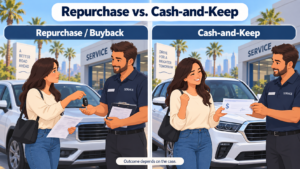
The right approach depends on what the consumer wants and the facts of the case.
Someone whose vehicle continues having significant problems may no longer want to own it and may prefer to pursue a repurchase or buyback.
Someone else may still want to keep the vehicle and may be more interested in discussing a cash-and-keep settlement.
No particular outcome can be guaranteed.
Every case depends on the repair history, warranty issues, manufacturer’s position, and settlement negotiations.
Keep the Bigger Picture in Mind
If something seems wrong immediately after buying a vehicle, the next step depends on what kind of problem you are dealing with.
If the issue involves the sale itself, such as pricing, financing, add-ons, or paperwork, the CARS Act and other consumer-protection laws may be relevant.
If the issue involves the vehicle itself, such as repeated warning lights, engine trouble, transmission problems, electrical failures, charging issues, or other warranty concerns, California Lemon Law may become more important.
And if your vehicle is still very new, it may simply be too early to know whether it will eventually qualify as a lemon.
That is why keeping accurate repair records from the beginning can be so valuable.
Frequently Asked Questions
1. Can I return a new car after buying it in California?
California generally does not provide a cooling-off period that lets you return a new vehicle simply because you changed your mind. If the vehicle develops qualifying warranty problems, a Lemon Law repurchase may become an option depending on the repair history and circumstances.
2. Can I return a new car within 3 days in California?
Not under the CARS Act simply because fewer than three days have passed. The new three-day cancellation right applies to qualifying used vehicles sold or leased at retail for $50,000 or less.
3. What if my new car has problems after only one week?
Report the problem to an authorized dealership when appropriate and keep the repair paperwork. One repair visit does not automatically make a vehicle a lemon, but the history may become important if the problem continues.
4. What is a Lemon Law buyback?
A Lemon Law buyback, or repurchase, generally involves the manufacturer taking back a qualifying defective vehicle and providing restitution as required under California law, subject to applicable deductions and other statutory rules.
5. What is a cash-and-keep settlement?
A cash-and-keep settlement is generally a negotiated settlement where the consumer keeps the vehicle and receives monetary compensation. It is not an automatic statutory outcome and depends on the particular case and negotiations.
6. Does a vehicle automatically become a lemon after 30 days in the shop?
No. More than 30 cumulative days out of service is one circumstance that can be important under California’s Lemon Law presumption, but a vehicle does not automatically become a lemon on day 31.
7. Should I keep a repair order if the dealership says “cannot duplicate”?
Yes. It can still show that you reported the problem and presented the vehicle for inspection.
Having Problems With a New Car in California?
If you are thinking about returning a new car in California because something is already wrong with it, start by keeping your records.
Save every repair order. Keep dealership and manufacturer communications. Document recurring problems and make sure your warranty complaints are accurately reflected in the repair paperwork.
At Cha Cha Cha Law, we focus on California Lemon Law.
We often speak with people who bought or leased their vehicle only a few weeks ago and are already dealing with problems. Sometimes the repair history is still developing. In other cases, the vehicle may already have multiple repair attempts or significant time out of service.
If your vehicle may qualify under California Lemon Law, our attorneys can review the repair history and discuss the types of resolutions we typically pursue, including a repurchase/buyback or a cash-and-keep settlement.
Contact Cha Cha Cha Law at (213) 351-3513 or submit a website inquiry for a free California Lemon Law consultation.