


Los Angeles County is dealing with another stretch of intense summer heat, making a working vehicle air conditioner especially important. For drivers researching car AC lemon law California, the question is simple: if your car’s A/C repeatedly stops working during extreme heat and the dealership cannot seem to fix it, could the vehicle qualify under California Lemon Law?
The answer is potentially—but a broken A/C does not automatically make a vehicle a lemon.
The National Weather Service has reported above-normal temperatures across the Los Angeles area and says additional warming is possible this week. Hotter inland portions of Los Angeles County, including areas of the San Fernando Valley, have been reaching or approaching triple-digit temperatures. During weather like this, repeated A/C failure can significantly affect how a driver is able to use a vehicle.

Whether that problem rises to the level of a California Lemon Law claim depends on the vehicle’s warranty, the severity of the defect, the repair history, and whether the manufacturer has been given a reasonable opportunity to fix it.
Quick Answer: Can a Failing Car A/C Qualify for California Lemon Law?
Yes, an A/C defect can potentially be a California Lemon Law issue. California Lemon Law is not limited to engine or transmission failures.
Under California Civil Code section 1793.2, a qualifying “nonconformity” is one that substantially impairs the use, value, or safety of the vehicle to the buyer or lessee.
That means the legal question is not simply:
“Is the A/C broken?”
Instead, important questions include:
- Is the problem covered by the manufacturer’s applicable warranty?
- How serious is the A/C failure?
- Does the problem repeatedly return?
- How many opportunities has the manufacturer had to repair it?
- Has the vehicle spent significant time out of service?
- Does the defect substantially affect the vehicle’s use, value, or safety?
One A/C problem that is successfully repaired is very different from an air-conditioning system that repeatedly fails after multiple dealership visits.
Can Car AC Lemon Law California Apply During Extreme Los Angeles Heat?
Potentially.
California law does not contain a special rule saying that an A/C defect automatically becomes a lemon because the weather reaches 100°F.
However, the circumstances surrounding a defect can matter when evaluating how seriously it affects the vehicle.
Imagine driving through the San Fernando Valley on a nearly 100-degree afternoon.
Your vehicle’s A/C starts blowing warm air.
You bring the car to the dealership and they perform a warranty repair.
A few weeks later, the same problem returns.
The dealership repairs another component.
Then the A/C fails again.
At that point, you are no longer dealing with a single isolated repair. You may have a recurring warranty-covered defect that has continued despite multiple opportunities to repair it.
That repair history is what becomes important under California Lemon Law.
When Is a Car A/C Problem More Than a Minor Inconvenience?
Not every air-conditioning complaint substantially impairs a vehicle’s use, value, or safety.
For example, a minor issue that is fixed during the first repair visit may not present the same circumstances as a complete A/C failure that repeatedly returns.
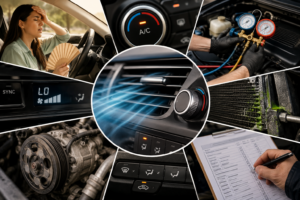
A potential Lemon Law concern may become stronger when the repair history shows problems such as:
- A/C repeatedly blowing warm or hot air
- Complete loss of cooling
- A/C working intermittently
- Cooling stopping after the vehicle has been driven for a period of time
- Different temperatures coming from the driver’s and passenger’s sides
- A/C compressor failures
- Refrigerant leaks that return after repair
- Evaporator or condenser problems
- Climate-control electrical problems
- Components being replaced without resolving the original complaint
- Repeated “could not duplicate” findings even though the problem continues
The particular part that the dealership replaces is not necessarily the only important issue.
The underlying complaint and repair history matter.
For example, one repair order may say “A/C blowing warm,” another may mention a compressor, and a third may document a refrigerant leak. Even though the technician’s diagnosis changes, the consumer may still be repeatedly experiencing the same basic problem: the vehicle will not properly cool the cabin.
How Many A/C Repair Attempts Does California Lemon Law Require?
There is no universal rule that says every California vehicle automatically becomes a lemon after exactly three or four visits.
California Civil Code section 1793.2 provides that when a manufacturer or its representative cannot repair a qualifying new motor vehicle to conform to its applicable express warranties after a reasonable number of attempts, the manufacturer must provide the remedy required by the statute, which may include replacement or restitution.
What constitutes a “reasonable number” can depend on the circumstances.
California also has a separate statutory rule commonly known as the Lemon Law Presumption.
The 18-Month / 18,000-Mile Lemon Law Presumption
California’s Lemon Law includes a rebuttable presumption that a reasonable number of repair attempts has been made when certain conditions are met within the first:
18 months after delivery OR 18,000 miles on the odometer, whichever comes first.
This is commonly referred to as the California Lemon Law Presumption.
The statute identifies circumstances that include:
- The same nonconformity has been subject to repair four or more times; or
- A nonconformity likely to cause death or serious bodily injury if the vehicle is driven has been subject to repair two or more times; or
- The vehicle has been out of service because of repairs for nonconformities for a cumulative total of more than 30 calendar days.
The statute also contains manufacturer-notice requirements in connection with the two- and four-repair presumptions when the manufacturer has provided the required disclosures.
These numbers are important—but they are often misunderstood.
Four repairs and 30 days are not universal minimum requirements for every California Lemon Law case.
They relate to the statutory presumption. A vehicle that does not fall within that presumption may still warrant a Lemon Law review based on its individual circumstances.
Do You Have to Wait Until Your Vehicle Has Been in the Shop for 30 Days?
No.
You do not necessarily have to wait until your vehicle has accumulated more than 30 days in the dealership before having the case evaluated.
The “30-day rule” is one part of the California Lemon Law Presumption.
Repeated unsuccessful repair opportunities may also matter.
For example:
First visit:
The A/C stops cooling. The dealership diagnoses the system and performs a repair.
Second visit:
The A/C starts blowing warm air again. Another component is repaired or replaced.
Third visit:
The cooling problem returns during hot weather. The dealership performs additional diagnosis.
The vehicle may not have accumulated 30 days out of service, but the repeated repair history could still be important.
California courts have also recognized that the law requires more than a single repair opportunity before the manufacturer faces the statutory refund-or-replacement obligation; what is reasonable beyond that depends on the circumstances.
What If the Dealer Says “Could Not Duplicate” the A/C Problem?
This can happen frequently with intermittent vehicle problems.
Your A/C may stop cooling after an hour of driving through Los Angeles traffic, but by the time a technician checks the car the following morning, the system appears to work normally.
The repair order may say:
“Could not duplicate customer concern.”
That does not erase the fact that you reported the problem.
If the A/C fails again, continue documenting it.
What to Document When the A/C Fails
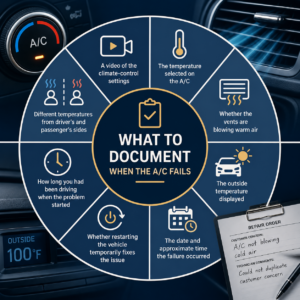
If it is safe to do so, consider recording:
- A video of the climate-control settings
- The temperature selected on the A/C
- Whether the vents are blowing warm air
- The outside temperature displayed by the vehicle
- How long you had been driving when the problem started
- Whether restarting the vehicle temporarily fixes the issue
- The date and approximate time the failure occurred
Then bring the vehicle back to an authorized dealership and explain the problem clearly.
Even if the dealership cannot reproduce the condition, keep the repair order.
It can help establish that you presented the vehicle for the problem.
Your Repair Orders Can Be Critical
When evaluating a potential car AC lemon law California claim, repair orders are some of the most important documents to review.
Each repair record creates a timeline showing:
- When the problem was reported
- Vehicle mileage
- How the consumer described the problem
- What the technician found
- What parts were repaired or replaced
- Whether the dealer duplicated the concern
- How long the vehicle remained at the dealership
- Whether the same problem returned later
When dropping off the vehicle, make sure the repair order accurately describes what is happening.
For example, instead of:
“Check A/C.”
A more specific description may be:
“Customer states A/C intermittently stops cooling and begins blowing warm air after approximately 30 minutes of driving.”
The description should reflect what you actually experienced.
When you pick up the vehicle, obtain and keep the final repair invoice even if no repair was performed.
California law separately requires that consumers receive copies of warranty work orders or repair invoices when warranty service or repairs are performed.
Should You Keep Returning to the Dealership If the A/C Fails Again?
Generally, if a warranty-covered defect continues, documenting additional repair opportunities can be important.
If the problem returns:
- Schedule another warranty repair visit.
- Tell the service adviser that the problem has happened before.
- Describe the symptoms as specifically as possible.
- Provide videos or other documentation if available.
- Make sure the complaint appears on the repair order.
- Keep the final repair invoice.
- Track the number of days the vehicle is at the dealership.
Avoid relying only on telephone conversations with the service department.
A written repair record creates much stronger documentation of when the defect was presented for repair.
Does the A/C Have to Be Completely Broken?
Not necessarily.
An intermittent defect can still be a real defect.
Some consumers experience an A/C system that works normally when the vehicle is first started but stops cooling later.
Others may experience:
- Warm air only during very hot weather
- Cooling that stops while idling
- One side of the cabin remaining warm
- A/C that works again after restarting the vehicle
- Cooling that works inconsistently from day to day
The fact that a problem is intermittent does not automatically disqualify it.
The important issue is whether the problem exists, whether it is covered by the applicable warranty, whether it substantially impairs the vehicle’s use, value, or safety, and whether the manufacturer has been given reasonable opportunities to correct it.
What Can Happen If a Vehicle Qualifies Under California Lemon Law?
If a vehicle qualifies under California Lemon Law, one potential outcome is a repurchase, commonly referred to as a buyback. In some cases, the consumer and manufacturer may instead agree to a cash-and-keep settlement, where the consumer keeps the vehicle and receives a monetary settlement.
With a buyback, the manufacturer may reimburse certain amounts paid toward the vehicle, subject to applicable deductions such as a mileage offset and other case-specific adjustments.
With a cash-and-keep settlement, the consumer generally keeps the vehicle rather than returning it to the manufacturer. The amount offered can vary depending on factors such as the vehicle’s repair history, defect, mileage, warranty, and the circumstances of the claim.
The available resolution and potential settlement amount depend on the individual facts of each case.
Does California Lemon Law Apply to Leased Vehicles?
Yes. qualifying leased vehicles can be covered under California Lemon Law. A vehicle does not have to be financed or purchased outright for a consumer to potentially have Lemon Law rights.
If a leased vehicle has a warranty-covered defect that substantially impairs its use, value, or safety, and the manufacturer is unable to repair the problem after a reasonable number of opportunities, the lease may still qualify for Lemon Law review.
For example, if the A/C in a leased vehicle repeatedly stops cooling or continues to fail after multiple warranty repair visits, the repair history may be relevant.
The specific outcome can depend on factors such as the lease terms, mileage, warranty coverage, repair history, and the circumstances of the defect.
What About Used Vehicles?
Used-vehicle cases require a more individualized analysis.
The California Supreme Court’s decision in Rodriguez v. FCA US LLC addressed whether a used vehicle purchased with some of the manufacturer’s original new-car warranty still remaining qualified as a “new motor vehicle” for the statutory refund-or-replacement remedy.
Because used-vehicle warranty issues can involve different rules and potential claims, consumers with used vehicles should avoid assuming that the same analysis applicable to a newly purchased or leased vehicle automatically applies.
This article primarily addresses new vehicles purchased or leased in California and covered by an applicable manufacturer’s warranty.
Frequently Asked Questions About Car A/C and California Lemon Law
Can a broken A/C make a car a lemon in California?
Potentially. A broken or repeatedly failing air-conditioning system can be relevant under California Lemon Law if the defect is covered by the manufacturer’s warranty and substantially impairs the vehicle’s use, value, or safety.
For example, an A/C system that repeatedly blows warm air, stops cooling during hot weather, or continues to fail after multiple dealership repairs may be more significant than a one-time problem that is successfully fixed. Factors such as the number of repair attempts, days the vehicle has been out of service, whether the problem keeps returning, and how seriously the defect affects normal use of the vehicle can all be important.
There is no automatic rule that a certain type of A/C failure makes a vehicle a lemon. Each case depends on the specific repair history, warranty coverage, severity of the defect, and whether the manufacturer has had a reasonable opportunity to repair the problem.
Is air conditioning considered a safety issue under California Lemon Law?
Not automatically. Under California Lemon Law, an A/C defect is evaluated based on whether it substantially impairs the vehicle’s use, value, or safety. A malfunctioning air conditioner may be more than a comfort issue depending on the severity of the problem and the conditions in which the vehicle is being used.
For example, an A/C system that completely stops cooling during extreme summer temperatures, repeatedly fails despite dealership repairs, or creates conditions that significantly interfere with the normal use of the vehicle may be more serious than a minor or temporary cooling issue. The impact may be especially important during hot Southern California weather, when cabin temperatures can become uncomfortable or potentially unsafe for occupants.
However, an A/C problem is not automatically classified as a safety defect simply because the system is not working. The vehicle’s repair history, severity of the defect, warranty coverage, number of repair attempts, and the extent to which the problem affects the vehicle’s use, value, or safety must all be considered.
Do I need four A/C repair attempts to qualify?
Not necessarily. California Lemon Law does not require every consumer to have exactly four repair attempts before a vehicle can potentially qualify. Instead, the law generally looks at whether the manufacturer has been given a reasonable number of opportunities to repair a warranty-covered defect.
The number four comes from California’s Lemon Law Presumption. Under certain circumstances, if the same nonconformity has been subject to repair four or more times within the first 18 months after delivery or 18,000 miles on the odometer, whichever occurs first, the law may presume that a reasonable number of repair attempts has been made.
However, this is a presumption—not a universal minimum requirement. A vehicle that has fewer than four A/C repair attempts may still warrant a Lemon Law review depending on the severity of the problem, how often it returns, the amount of time the vehicle has been out of service, and the overall repair history.
For example, if your A/C repeatedly stops cooling despite multiple warranty repairs during extreme California heat, you do not necessarily need to wait for a fourth visit before having your repair records reviewed.
Does my vehicle have to be in the dealership for 30 days?
No. A vehicle does not have to spend 30 days in the dealership before it may qualify for review under California Lemon Law. The commonly referenced 30-day rule is part of California’s Lemon Law Presumption, not a universal requirement for every case.
Under certain circumstances, if a vehicle has been out of service for warranty repairs for a cumulative total of more than 30 calendar days within the first 18 months after delivery or 18,000 miles on the odometer, whichever occurs first, the law may presume that a reasonable number of repair attempts has been made.
However, a consumer does not necessarily need to reach 30 days out of service. Repeated unsuccessful repair attempts for the same or related A/C problem may also be important. For example, if the dealership has tried several times to repair an air-conditioning system that continues to blow warm air or stop cooling, the repair history may still warrant a Lemon Law review even if the vehicle has been in the shop for fewer than 30 total days.
The key factors include the number of repair opportunities, severity of the defect, total days out of service, warranty coverage, and whether the problem continues after repairs.
What if the dealership cannot duplicate the A/C problem?
If the dealership says it “could not duplicate” the A/C problem, keep the repair order and continue documenting the issue if it happens again. Intermittent air-conditioning problems can be difficult to reproduce, especially if the A/C fails only after extended driving, during very hot weather, or under certain driving conditions.
If the problem returns, try to document the date, outside temperature, how long you had been driving, the climate-control settings, and exactly what the A/C was doing. If it is safe to do so, a video showing the vents blowing warm air or the vehicle’s temperature settings may also help establish what you experienced.
Then return the vehicle to an authorized dealership and make sure the same concern is clearly written on the repair order. Even if the technician cannot reproduce the problem during that visit, the repair record can still help show that you repeatedly presented the vehicle for the same or related A/C complaint.
For a potential California Lemon Law claim, the overall repair history matters. Multiple “could not duplicate” findings do not automatically mean there is no defect, particularly when the same intermittent A/C problem continues to return.
What if the dealership replaced different A/C parts each time?
Different A/C parts being repaired or replaced at each visit does not necessarily mean the problems are unrelated. For California Lemon Law purposes, the repair history should be reviewed as a whole, including the symptoms you reported, the dealership’s diagnoses, the repairs performed, and whether the same underlying problem continued afterward.
For example, one visit may involve a refrigerant leak, another may result in replacement of the A/C compressor, and a later visit may involve the condenser, evaporator, sensors, or climate-control system. Even though different components were addressed, the underlying complaint may remain the same: the vehicle’s A/C repeatedly fails to cool properly or continues blowing warm air.
What matters is whether the vehicle continues experiencing a warranty-covered defect that substantially impairs its use, value, or safety despite reasonable repair opportunities. A dealership’s changing diagnosis does not automatically erase the history of a recurring A/C complaint.
Keeping every repair order is especially important because the records can help show how the problem developed over time, what repairs were attempted, and whether those repairs successfully resolved the condition.
Can a leased vehicle qualify for California Lemon Law?
Yes. Qualifying leased new motor vehicles can be covered under California Lemon Law. California law extends important Lemon Law protections to lessees, so a vehicle does not have to be financed or purchased outright to potentially qualify.
If a leased vehicle has a warranty-covered defect that substantially impairs its use, value, or safety, and the manufacturer is unable to repair the problem after a reasonable number of opportunities, the lessee may have potential Lemon Law rights.
For example, if the A/C in a leased vehicle repeatedly stops cooling, continues blowing warm air after warranty repairs, or causes the vehicle to spend significant time at the dealership, the repair history may be worth reviewing.
The specific remedy and calculation can depend on the lease terms, repair history, mileage, manufacturer, and applicable California Lemon Law procedures, so leased-vehicle cases should be evaluated based on their individual facts.
Car AC Lemon Law California: When Should You Have the Repair History Reviewed?
As temperatures climb toward triple digits in parts of Los Angeles County, repeatedly losing your vehicle’s air conditioning can become extremely frustrating.
One A/C failure does not automatically make a vehicle a lemon.
But if your vehicle’s A/C has been repaired under warranty and keeps failing, the dealership has attempted multiple repairs, the same complaint continues to return, or the vehicle has spent significant time out of service, the complete repair history may be worth reviewing.
Cha Cha Cha Law can review your repair orders and vehicle documents to determine whether your circumstances may qualify under California Lemon Law.
Call (213) 351-3513 or submit a website inquiry for a free consultation.
This article is provided for general informational purposes only and does not constitute legal advice. California Lemon Law claims depend on the specific facts of the vehicle, warranty, repair history, manufacturer, dates, mileage, and applicable law.