


If your vehicle has been in the shop repeatedly for warranty repairs, you may be wondering how much you could receive from a California Lemon Law settlement.

There is no standard settlement amount that applies to every case. The potential outcome depends on factors such as the vehicle’s purchase or lease terms, repair history, mileage, related expenses, and how the claim is resolved.
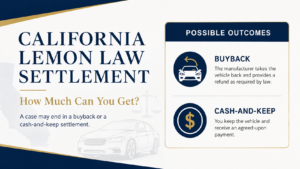
Depending on the circumstances, a Lemon Law case may result in a buyback, where the manufacturer takes the vehicle back and provides a refund as required by law, or a cash-and-keep settlement, where you keep the vehicle and receive an agreed-upon monetary payment.
What Can You Get From a California Lemon Law Settlement?
If your vehicle qualifies under California’s Lemon Law, one possible outcome is a vehicle buyback. This means the manufacturer takes the vehicle back and refunds certain amounts as required by California law.
A qualifying buyback can generally include:
- The actual price paid or payable for the vehicle
- Manufacturer-installed options
- Certain reasonable towing, rental car, and repair expenses
Some cases may also be resolved through a cash-and-keep settlement, where you keep your vehicle and receive an agreed-upon amount of money. There is no fixed formula for determining the amount of a cash-and-keep settlement.
Will You Get the Full Purchase Price Back?
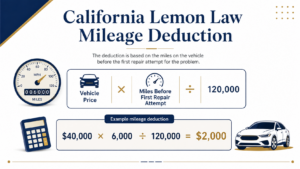
Not necessarily. California law allows the manufacturer to deduct an amount for your use of the vehicle before it was first brought in for repair of the problem that led to the Lemon Law claim.
The formula is:
Vehicle Price × Miles Before First Relevant Repair Attempt ÷ 120,000
For example, if the applicable vehicle price is $40,000 and the vehicle had 6,000 miles before the first relevant repair attempt:
$40,000 × 6,000 ÷ 120,000 = $2,000
In this example, the mileage deduction would be $2,000.
Importantly, this calculation is not based on your vehicle’s current mileage. It generally looks at the mileage before the first repair attempt for the problem that led to the Lemon Law claim.
What Affects Your Lemon Law Settlement Amount?
There is no official average California Lemon Law settlement amount because every case is different.
Several factors can affect the potential outcome, including:
- Your vehicle’s purchase or lease terms
- Mileage before the first relevant repair attempt
- Number and length of repair visits
- The vehicle’s repair history
- Certain expenses caused by the vehicle’s problems
- Whether you return the vehicle or keep it as part of a negotiated settlement
Your purchase or lease agreement and complete repair orders are especially important when evaluating a potential claim.
What About Attorney’s Fees?
California’s Lemon Law includes a provision allowing a buyer who prevails in an action to recover reasonable attorney’s fees and costs.
Under California Civil Code section 1794, recoverable attorney’s fees are based on the actual time reasonably spent pursuing the case and are determined by the court.
Frequently Asked Questions About California Lemon Law Settlement
What is the average California Lemon Law settlement?
There is no official average California Lemon Law settlement amount. California law does not set a standard payout, and the amount a consumer may receive can vary significantly from case to case.
For example, if a qualifying case results in the manufacturer taking the vehicle back, the amount is generally tied to the vehicle’s actual price paid or payable, manufacturer-installed options, and qualifying expenses. A mileage deduction may also apply based on how many miles the vehicle was driven before the first repair attempt for the problem that led to the Lemon Law claim.
Other cases may be resolved through a cash-and-keep settlement, where the consumer keeps the vehicle and receives an agreed-upon payment. Unlike a vehicle buyback, California law does not provide a fixed formula for determining the amount of a cash-and-keep settlement.
Because vehicle prices, mileage, repair histories, expenses, and settlement terms can be very different, an “average” settlement figure found online may not provide a meaningful estimate of what your case could be worth. Reviewing your purchase or lease agreement and repair orders provides a much better starting point for evaluating a potential California Lemon Law settlement.
How many repair attempts are needed for California Lemon Law?
There is no single number of repair attempts that automatically determines whether a vehicle qualifies under California Lemon Law. Instead, the number of repair attempts considered reasonable can depend on the type and severity of the vehicle’s problem, whether the problem continues after repairs, and the overall repair history.
California does have a Lemon Law presumption that may make it easier to establish a claim when certain conditions occur within the first 18 months after the vehicle is delivered or 18,000 miles on the odometer, whichever comes first. Depending on the circumstances and other legal requirements, the presumption may apply when:
- The manufacturer or its authorized repair facility has made four or more attempts to repair the same problem, and the problem continues.
- The vehicle has been subject to repair two or more times for a problem that is likely to cause death or serious bodily injury if the vehicle is driven, and the problem continues.
- The vehicle has been out of service for repairs for more than 30 cumulative calendar days because of warranty problems.
These numbers are not absolute requirements for every California Lemon Law claim. A vehicle that does not meet the 18-month/18,000-mile presumption or these specific repair thresholds may still potentially qualify. The complete repair history, nature of the problems, warranty coverage, and circumstances of each repair attempt should be considered when evaluating a claim.
Does 30 days in the repair shop automatically make my car a lemon?
No. Having your vehicle in the repair shop for 30 days does not automatically mean it qualifies as a lemon under California law.
California’s Lemon Law includes a presumption that may apply when a vehicle has been out of service for repairs for more than 30 cumulative calendar days because of warranty-covered problems, provided the other requirements for the presumption are met. These days do not necessarily have to come from one continuous repair visit—they can accumulate across multiple qualifying repair visits.
The 30-day rule is also not a strict requirement for every Lemon Law case. A vehicle may potentially qualify with fewer than 30 days out of service depending on its repair history, the nature of the problems, the number of repair attempts, and other circumstances.
It is therefore important to look at the vehicle’s complete repair history, rather than relying on the number of days in the shop alone.
Can I keep my vehicle and still receive money?
Yes, in some cases. A California Lemon Law claim may be resolved through a cash-and-keep settlement, where the consumer keeps the vehicle and receives an agreed-upon monetary payment from the manufacturer.
Unlike a vehicle buyback, a cash-and-keep settlement does not require the consumer to return the vehicle. The consumer generally continues to own or lease the vehicle and remains responsible for any existing loan or lease obligations.
There is no fixed formula or guaranteed amount for a cash-and-keep settlement under California law. The amount is negotiated and can depend on factors such as the vehicle’s repair history, the nature and severity of the problems, and the circumstances of the individual claim.
Because the consumer keeps the vehicle, a cash-and-keep settlement is different from a Lemon Law buyback. The specific terms of any settlement should be carefully reviewed so the consumer understands the payment, vehicle ownership, warranty implications, and any claims being released.
Who pays the attorney’s fees in a California Lemon Law case?
In many California Lemon Law cases, the manufacturer is responsible for paying the consumer’s reasonable attorney’s fees and costs when the consumer wins the case. California Civil Code section 1794 allows a consumer who prevails to recover reasonable attorney’s fees based on the time the attorney spent working on the case.
This means that attorney’s fees awarded under the Lemon Law are generally paid by the manufacturer rather than taken out of the consumer’s vehicle refund.
However, every law firm may have different fee arrangements, so consumers should review their agreement with their attorney to understand how fees and costs will be handled.
How Much Could Your Lemon Law Case Be Worth?
There is no one-size-fits-all California Lemon Law settlement amount. Your purchase or lease agreement, repair history, mileage, and related expenses can all affect what may be available.
If your vehicle has undergone repeated warranty repairs or has spent significant time at the dealership, a California Lemon Law attorney can review your repair orders and purchase or lease agreement and explain what options may be available based on your situation.
Contact Cha Cha Cha Law by calling 213-351-3513 or submit a website inquiry for a free consultation. Our team can review your situation, answer your questions, and help you understand your options under California Lemon Law. Consultations are available in English, Korean, and Spanish.
This article is for general informational purposes only and does not constitute legal advice. Results depend on the facts and circumstances of each case.