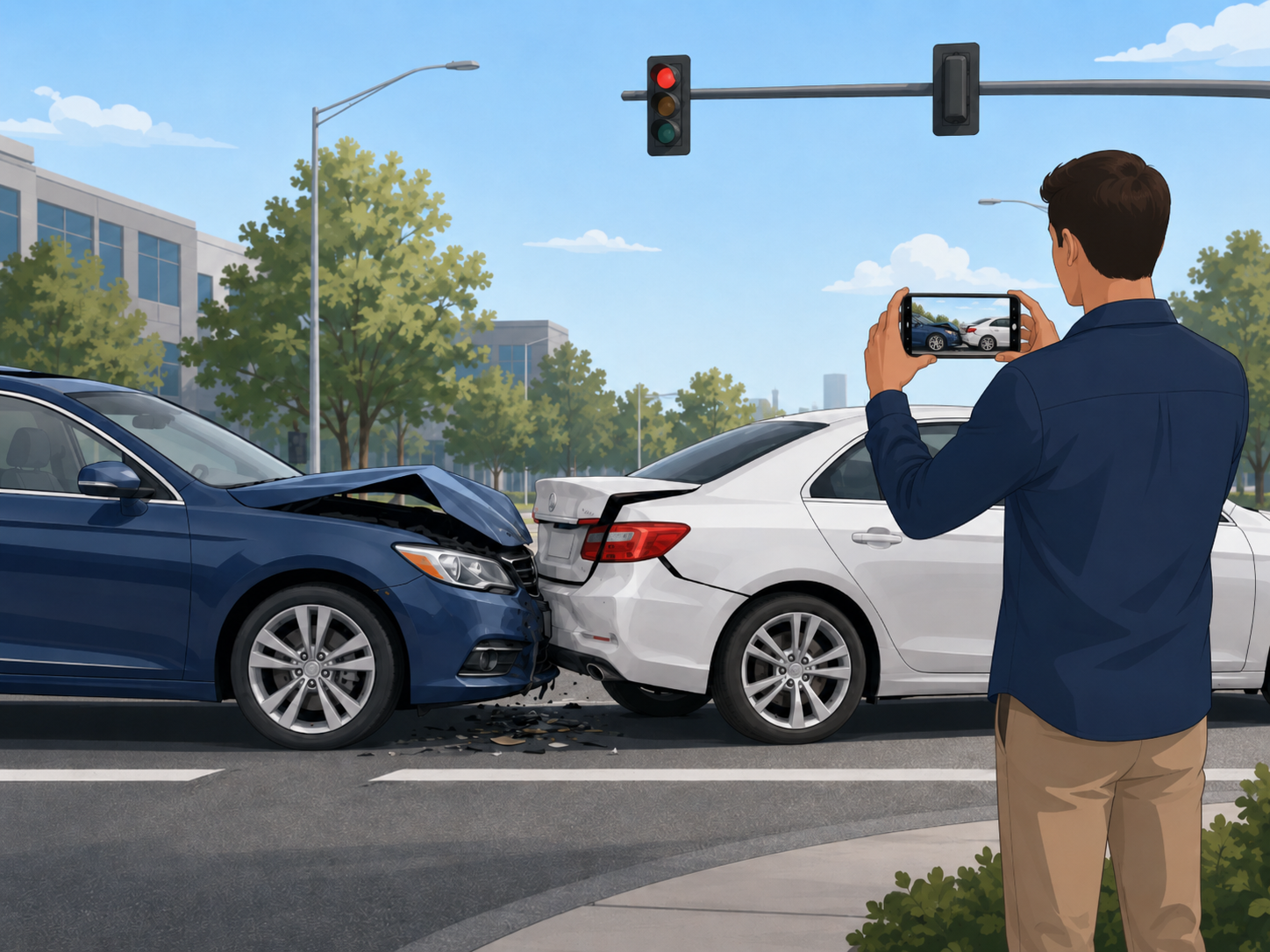
Knowing what to do after a car accident can be difficult when everything happens so quickly. You may be shaken, checking yourself for injuries, looking at your car, and trying to understand what just happened. If you are physically able and it is safe to do so, one of the most helpful things you can do before leaving the scene is use your phone to document the accident.
You do not need to investigate the collision yourself or figure out who was at fault on the side of the road.
Instead, keep it simple.
If you remember only five things, try to get:
- The other driver’s license information
- The other driver’s insurance card
- The license plate
- Photos of the vehicles and damage
- Photos of where the accident happened
These basic pieces of information can help document who was involved, what vehicles were involved, where the accident occurred, and what the scene looked like immediately afterward.
What to Do After a Car Accident Before You Leave the Scene
Your safety should always come first.
If you are injured, need emergency medical attention, or cannot safely walk around the accident scene, do not put yourself at risk just to take photographs.
But if you are physically able and the area is safe, use your phone to gather the basic information you may need later.
Here are the five things we recommend trying to document.
1. Get the Other Driver’s License Information
Start with the person who was driving the other vehicle.
Get the other driver’s driver’s license information. If the driver agrees, taking a clear photograph can be an easy way to avoid accidentally writing down the wrong name or license number. Otherwise, record the relevant information.
Before moving on, check what you saved.
Make sure the information is clear enough to read. A blurry photograph will not be very helpful if you discover later that you cannot make out the driver’s name or license number.
The purpose is simple: you want to be able to identify who was driving the other vehicle at the time of the collision.
2. Get the Other Driver’s Insurance Card
Next, get the other driver’s insurance information.
If possible, take a clear photo of the insurance card or carefully record the information shown on it.
Make sure you can see the:
- Insurance company
- Policy information
- Name shown on the card
You do not need to determine at the accident scene whether the insurance company will accept the claim or whether a particular policy provides coverage.
Your job at that moment is simply to preserve the information you were given.
What if the insurance card doesn’t match the driver’s name?
Don’t immediately assume that means the driver is uninsured.
The vehicle could belong to a spouse, parent, employer, rental company, or another person.
Instead of arguing about the insurance coverage at the scene, document what you were given and photograph the vehicle and license plate.
Insurance coverage can be investigated later.
3. Take a Clear Photo of the License Plate
Photograph the license plate of every vehicle involved in the accident.
Make sure you can clearly see the plate number and the state.
This takes only a few seconds, but it can be valuable if there is later a question about which vehicle was involved or who owns the vehicle.
It can be especially important if the other driver leaves the scene before you have finished exchanging information.
If you are able to take only a few photographs before the vehicles move, make the license plate one of them.
4. Take Photos of the Vehicles and Damage
When deciding what to do after a car accident, don’t stop after taking one close-up picture of your bumper.
Take several photographs of all vehicles involved.
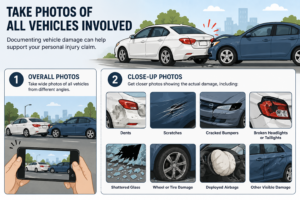
Start with the visible damage to your vehicle. Then photograph the other vehicle or vehicles involved in the collision.
Try to take two types of photographs:
Close-up photos
Get closer photographs showing the actual damage, including things such as:
- Dents
- Scratches
- Cracked bumpers
- Broken headlights or taillights
- Shattered glass
- Wheel or tire damage
- Deployed airbags
- Other visible vehicle damage
Wide photos
Then take a few steps back, when it is safe, and photograph the entire vehicle.
Wider photographs help show where the damage is located on the vehicle.
For example, a close-up photo may show a damaged bumper. A wider photograph may show whether that damage is in the center, on the driver’s side, or near the passenger-side corner.
That context can become useful later.
Photograph the other vehicle too
It is natural to focus on your own car after an accident, but don’t forget about the other vehicle.
Try to photograph:
- Your vehicle
- The other vehicle
- The damaged areas of each vehicle
- The overall condition of each vehicle
- The position of the vehicles, if they have not already been moved
If three or more vehicles were involved, try to document each vehicle when it is safe to do so.
You do not need to decide what the damage proves.
The goal is simply to preserve what the vehicles looked like before they were moved or repaired.
5. Take Photos of Where the Accident Happened
One of the most commonly overlooked pieces of car accident evidence is the accident location itself.
The damaged vehicles tell only part of the story.
If it is safe to do so, step back and take a few wider photographs showing where the accident happened.
Depending on the location, photograph things such as:
- The roadway
- The intersection
- Street names
- Traffic lights
- Stop signs
- Lane markings
- Turn lanes
- Crosswalks
- Driveways
- Parking lot entrances
- Freeway lanes or exits
- Skid or tire marks
- Vehicle debris
- Broken glass
- Nearby road construction
- Anything that may have affected visibility
You do not need to photograph every building or traffic sign in the area.
The goal is to show enough of the accident scene that someone who was not there can later understand where the vehicles were and how the roadway was arranged.
What Pictures Should You Take After a Car Accident?
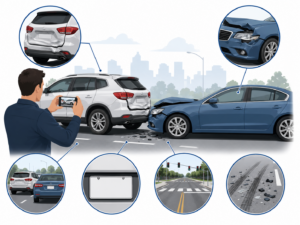
A simple rule is to take both close-up pictures and wide pictures.
Close-up photographs document specific damage.
Wide photographs provide context.
For example, if an accident happened while one vehicle was making a left turn, a wide photograph showing the intersection, turn lane, traffic signal, and vehicle positions could provide much more information than a close-up of a damaged door alone.
Useful accident photos may include:
- Damage to your vehicle
- Damage to the other vehicle
- Each vehicle’s license plate
- The entire vehicle from several angles
- Where the vehicles stopped
- The overall roadway
- Traffic lights and signs
- Lane markings
- Debris or skid marks
- Any other condition that may help explain the collision
You may never need every photograph you take.
But once the vehicles are moved, debris is cleared, or repairs are completed, it may be impossible to recreate exactly what the accident scene looked like.
Should You Take a Video After a Car Accident?
If you can safely do so, yes.
A short video can complement your accident photos by showing how different parts of the scene relate to one another.
Slowly record:
- Your vehicle
- The other vehicles
- The damage
- Where the vehicles are located
- The roadway
- Traffic signals or signs
- Lane markings
- Debris
- The surrounding area
You do not need to narrate the video or explain who you believe caused the crash.
Simply document what you see.
And never walk into moving traffic or another unsafe location just to get a better photo or video.
Why Is Car Accident Evidence Important for a Personal Injury Claim?
Immediately after a collision, what happened may seem obvious.
Maybe you were stopped at a red light when another vehicle hit you from behind.
Maybe another driver suddenly entered your lane.
Maybe the other driver apologized immediately afterward.
But questions can arise later.
The drivers may remember the collision differently. An insurance company may dispute how the accident happened. Vehicles may be repaired before someone has a chance to inspect the damage.
Evidence collected at the accident scene can help preserve details before they disappear.
Photos and videos may help document:
- Which vehicles were involved
- Where each vehicle was damaged
- Where the collision occurred
- How the roadway was configured
- Where the vehicles stopped
- Conditions at the accident scene
No single photograph automatically proves who was responsible for a collision.
Instead, photos, videos, statements, police reports, witnesses, vehicle damage, and other evidence may all become part of the overall investigation.
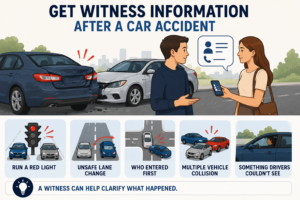
Should You Get Witness Information After a Car Accident?
Yes, if someone tells you they witnessed the collision and you can safely speak with them.
Ask for their name and phone number before they leave.
An independent witness may be particularly helpful if the drivers later disagree about what happened.
For example, a witness may have seen:
- A vehicle run a red light
- An unsafe lane change
- Which vehicle entered an intersection first
- A collision involving several vehicles
- Something the drivers themselves could not see
You do not need to conduct an interview at the accident scene.
Simply getting reliable contact information may allow your insurance company or attorney to speak with the witness later.
Save Your Dashcam Footage
If you have a dashcam, preserve the recording as soon as possible.
Depending on the device and its settings, a dashcam may eventually record over older footage.
Save the relevant recording somewhere else, such as your:
- Phone
- Computer
- Cloud storage
If a passenger recorded the collision or took photos immediately afterward, ask them to preserve the original files as well.
What If You Couldn’t Take Photos After the Accident?
Not everyone is physically able to gather evidence after a crash.
You may have been injured.
You may have been transported by ambulance.
Your vehicle may have been stopped in a dangerous location.
Or you may simply have been too shaken to think about taking photographs.
Your health and safety come first.
Not having photos from the accident scene does not automatically mean you cannot pursue a personal injury claim.
Depending on the circumstances, other evidence may still be available, such as:
- Police or CHP reports
- Passenger photographs
- Witness statements
- Dashcam recordings
- Nearby surveillance footage
- Vehicle damage
- Repair records
- Tow yard photographs
- Insurance documentation
A personal injury attorney may also be able to determine what additional evidence should be investigated or preserved.
What to Do After a Car Accident in California: A Simple Checklist
If you are physically able and it is safe to do so, remember these five things:
- Driver’s license information
- Insurance card
- License plate
- Photos of all vehicles and damage
- Photos of the accident location
If available, also:
- Save dashcam footage
- Get witness names and phone numbers
- Take a short video of the accident scene
You do not need to conduct your own investigation or decide who was at fault.
Focus on preserving the basic information while it is still available.
A Quick Note About California Accident Requirements
The five-item checklist above is meant to be an easy way to remember useful information to gather at the scene. It is not a complete list of every legal responsibility a driver may have after a California collision.
California DMV guidance instructs drivers involved in a collision to show their driver’s license, vehicle registration, insurance information, and current address to the other people involved.
There may also be separate reporting requirements depending on what happened.
For example, California DMV currently requires an SR-1 Traffic Accident Report within 10 days when someone is injured or killed or when property damage exceeds $1,000. This report is required in addition to reports made to law enforcement or an insurance company.
If anyone is injured or killed, California DMV guidance also states that the collision must be reported to law enforcement within 24 hours.
The practical takeaway: gathering evidence at the scene is important, but it does not replace any reporting obligations that may apply to your accident.
Frequently Asked Questions About What to Do After a Car Accident
What should I get from the other driver after a car accident?
After a car accident, try to get the other driver’s driver’s license information, insurance information, and license plate. You should also take clear photos of both vehicles, the damage, and the accident scene.
If possible, also get the name and phone number of any witnesses and save any dashcam footage.
Before leaving, check that your photos are clear and readable. These details can help identify the driver, vehicle, insurance coverage, and how the collision occurred if there is a dispute later.
Should I take pictures after a minor car accident?
Yes. Even if a car accident appears minor, take photos if it is safe to do so.
Photograph both vehicles, any visible damage, the license plates, and the accident scene. Damage that looks small at first may become more significant once the vehicle is inspected, and the other driver or insurance company may later dispute how the accident happened.
Photos taken immediately after the crash can help preserve what the vehicles and scene looked like before anything was moved, repaired, or changed.
What if the other driver’s insurance card doesn’t match their name?
If the name on the insurance card does not match the driver, do not automatically assume the vehicle is uninsured. The car or insurance policy may belong to a spouse, parent, employer, rental company, or another person.
Take clear photos of the driver’s license, insurance card, license plate, and vehicle, and keep the information you were given. Insurance coverage can be investigated later if there is a question about who or what policy applies.
Should I take a picture of the other driver’s license?
Yes. A clear photo of the driver’s license can help you accurately preserve their name, address, and driver’s license information without worrying about writing something down incorrectly.
If they do not want you to take a photo, carefully write down the relevant information instead. Before leaving the scene, make sure the information you collected is clear and complete.
What if the other driver refuses to exchange information after a car accident?
If the other driver refuses to provide their driver’s license, registration, or insurance information, you can contact law enforcement and explain that the other driver is refusing to exchange information.
Do not argue or put yourself in an unsafe situation. If it is safe to do so, take photos of the vehicle, license plate, damage, and accident scene, and get the names and phone numbers of any witnesses.
Should I take a video of the accident scene?
Yes, if it is safe and you are physically able to do so. A short video can help document the vehicles, damage, roadway, traffic signs, lane markings, debris, and overall accident scene.
Video can also show how the vehicles and surrounding area were positioned in relation to one another. Keep the video simple and focused on the scene rather than arguing with the other driver or trying to determine fault.
What if I forgot to take pictures after my car accident?
Forgetting to take pictures does not automatically mean you do not have a personal injury claim. Other evidence may still help show what happened, including police reports, witness statements, dashcam footage, surveillance video, vehicle damage, repair photographs, and insurance records.
If possible, take photos of your vehicle and any visible injuries afterward, and preserve any documents or videos related to the accident. A personal injury attorney may also be able to help identify other evidence that can be obtained later.
Injured in a Car Accident in Los Angeles?
Knowing what to do after a car accident can help preserve valuable information, but collecting evidence is only one part of what comes next.
If you were injured in a collision, you may have questions about fault, insurance coverage, medical bills, vehicle damage, or what to do when an insurance company contacts you.
At Cha Cha Cha Law, our personal injury team helps people injured in car accidents throughout Los Angeles and Southern California understand their legal options and navigate the claims process.
If you already have photos, videos, insurance information, dashcam footage, or other documents related to the collision, keep the original files and bring them with you when discussing your case.
For a broader overview of what to do following a rear-end collision, read our guide, Los Angeles Rear-End Accident Lawyer: 7 Steps to Take After a Rear-End Accident.
If you or a loved one was injured in a car accident in Los Angeles or Southern California, call Cha Cha Cha Law at (213) 351-3513 or submit a website inquiry for a free consultation.