





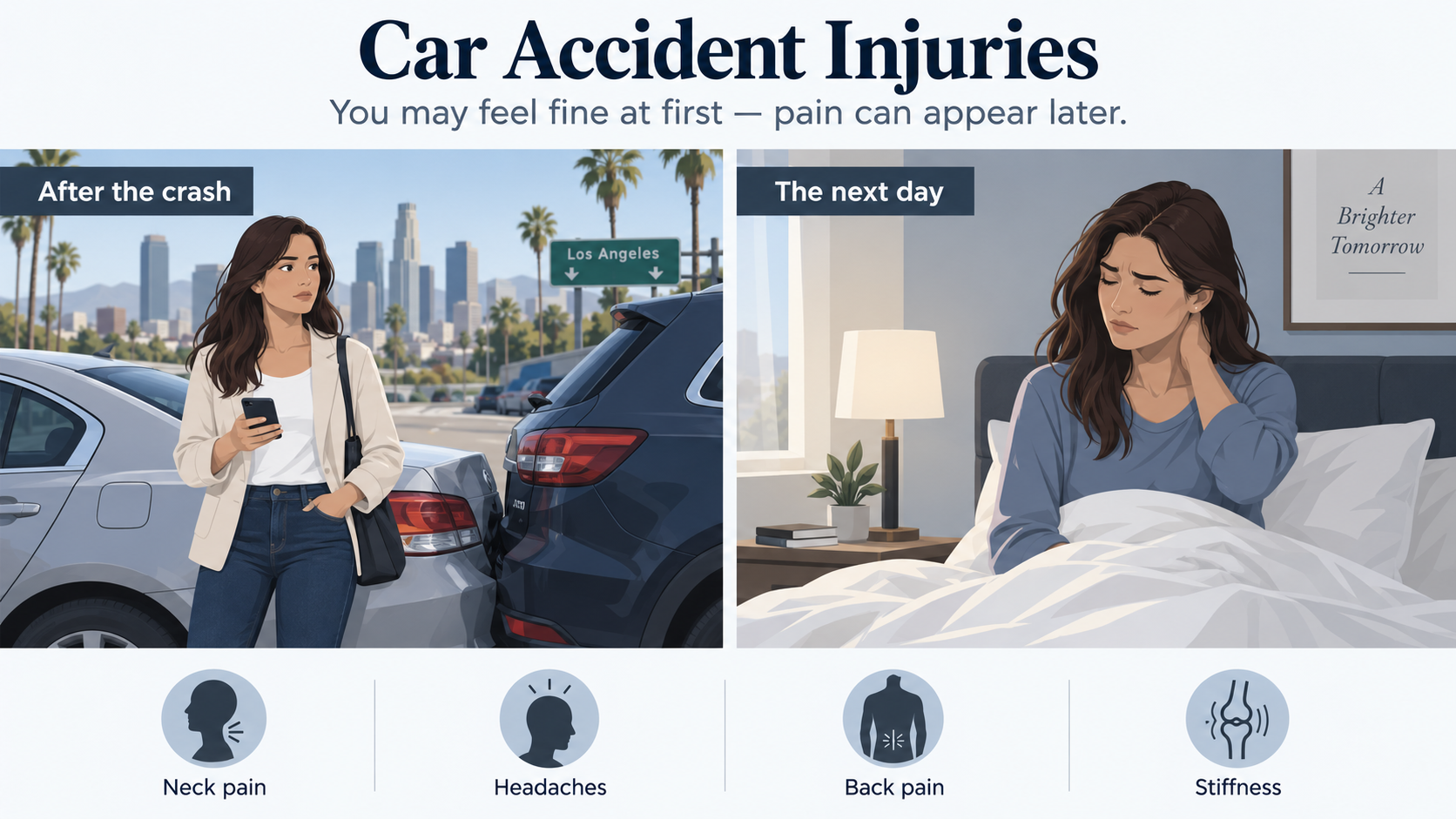
Car accident injuries do not always cause pain immediately. You may walk away from a collision feeling fine, only to wake up the next morning with neck pain, back pain, headaches, stiffness, soreness, or other symptoms you did not notice at the accident scene.
This can be confusing. If you were able to walk around, exchange insurance information, speak with the police, and leave the scene without significant pain, you may naturally assume that you were not injured.
But how you feel during the first few minutes after a crash does not always tell the whole story.
Some injuries can produce symptoms that become noticeable hours or even days later. For example, Mayo Clinic states that whiplash symptoms most often begin within days of the injury. The Centers for Disease Control and Prevention also explains that some symptoms of a mild traumatic brain injury or concussion may not appear until hours or days after the injury.
If you begin experiencing pain or other symptoms after a California car accident, do not automatically dismiss them simply because you felt fine at first. Changes in how you feel after a collision may warrant medical evaluation, particularly when symptoms are significant, worsening, or concerning.
Can Car Accident Injuries Cause Delayed Symptoms?
Yes. Car accident injuries can cause symptoms that are not immediately noticeable.
Some people experience pain as soon as a collision occurs. Others may initially feel shaken but otherwise normal and begin noticing symptoms later that evening, the following morning, or during the next several days.
Whiplash is one example. It is a neck injury caused by rapid back-and-forth movement of the neck and is commonly associated with rear-end collisions. Symptoms can include neck pain, stiffness, headaches, reduced range of motion, shoulder or upper-back pain, dizziness, fatigue, and tingling or numbness in the arms. Mayo Clinic notes that these symptoms most often begin within days of the injury.
Symptoms associated with concussion may also be delayed. The CDC explains that some mild traumatic brain injury symptoms appear immediately while others may not become noticeable until hours or days later.
In other words, feeling okay immediately after the collision does not necessarily mean you will continue feeling that way.
Why Do Some Car Accident Injuries Hurt Later?
There is no single explanation that applies to every person or every accident.
A sudden collision can trigger the body’s acute stress response. During a stressful event, physiological changes may temporarily affect how someone perceives pain. This is one reason a person may initially focus on getting out of traffic, checking on passengers, speaking with the other driver, or exchanging insurance information without immediately noticing every physical symptom.
At the same time, some symptoms simply become more noticeable as time passes.
Neck stiffness, muscle soreness, headaches, back pain, limited movement, dizziness, or other symptoms may not be obvious while you are standing at the scene. You may notice them several hours later after you have gone home, or the following morning when you get out of bed.
This is why someone can truthfully say:
“I felt okay immediately after the accident, but my neck started hurting later that night.”
Feeling fine immediately after a collision and developing symptoms later are not necessarily inconsistent.
Common Car Accident Injuries That May Have Delayed Symptoms
Different accidents can affect the body in different ways. The nature and severity of an injury can depend on the circumstances of the collision, including the direction of impact and what happened to the occupants during the crash.
Some car accident injuries are especially associated with symptoms that may not be obvious at first.
Whiplash After a Car Accident
Whiplash is commonly associated with rear-end accidents.
The sudden movement caused by an impact can force the neck backward and forward rapidly. Symptoms may include neck pain or stiffness, headaches, shoulder or upper-back discomfort, reduced range of motion, dizziness, fatigue, and tingling or numbness.
Importantly, these symptoms do not always begin at the accident scene. Mayo Clinic states that whiplash symptoms most often develop within days after the injury.
Someone may therefore exchange information with the other driver without significant pain and notice considerable stiffness the following morning.
Neck Pain After a Car Accident
Neck pain can develop immediately or sometime after a collision.
A person may notice stiffness, discomfort when turning the head, tenderness around the shoulders or upper back, headaches, or reduced range of motion.
Because different injuries can cause similar symptoms, neck pain alone does not establish exactly what type of injury occurred. A healthcare professional can evaluate the symptoms and determine their medical significance.
Back Pain After a Car Accident
Back pain is another common complaint following a motor vehicle collision.
A person may initially describe themselves as simply feeling sore and later notice that sitting, standing, bending, walking, sleeping, or other ordinary activities have become uncomfortable.
Pain may involve the lower, middle, or upper back.
The fact that back pain did not begin at the exact moment of impact does not necessarily mean it is unrelated to the collision.
Headaches After a Car Accident
A headache may also develop after a crash.
Headaches following an accident can have different causes, so it is important not to diagnose their source based on symptoms alone.
A new or worsening headache can be particularly important when it occurs with dizziness, nausea, confusion, weakness, unusual behavior, vision changes, loss of consciousness, or other neurological symptoms.
Concussion and Mild Traumatic Brain Injury
A concussion is a form of mild traumatic brain injury.
Symptoms may include headaches, dizziness or balance problems, nausea, fatigue, sensitivity to light or noise, difficulty concentrating, memory problems, feeling foggy, or changes in sleep.
The CDC notes that concussion symptoms vary from person to person and that some may not appear until hours or days after the injury.
A person also does not necessarily have to lose consciousness for a concussion to occur.
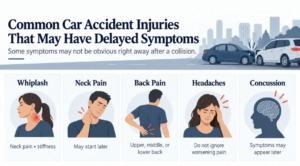
What Are Common Delayed Symptoms of Car Accident Injuries?
Symptoms following a crash vary considerably from person to person.
Delayed symptoms may include neck pain or stiffness, lower- or upper-back pain, headaches, shoulder pain, soreness, decreased range of motion, dizziness, balance problems, nausea, fatigue, numbness or tingling, difficulty concentrating, memory problems, sensitivity to light or noise, changes in sleep, or pain that becomes more noticeable with movement.
These symptoms do not automatically establish that someone has a particular injury.
They are simply signs that something may have changed after the collision. A healthcare professional is the appropriate person to evaluate the medical cause of symptoms.
Why Might You Feel Worse the Day After a Car Accident?
Many people are surprised when they feel relatively normal after a collision but significantly more uncomfortable the following morning.
During the immediate aftermath of an accident, your attention may be focused on what just happened.
You may be checking your passengers, moving your vehicle to a safe location, speaking with law enforcement, taking photographs, exchanging insurance information, or arranging transportation.
Several hours later, you may begin noticing stiffness or discomfort that was not obvious during those first few minutes.
Certain conditions can also have symptoms that develop later. Whiplash symptoms, for example, often begin within days of the injury, while some concussion symptoms may take hours or days to appear.
So waking up with pain after feeling okay at the scene is not necessarily unusual.
What Should You Do if You Notice Pain After a Car Accident?
First, do not ignore a meaningful change in how you feel simply because the pain was not immediate.
Pay attention to what you are experiencing and when it began.
For example, maybe you had no significant neck pain at the scene but noticed stiffness several hours later. Maybe you woke up the next morning with back pain. Or perhaps a headache developed later in the day.
If symptoms develop after the accident, seeking appropriate medical evaluation can help determine what may be causing them.
When discussing what happened with a healthcare professional, it is important to provide an accurate history of the accident and when you first noticed your symptoms.
From a personal injury standpoint, accuracy matters as well.
Do not minimize them simply because you want to appear okay. Explain what you actually experienced and when you experienced it.
When Can Car Accident Injuries Require Emergency Attention?
Some symptoms following an accident can indicate a potentially serious condition.
The CDC identifies danger signs following a possible traumatic brain injury that warrant emergency medical attention. These include a headache that becomes worse and does not go away, repeated vomiting, seizures, slurred speech, increasing confusion or unusual behavior, weakness or numbness, one pupil appearing larger than the other, loss of consciousness, or difficulty waking up.
If you believe you or someone else may be experiencing a medical emergency after a collision, call 911 or seek emergency medical care.
Should You Keep Track of Symptoms After a Car Accident?
It can be useful to keep an accurate record of what you experience following an accident.
Memories fade, particularly when someone is dealing with an accident, vehicle repairs, insurance calls, work responsibilities, and physical discomfort at the same time.
You may want to note when a symptom first became noticeable, whether it changed over time, whether you missed work, and whether ordinary activities became more difficult.
For example, perhaps turning your head while driving became uncomfortable. Maybe sitting through an entire workday became difficult because of back pain. You may have had trouble sleeping comfortably or found that headaches made concentrating more difficult.
The purpose is not to create or exaggerate symptoms.
It is simply to keep an accurate record of what actually happened.
Can Delayed Car Accident Injuries Affect a California Personal Injury Claim?
Having delayed symptoms does not automatically prevent someone from pursuing a California personal injury claim.
Medical sources recognize that symptoms associated with conditions such as whiplash and concussion may not always appear immediately.
However, the timeline can become an important issue when an insurance company evaluates a claim.
If there is a substantial period between the accident and the first documentation of symptoms, an insurer may question whether the collision caused the injury or whether something else occurred afterward.
That does not automatically mean the insurance company’s position is correct.
A personal injury claim is evaluated based on the available evidence, which may include medical records, photographs, witness statements, police reports, video footage, vehicle damage, and the overall timeline of the accident and reported symptoms.
This is one reason it is important to be consistent and accurate when describing what happened.
What if You Insurance Contacts You After the Crash?
The same concern can arise when an insurance adjuster contacts you shortly after the crash.
Be careful about guessing about a diagnosis, predicting how long symptoms will last, or making statements about matters you do not yet know.
If the other driver’s insurance company requests a recorded statement or begins asking detailed questions about your injuries, you may wish to speak with a California personal injury attorney about your rights before proceeding.
Does Minor Vehicle Damage Mean Car Accident Injuries Are Minor?
Not necessarily.
The appearance of a vehicle cannot diagnose whether an occupant was injured.
Property damage and physical injury are separate issues.
Vehicle damage may be considered along with other evidence when evaluating how an accident occurred, but the appearance of a bumper alone cannot establish whether a particular person is injured or uninjured.
If you experience symptoms following a collision, do not automatically dismiss them simply because your vehicle does not look severely damaged.
Why Is Accident Documentation Important?
People often assume they will remember every detail of an accident.
Weeks or months later, that may not be the case.
If it is safe and physically possible at the scene, photographs or video can preserve what the vehicles and surrounding roadway looked like immediately after the collision.
Vehicle damage, license plates, traffic signals, stop signs, road markings, debris, the surrounding intersection, and other conditions may later help explain what happened.
Dashcam footage can also be valuable. Witness information may become important if the drivers later disagree about how the accident occurred.
Evidence can disappear. Vehicles get repaired, witnesses become difficult to locate, and surveillance footage may be overwritten.
Preserving available information early can therefore become important in a personal injury claim.
Do You Have to Report an Accident to the California DMV if Someone Is Injured?
California has specific accident-reporting requirements.
The California DMV states that an SR-1 Report of Traffic Accident Occurring in California must be submitted within 10 days when someone is injured, regardless of how minor the injury is, someone is killed, or property damage exceeds $1,000.
The SR-1 is required in addition to reports made to the police, California Highway Patrol, or an insurance company.
This requirement can be particularly relevant when someone initially believes they are uninjured but begins experiencing symptoms after leaving the accident scene.
How Long Do You Have to File a Personal Injury Lawsuit in California?
For many California personal injury cases, the general deadline to file a lawsuit is two years from the date of injury.
California Courts states that a person usually has two years from the date of injury to sue. However, different deadlines can apply depending on who is involved and the facts of the case.
Claims involving government entities can have significantly shorter deadlines.
For example, California Courts explains that a claim involving personal injury or damage to personal property against a government agency generally must first be presented to the agency within six months. Additional deadlines can apply after the agency responds.
Because legal deadlines can depend on the parties involved and other circumstances, it is important not to assume that every California personal injury case has the same deadline.
How Can a Los Angeles Car Accident Lawyer Help With Car Accident Injuries?
When symptoms appear after an accident, one isolated fact rarely tells the entire story.
A Los Angeles car accident lawyer can review the broader circumstances surrounding the collision and help determine what evidence may be relevant to a potential personal injury claim.
Depending on the case, that may include reviewing how the accident happened, police reports, photographs, video or dashcam footage, witness information, vehicle damage, medical documentation, insurance coverage, lost wages, and the timeline of reported symptoms.
A personal injury attorney can also communicate with insurance companies, investigate available coverage, preserve relevant evidence when possible, and explain California legal deadlines and the claims process.
The attorney’s role is to handle the legal side of the case.
Questions concerning the diagnosis or medical management of an injury should be addressed by an appropriate healthcare professional.
Frequently Asked Questions About Car Accident Injuries
1. Can car accident injuries show up the next day?
Yes. Some car accident injuries can produce symptoms that are not immediately noticeable.
Whiplash symptoms often begin within days of the injury, while certain concussion symptoms may take hours or days to appear.
If you notice new or concerning symptoms after an accident, consider obtaining appropriate medical evaluation.
2. Is it normal to feel fine immediately after a car accident?
It can happen.
Some people experience immediate pain while others initially notice very little discomfort.
The stress of the accident may affect how someone initially perceives pain, and some injury symptoms can develop gradually.
Feeling fine at the scene therefore does not necessarily mean that symptoms will not appear later.
3. Why am I sore the day after a car accident?
Soreness, stiffness, or pain may become more noticeable during the hours after a collision.
For example, whiplash symptoms most often develop within days rather than necessarily occurring immediately.
If your symptoms are significant, worsening, or concerning, consider medical evaluation.
4. How long after a car accident can pain start?
There is no single timeline that applies to everyone.
Some people experience pain immediately. Other symptoms may become apparent later that day or within the following days.
The timing can depend on the individual and the type of injury involved.
5. Can whiplash start the next day?
Yes.
Whiplash symptoms may not become noticeable until after someone has already left the accident scene.
Mayo Clinic states that symptoms most often begin within days of the injury.
6. Can neck pain start hours after a car accident?
Yes.
Neck pain or stiffness may become noticeable hours after a collision or the following day.
Because several different conditions can cause neck pain, the timing or location of pain alone cannot establish a diagnosis.
7. Can back pain start the day after a car accident?
Yes.
Someone may initially feel okay or mildly sore and notice more significant back discomfort later.
If back pain develops after an accident, a healthcare professional can evaluate its possible medical cause.
8. Can you have a concussion without losing consciousness?
Yes.
A person does not have to lose consciousness to experience a concussion.
Concussion symptoms can vary widely, and some may take hours or days to appear.
9. Can concussion symptoms appear later?
Yes.
According to the CDC, some symptoms of mild traumatic brain injury or concussion may appear immediately, while others may not appear until hours or days after the injury.
10. When should I be concerned about a headache after a car accident?
A new or worsening headache after a collision can warrant medical attention, particularly when it is accompanied by neurological symptoms.
The CDC identifies a worsening headache that does not go away, repeated vomiting, seizures, weakness or numbness, slurred speech, increasing confusion, unusual behavior, unequal pupils, and difficulty waking as danger signs requiring emergency medical care.
11. Can I still have a personal injury claim if I did not go to the hospital from the accident scene?
Potentially.
Not going directly to a hospital does not by itself determine whether someone has a valid personal injury claim.
Some symptoms can appear later.
However, the timing of symptoms and medical documentation may become relevant if an insurance company disputes whether an injury was caused by the collision.
Each case depends on its own facts and evidence.
12. Does minor vehicle damage mean I could not have been injured?
No.
Visible vehicle damage cannot determine whether a particular occupant was physically injured.
An insurance company may consider the nature of the collision and vehicle damage when reviewing a claim, but photographs of a bumper are not a medical diagnosis.
13. Should I document symptoms that develop after an accident?
Keeping accurate notes can help preserve your recollection of when symptoms began and how they changed.
Those notes should be factual and should reflect what you actually experienced.
Medical records may also become important evidence regarding when symptoms were reported and what was documented by healthcare professionals.
14. How long do I have to file a car accident injury lawsuit in California?
For many personal injury cases, California generally provides two years from the date of injury to file a lawsuit.
However, exceptions and shorter deadlines can apply, particularly when a government entity is involved.
Because legal deadlines depend on the circumstances, you should not assume that every accident gives you two full years.
15. When should I contact a Los Angeles car accident lawyer?
You may want to speak with a lawyer if you were injured in a collision, your symptoms developed after the accident, liability is disputed, the other driver was uninsured or left the scene, an insurance company is asking detailed questions about your injuries, important evidence may need to be preserved, or you are unsure about your legal rights.
You do not need to diagnose your injuries before speaking with an attorney.
A personal injury lawyer can evaluate the legal aspects of the accident while medical questions remain with appropriate healthcare professionals.
Don’t Ignore Car Accident Injuries Just Because You Felt Fine at First
Walking away from a collision without immediate pain can feel reassuring.
But car accident injuries do not always cause symptoms right away.
Neck pain, back pain, headaches, stiffness, dizziness, numbness, and other symptoms may become noticeable only after you have left the accident scene.
If your condition changes, do not automatically dismiss those symptoms because you felt okay immediately after the crash.
And remember that the amount of visible vehicle damage does not determine whether someone was physically injured.
When another person’s negligence causes a collision, understanding your legal rights early can also help protect important evidence and prevent you from unknowingly missing deadlines that may apply to your claim.
Contact a Los Angeles Car Accident Lawyer About Car Accident Injuries
If you or a loved one suffered car accident injuries in Los Angeles or elsewhere in Southern California, Cha Cha Cha Law can help you understand your legal options.
Our personal injury team handles cases involving rear-end collisions, intersection accidents, hit-and-run crashes, uninsured and underinsured drivers, and other motor vehicle accidents.
We can review how the collision occurred, evaluate available evidence and insurance coverage, communicate with insurance companies when appropriate, and explain the California personal injury claims process.
Our role is to handle the legal issues surrounding your accident so you can make informed decisions about your case.
Cha Cha Cha Law offers free consultations. Call us at (213) 351-3513 or contact us online to discuss your situation with our team.
This article is provided for general informational purposes only and does not constitute legal or medical advice. Every accident, injury, and personal injury claim is different. Questions concerning a medical condition should be directed to an appropriate healthcare professional. For questions about your legal rights following a California car accident, consult a qualified attorney.