


Police report after car accident questions are common, especially after a rear-end collision in California. You may be wondering whether you should call the police, whether a police report is required, and whether not having one could affect a personal injury claim.
The answer depends on the circumstances of the accident.
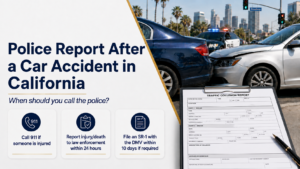
In California, not every minor collision results in a police report. However, accidents involving injuries or death are subject to specific reporting requirements. California also has a separate DMV reporting requirement that may apply when someone is injured or killed or when property damage exceeds $1,000.
For someone injured in a car accident, a police report may also provide useful documentation of the collision. But it is important to understand what a police report can—and cannot—do in a personal injury claim.
When Should You Call the Police After a Car Accident?
If someone is injured in a car accident, getting appropriate emergency assistance should come first.
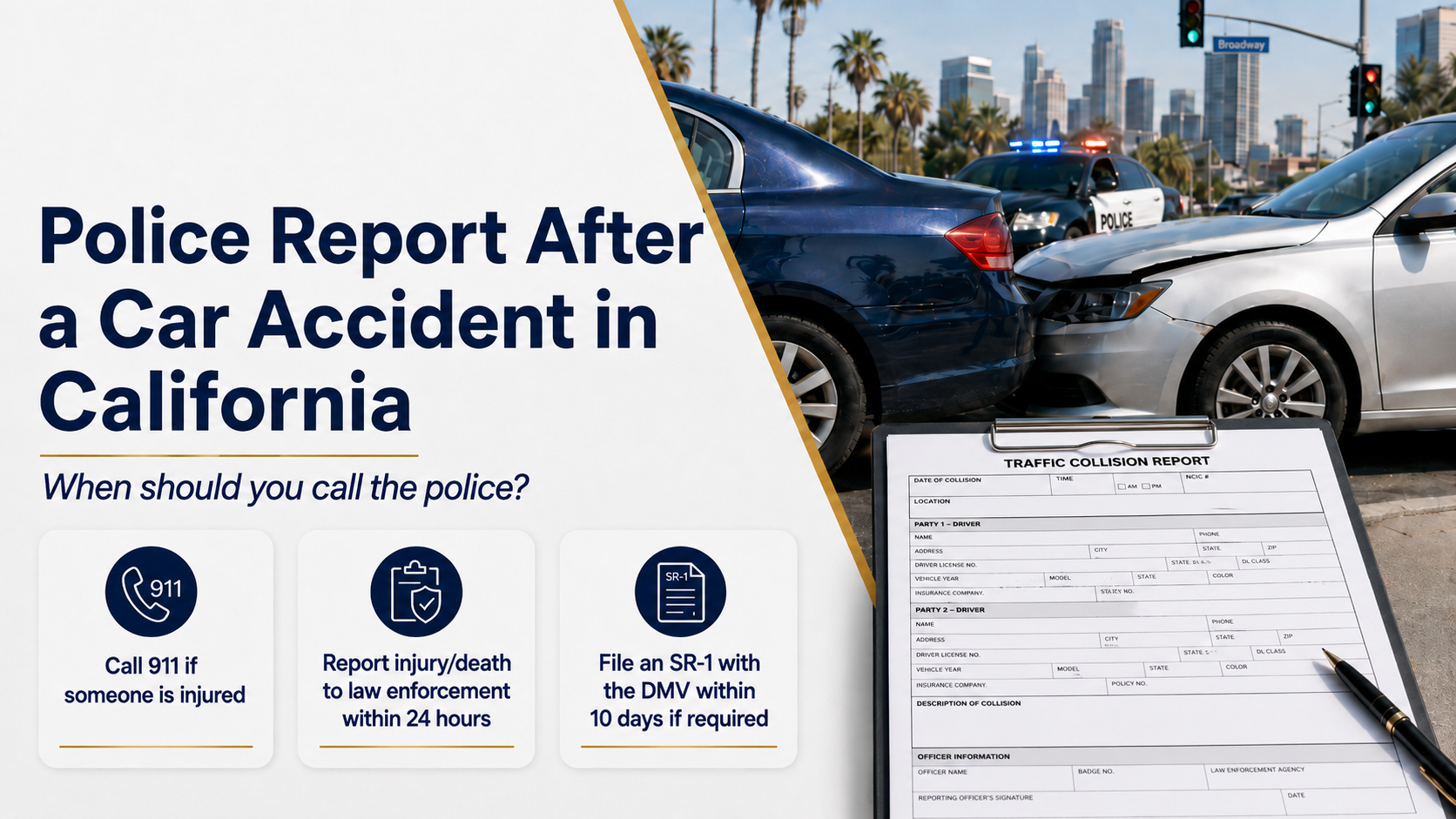
California DMV guidance states that drivers should call 911 right away if anyone is hurt. California law also requires a driver involved in a collision resulting in injury or death to make or cause to be made a written report to the appropriate law enforcement agency within 24 hours.
Police involvement may also be appropriate when:
- Someone is injured.
- A driver appears to be under the influence of alcohol or drugs.
- A driver leaves the scene.
- A driver does not have a valid driver’s license.
- There is an immediate safety concern.
- Emergency assistance is needed.
However, procedures may vary depending on where the accident occurs.
What If the Accident Happens in Los Angeles?
The Los Angeles Police Department provides specific instructions for traffic collisions within its jurisdiction.
According to LAPD, drivers should:
- Call 911 if anyone is injured or a driver appears intoxicated.
- Call 1-877-ASK-LAPD if there are no injuries but the accident involves a hit-and-run or an unlicensed driver.
- Exchange driver’s license, registration, insurance, and telephone information when there are no injuries and all drivers are licensed. LAPD states that it does not complete a traffic collision report for that category of collision.
This distinction is important.
You should not assume that every minor Los Angeles car accident will result in an officer responding to the scene or preparing a police report.
At the same time, the absence of a police report does not automatically prevent someone from pursuing a personal injury claim. Other evidence may be used to document how the collision happened and the injuries that resulted.
Is a Police Report Required After Every Car Accident in California?
No. California does not require a police report simply because two vehicles collided.
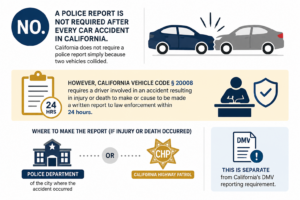
However, California Vehicle Code § 20008 requires a driver involved in an accident resulting in injury or death to make or cause to be made a written report to law enforcement within 24 hours.
If the accident happened within a city, the report may be made to the police department of that city or to the California Highway Patrol.
This should not be confused with California’s separate DMV reporting requirement.
What Is the California SR-1 Accident Report?
An SR-1, or Report of Traffic Accident Occurring in California, is a report filed with the California Department of Motor Vehicles.
According to the California DMV, drivers must generally submit an SR-1 within 10 days when:
- Anyone was injured, even if the injury was minor;
- Anyone was killed; or
- Property damage exceeded $1,000.
The requirement applies regardless of who caused the collision.
Is an SR-1 the Same as a Police Report?
No.
This is an important distinction for California drivers.
A police or traffic collision report is associated with a law enforcement agency.
An SR-1 is submitted to the California DMV.
The California DMV expressly states that each driver is responsible for filing the required SR-1 and that law enforcement will not file it for the driver.
That means having an officer investigate the accident does not eliminate a driver’s separate DMV reporting responsibility when the collision meets the SR-1 reporting requirements.
Why Can a Police Report Matter in a Personal Injury Claim?
After a car accident, the drivers may remember or describe what happened differently.
A police or traffic collision report can provide an additional record connected to the accident investigation.
Depending on the circumstances, an investigation may document information concerning the people, vehicles, location, and events surrounding the collision. CHP advises people speaking with an investigating officer to provide information about what happened before, during, and after the collision, including the vehicles involved, directions of travel, lanes, location, and other circumstances.
For a personal injury claim, that type of documentation may become useful when evaluating what happened.
However, a police report should not be treated as the only evidence in a car accident claim.
Other evidence may include:
- Photos of vehicle damage
- Photos or video of the accident scene
- Dashcam footage
- Surveillance footage
- Witness statements
- Driver statements
- Medical records
- Repair records
- Insurance information
- Physical evidence from the vehicles or roadway
A personal injury attorney may evaluate the police report together with the other available evidence rather than relying on one document alone.
Does a Police Report Prove Who Was at Fault?
Not necessarily.
A police report may be important evidence, but the existence of a police report does not automatically resolve every issue involving legal responsibility.
The circumstances of the collision still matter.
For example, a multi-vehicle rear-end accident may involve a dispute over the sequence of impacts.
The first driver may say they were stopped at a red light when they felt one significant impact. The middle driver may say they were pushed into the first vehicle by the car behind them. The last driver may give another account.
In a situation like that, determining responsibility may require consideration of:
- The damage to each vehicle
- Statements from the drivers
- Witness accounts
- Photographs
- Dashcam or surveillance footage
- The positions of the vehicles
- Traffic conditions
- Other available evidence
This is why accident victims should preserve their own evidence even when police respond.
What Should You Tell the Police After a Car Accident?
When speaking with an officer, focus on what you actually observed and experienced.
Be accurate.
You may want to explain:
- Where you were driving
- Which lane you were in
- Whether you were stopped or moving
- What happened immediately before the collision
- Where your vehicle was struck
- How many impacts you felt
- What you observed after the collision
- Whether you or your passengers are experiencing symptoms
Avoid guessing about facts that you do not know.
For example, if you did not see the vehicle approaching behind you, you probably do not know its exact speed.
Instead of speculating, explain what you actually experienced.
Should You Tell the Police You Are “Fine” After an Accident?
You should describe how you feel accurately.
Do not exaggerate symptoms, but do not feel that you have to minimize them either.
Immediately after an accident, people may be focused on the shock of the collision, their passengers, traffic, or damage to their vehicle.
If you are experiencing neck pain, back soreness, dizziness, a headache, or another symptom, accurately describe what you are experiencing.
If you do not know whether you are injured yet, you do not need to make a definitive statement that nothing is wrong.
And if symptoms develop after you leave the scene, consider obtaining appropriate medical attention.
What If the Police Do Not Come to the Accident Scene?
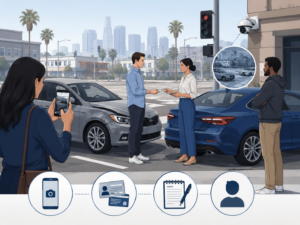
Not having an officer respond does not mean you should leave without documenting the accident.
If it is safe to do so, collect as much information as possible.
Photograph the Vehicles
Take photos showing:
- Damage to your vehicle
- Damage to the other vehicles
- All sides of the vehicles when possible
- License plates
- The overall positions of the vehicles
Take both close-up and wider photographs.
Document the Accident Scene
Photograph or record:
- The roadway
- Intersection
- Traffic signals
- Stop signs
- Lane markings
- Debris
- Skid marks, if present
- Weather and road conditions when relevant
Exchange Information
California DMV guidance instructs drivers involved in a collision to provide their driver’s license, vehicle registration, insurance information, and current address to the other parties involved.
You should make sure you have enough identifying and insurance information to properly document the other vehicles and drivers.
Look for Witnesses
If another person saw the accident, ask for their name and contact information.
An independent witness may become especially important if the drivers later disagree about how the collision occurred.
Look for Cameras
Consider whether the collision occurred near:
- A business
- Apartment building
- Gas station
- Parking structure
- Home
- Intersection camera
- Dashcam-equipped vehicle
Video evidence may not be preserved indefinitely, so identifying potential sources early can be important.
What If the Other Driver Asks You Not to Call the Police?
You do not have to agree simply because another driver says:
“Let’s just handle this ourselves.”
The appropriate response depends on the circumstances.
If someone is injured, California’s reporting requirements should be considered. If a driver appears intoxicated, LAPD instructs drivers in Los Angeles to call 911. A hit-and-run or unlicensed driver also triggers specific LAPD reporting instructions.
You should also be cautious about relying only on another driver’s promise that they will personally pay for the damage.
Vehicle damage and physical symptoms may be more significant than they initially appear.
What If the Other Driver Does Not Have Insurance?
If the other driver cannot provide insurance information, document the situation carefully.
Collect identifying information when it is safe and lawful to do so, including:
- Driver’s name and contact information
- Driver’s license information
- Vehicle information
- License plate
- Registration
- Photographs of the vehicles and damage
Your own automobile insurance coverage may become important when the responsible driver is uninsured or when there is a dispute concerning coverage.
Because policies and accidents differ, the availability of particular insurance benefits should be evaluated based on the actual policy and circumstances.
What If the Other Driver Leaves the Scene?
Do not put yourself in danger by chasing a hit-and-run driver.
Instead, try to safely document:
- License plate number
- Vehicle make and model
- Vehicle color
- Distinctive vehicle features
- Damage to the fleeing vehicle
- Direction of travel
Look for witnesses and nearby surveillance cameras.
For accidents within Los Angeles, LAPD instructs drivers to call its non-emergency line when a non-injury collision involves a hit-and-run. If someone is hurt, LAPD directs drivers to call 911.
Can You Have a Personal Injury Claim Without a Police Report?
Potentially, yes.
A police report is not the only way to establish that a collision occurred.
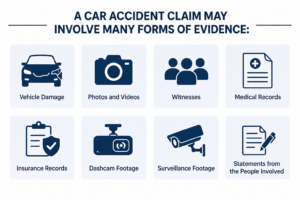
A car accident claim may involve many different forms of evidence, such as:
- Vehicle damage
- Photos and videos
- Witnesses
- Medical records
- Insurance records
- Dashcam footage
- Surveillance footage
- Statements from the people involved
The absence of a police report can make preserving other evidence particularly important.
For example, if two drivers leave the scene after exchanging only their phone numbers and one driver later disputes what happened, there may be fewer independent sources available to help establish the facts.
That is one reason thorough accident documentation can matter in a personal injury case.
Frequently Asked Questions About Police Report After Car Accident
Do I Need a Police Report After a Minor Car Accident in California?
Not every minor car accident in California requires a police report. Whether one is needed depends on the circumstances of the crash, including whether anyone was injured and how much property damage occurred.
In Los Angeles, LAPD states that when there are no injuries and all drivers are licensed, the parties should exchange information. In those situations, LAPD generally will not complete a traffic collision report.
If someone is injured or a driver appears intoxicated, LAPD advises calling 911.
California law also requires an accident involving injury or death to be reported to the appropriate law enforcement agency within 24 hours. Separately, a DMV SR-1 report is generally required within 10 days if someone is injured or killed or if property damage exceeds $1,000.
Even if no police report was prepared, you may still be able to pursue a personal injury claim. Photos from the scene, vehicle damage, witness information, medical records, and other evidence can help document what happened.
Should I Call 911 After a Rear-End Accident?
If anyone is injured after a rear-end accident, call 911 right away. California DMV guidance specifically instructs drivers to call 911 if anyone is hurt.
For accidents in Los Angeles, LAPD also directs drivers to call 911 when there is an emergency, including when a driver appears intoxicated.
Not every minor rear-end collision requires an emergency response. If no one is injured, make sure you safely document the accident, exchange insurance and contact information, and follow any applicable reporting requirements. Even when police do not respond, photographs, witness information, vehicle damage, and other evidence may still be important if you later pursue a personal injury claim.
What Happens If I Did Not Call the Police After My Accident?
Not calling the police from the scene does not automatically prevent you from pursuing a personal injury claim. Other evidence may still help establish how the accident happened and the injuries you suffered.
However, California has separate accident-reporting requirements. If a collision results in injury or death, California Vehicle Code § 20008 requires the driver to make or cause to be made a written report to the appropriate law enforcement agency within 24 hours.
A separate SR-1 report must generally be submitted to the California DMV within 10 days if anyone was injured, killed, or if property damage exceeded $1,000. The SR-1 is required in addition to any report made to police, CHP, or an insurance company.
If no police report was prepared, preserve as much other evidence as possible, including photos, witness information, insurance details, vehicle damage, and medical records. These records may become important if the other driver or insurance company later disputes the collision or your injuries.
Is a Police Report Required If I Was Injured?
If you were injured in a California car accident, the collision is subject to specific reporting requirements.
Under California Vehicle Code § 20008, a driver involved in an accident resulting in injury or death must make or cause to be made a written report to the appropriate law enforcement agency within 24 hours.
There is also a separate DMV requirement. An SR-1 report must generally be filed within 10 days if anyone was injured, even if the injury was minor, anyone was killed, or property damage exceeded $1,000. The SR-1 is required in addition to any report made to police, CHP, or an insurance company.
Do I Have to File an SR-1 If the Other Driver Was at Fault?
Yes. If the accident meets California’s SR-1 reporting requirements, you must file the report regardless of who was at fault. The California DMV specifically states that each driver must file an SR-1 when required, even if they did not cause the collision.
Filing an SR-1 does not mean that you are admitting fault. It is simply a DMV reporting requirement for qualifying accidents.
If you were injured in a car accident and are unsure whether an SR-1 needs to be filed, a personal injury law firm can help review the circumstances of the collision and assist with the reporting process when appropriate.
Does the Police File the SR-1 for Me?
No. Law enforcement does not file the SR-1 for you. Even if an officer responds to the accident and prepares a police or traffic collision report, the SR-1 is a separate report that must be submitted to the California DMV when required.
The driver is responsible for making sure the SR-1 is filed within 10 days of a qualifying accident. However, the California DMV allows your insurance agent, broker, or legal representative to complete and submit the report on your behalf.
If you were injured in a car accident, a personal injury law firm can help determine whether an SR-1 is required and assist with the reporting process when appropriate.
Should I Call the Police After a Three-Car Rear-End Accident?
If anyone is injured in a three-car rear-end accident, call 911. In Los Angeles, LAPD also instructs drivers to call 911 if a driver appears intoxicated.
Three-car collisions can be more complicated because the drivers may disagree about the sequence of impacts and who caused the chain reaction. For example, the middle vehicle may have been pushed into the car in front, rather than causing the first impact on its own.
If it is safe to do so, photograph all of the vehicles, including damage to the front and rear, and document where they came to rest. Get witness information and write down how many impacts you felt and what you remember happening.
If anyone was injured, California’s separate accident-reporting requirements may also apply, including the 24-hour law-enforcement reporting requirement and the 10-day DMV SR-1 requirement.
Can a Police Report Help a Car Accident Injury Claim?
Yes, a police report can be helpful in a car accident injury claim. It may document important details about the collision, including the drivers and vehicles involved, the location of the crash, statements made at the scene, and other information gathered during the investigation.
A police report can be especially useful if the other driver later disputes how the accident happened. However, it is only one piece of evidence.
Photos, video footage, witness statements, vehicle damage, medical records, and other documentation may also play an important role in evaluating a personal injury claim. A personal injury attorney can review the police report together with the rest of the available evidence to better understand how the collision occurred and what may support the claim.
Does a Police Report Automatically Prove the Other Driver Was at Fault?
No. A police report does not automatically determine legal fault in a car accident claim. An investigating officer may identify a primary collision factor or note whether another party contributed to the crash, but the full circumstances still need to be evaluated.
Other evidence—such as photographs, dashcam or surveillance footage, witness statements, vehicle damage, and statements from the drivers—may also be important in determining how the collision occurred.
This can be especially important when liability is disputed or multiple vehicles are involved. A personal injury attorney can review the police report together with the other available evidence when evaluating responsibility for the accident.
Injured in a Car Accident in Los Angeles?
Knowing when to contact police is only one part of protecting yourself after a collision.
If you were injured in a rear-end accident or another car crash, carefully preserve the evidence surrounding the accident, including police or collision reports, photographs, insurance information, witness information, vehicle damage records, and medical documentation.
A personal injury attorney can review the circumstances of the collision, available evidence, insurance coverage, injuries, and other factors that may affect a potential claim.
If you were injured in a car accident in Los Angeles or Southern California, contact Cha Cha Cha Law at (213)-351-3513 or submit a website inquiry to discuss your situation.
This article is provided for general informational purposes only and does not constitute legal advice. Every accident is different, and applicable reporting requirements and legal rights depend on the particular facts and circumstances.