

Modern cars are basically computers on wheels — and that’s exactly why more drivers are hearing about California Lemon Law than ever before. Today’s vehicles are packed with sensors, semiconductors, electronic control units (ECUs), and over-the-air software updates. All that technology makes driving more convenient, but it also opens the door to a new wave of electrical and software glitches that older cars simply didn’t have.
Check-engine lights that won’t turn off. Batteries that mysteriously drain overnight. Infotainment screens that freeze. Backup cameras that go dark. Bluetooth that won’t pair. EV charging errors. These are exactly the kinds of repeat-visit problems that are now sending drivers back to the dealership again and again — and in many cases, back to their rights under the Lemon Law.
What Is the California Lemon Law?
California Lemon Law is best known through the Song-Beverly Consumer Warranty Act, one of the strongest consumer protection laws in the country. In simple terms: if your vehicle has a problem that the manufacturer can’t fix within a reasonable number of attempts while it’s still under warranty, you may be entitled to a a full buyback or a cash settlement. Additionally, the California Lemon Law provides essential protections for consumers facing persistent vehicle issues.
Understanding your rights under the California Lemon Law can help you navigate issues with your vehicle efficiently.
The law technically applies to many types of consumer goods, but it’s most famous — and most frequently used — in the context of automobiles, given how expensive cars are and how directly they affect passenger safety.
The “2-3-4 Rule,” Simplified
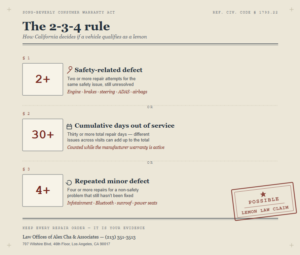
Consumer attorneys often describe California lemon law using an easy shorthand — the “2, 3, 4 rule”:
- 2 — The vehicle has been in for repair 2 or more times for a safety-related issue (engine, brakes, steering, etc.) and the problem persists.
- 30 — The car has been out of service for repairs for a combined total of 30 days or more.
- 4 — The vehicle has been in for repair 4 or more times for a less serious (non-safety) issue that still hasn’t been resolved.
If any one of these applies, you may have a valid California Lemon Law claim.
A Common Misunderstanding
Many consumers assume the repairs all have to be for the same issue. That’s not true. Different electronic or mechanical problems occurring repeatedly can still support a claim, because the real question is whether the vehicle as a whole has failed to live up to its warranty.
For example: a check-engine light on visit one, an adaptive cruise control malfunction on visit two, and a faulty backup camera on visit three could all combine to show a pattern of unreliability — even though no single defect repeated.
Two conditions typically must be met:
- Repairs must have been performed by an authorized/factory dealership.
- The vehicle must still be within the manufacturer’s warranty period.
Digging Into Each Part of the Rule
1. Safety Defects Repaired 2+ Times
Under the law, consumers must give the manufacturer a “reasonable number” of repair attempts. For safety-critical systems — engine, brakes, steering, transmission, or electrical systems — as few as two failed repair attempts can be enough to trigger California Lemon Law protection.
Modern ADAS (advanced driver-assistance systems) failures are increasingly treated as safety defects too, including:
- Lane-keep assist malfunctions
- Automatic emergency braking errors
- Backup camera failures
- EV battery warning lights
Even climate-control issues like a broken defroster can qualify, since fogged-up windows directly affect a driver’s visibility and safety.
2. Cumulative Repair Time of 30+ Days
One of the most commonly used triggers is 30 or more cumulative days out of service for repairs — and these don’t need to be for the same issue. Multiple shorter dealership visits for different problems can add up to 30 days combined.
Repair times have also gotten longer industry-wide due to parts shortages and technician shortages, especially for EVs and hybrids waiting on battery components or specialized electronics. Backordered parts have kept some Hyundai, Kia, Genesis, BMW, Tesla, and Volkswagen owners without their vehicles for months at a time.
3. Minor but Repeated Problems (4+ Repairs)
California Lemon Law isn’t reserved only for catastrophic engine failure or a car that won’t start. Persistent “minor” annoyances can also qualify if they’re repaired four or more times without success, including:
- Bluetooth connectivity failures
- Infotainment or navigation system crashes
- Speaker static or audio glitches
- Sunroof noise
- Power seat malfunctions
Because so much of a modern car is software-dependent, a single recurring “small” glitch can end up affecting the entire vehicle’s usability.
What You Can Get If Your Car Qualifies
If your vehicle is found to be a lemon, you’re generally entitled to:
- A buyback (refund) of the purchase price, minus a mileage-based usage deduction, or
- In some cases, a cash settlement while keeping the vehicle.
Manufacturers found liable typically also have to cover the consumer’s reasonable attorney’s fees — which is why most California lemon law cases cost the consumer nothing out of pocket.
What You Should Do Right Now
If you suspect your car is a lemon:
- Keep every repair order (RO) — these are your single most important piece of evidence.
- Note the dates each time the car went in and came out of the shop.
- Talk to a California lemon law attorney before assuming your case doesn’t qualify — consultations are typically free.
Frequently Asked Questions (FAQ)
Q: Does my car have to have the exact same problem every time to qualify?
No. California courts and manufacturers generally look at whether the vehicle overall has failed to meet warranty standards — different defects across multiple visits can still add up to a valid claim.
Q: Does the California Lemon Law only apply to brand-new cars?
No. As long as the vehicle is still covered by an active manufacturer warranty (including a New Certified Pre-Owned warranty), used Certified Pre-Owned (CPO) vehicles can qualify too.
Q: Do repairs have to happen at the dealership, or can any mechanic do them?
For purposes of a California Lemon Law claim, repairs generally should be performed by an authorized dealership for the vehicle’s manufacturer. This is important because the manufacturer must be given a reasonable opportunity to diagnose and repair the warranty-covered defect.
Repairs performed by an independent mechanic may not count as a repair opportunity for the manufacturer because the mechanic is not authorized to perform warranty repairs on the manufacturer’s behalf. For this reason, vehicle owners should keep copies of all repair orders from authorized dealerships, including records showing the reported concerns, repair attempts, mileage, and dates the vehicle was in the shop.
Q: Will I have to pay attorney’s fees out of pocket?
Usually not. Under the Song-Beverly Act, a manufacturer found liable is typically required to pay the consumer’s reasonable attorney’s fees, which is why most consumer lemon law attorneys work on contingency.
Have questions about a vehicle that keeps going back to the dealership?
Consultations with Cha Cha Cha Law are free, and if your case succeeds, the manufacturer often covers attorney’s fees. Call (213) 351-3513 or submit a website inquiry for a free consultation.