



Dealership hidden fees can make a vehicle cost much more than you expected. You find a car online at one price, but when it is time to sign, additional charges or protection packages appear in the paperwork. California’s Combating Auto Retail Scams Act, commonly called the CARS Act, adds protections involving vehicle pricing, optional add-ons, and misleading dealership sales practices. Its provisions became operative on October 1, 2026.

For someone buying or leasing a vehicle, these protections address familiar questions:
“Why is the price higher than the online listing?”
“Do I have to purchase this protection package?”
“Am I actually saving money with a lower monthly payment?”
Understanding what the CARS Act requires can help you review the transaction more carefully. It is also important to understand how dealership sales concerns differ from the warranty problems that may lead to a California Lemon Law claim.
What Is California’s CARS Act?
California enacted the CARS Act through Senate Bill 766 to address unfair and deceptive practices in covered vehicle transactions.
The law includes protections involving:
- Advertised vehicle prices.
- Initial written communications about vehicle pricing.
- Misleading statements about sales, financing, and leasing.
- Written disclosures about optional add-ons.
- Charges for add-ons that would not benefit the buyer or lessee.
- Written representations about monthly payments.
- Cancellation rights for qualifying used vehicles.
- Dealer recordkeeping.
Many of its transaction protections concern both new and used vehicles. However, the law has exceptions, including certain commercial transactions and vehicles with a gross vehicle weight rating of 10,000 pounds or more. The used-vehicle cancellation right also has separate requirements and exclusions.
Dealership Hidden Fees and the Advertised Price
Imagine finding an SUV advertised online for $32,000.
When you arrive at the dealership, you are told the price does not include a $2,000 dealer markup or a $1,500 charge for equipment already installed on that vehicle.
Under the CARS Act, the legally defined total price includes dealer price adjustments and the cost of items installed on the vehicle when the advertisement or communication is made.
The total price is calculated without subtracting rebates. Rebates and incentives may still be disclosed separately under applicable advertising rules.
For covered sales or financing transactions, dealers must disclose the total price in advertisements referencing a specific vehicle for sale or a monetary amount or financing term for a specific vehicle.
The law also requires that price to be disclosed in the dealer’s first written response regarding a specific vehicle when the statutory requirements apply.
That makes an initial email or text message worth keeping. It can help document the vehicle and price discussed before you visit the dealership.
Does the Advertised Price Include Every Charge?
No. The CARS Act’s defined total price is not necessarily the complete out-the-door amount.
The law allows certain charges identified in California Vehicle Code section 11713.1(e) to be excluded. For ordinary passenger vehicle transactions, these include:
- Taxes.
- Vehicle registration fees.
- The California tire fee.
- Finance charges.
- Dealer document processing charges.
- Electronic registration or transfer charges.
- Certain emissions-related charges.
Therefore, a final amount that is higher than the advertised vehicle price does not automatically establish a violation.
The type of charge matters, along with the required disclosures and how the dealership represented it. California law also prohibits dealers from representing document processing, electronic registration or transfer, or emissions testing charges as government fees.
Before signing, ask for a written, itemized out-the-door quote showing the vehicle price and each additional charge.
Can a Dealership Require You to Buy Optional Add-Ons?
During negotiations, a dealership may offer products such as:
- Service contracts.
- Maintenance plans.
- Theft-related products.
- Surface protection products.
- Guaranteed asset protection, commonly called GAP.
Under the CARS Act, when a dealer makes a written representation about an add-on during negotiations to purchase or lease a specific vehicle, the dealer must disclose at least once, clearly and in writing, that the add-on is not required and that the consumer can purchase or lease the vehicle without it.
For example, if a salesperson says you must purchase an optional service contract to complete the transaction, ask for clarification in writing.
Helpful questions include:
- Is this product optional?
- What does it cost separately?
- Who provides the service or coverage?
- What does it cover?
- What exclusions apply?
- What are the cancellation and refund terms?
Optional products offered during negotiations should also be distinguished from items already installed on the vehicle. The CARS Act requires the cost of installed items to be reflected in the disclosed total price as specified by the statute.
Which Dealership Add-On Charges Does the CARS Act Prohibit?
The CARS Act prohibits charging for an add-on that would not benefit the vehicle purchaser or lessee.
Examples identified in the law include:
- Oil changes for an electric vehicle.
- Catalytic converter markings for a vehicle without a catalytic converter.
- Products or services that do not cover the vehicle, consumer, or transaction.
- Service contracts that are void because of preexisting crash damage, flood damage, or mechanical conditions.
- Nitrogen tire products or services containing less than 95% nitrogen purity.
- Surface protection products that void the manufacturer’s paint warranty.
The law also addresses GAP agreements that do not comply with the California statutory provisions identified in the Act.
However, an optional product is not automatically unlawful simply because it is expensive or the buyer never uses it.
A consumer may select a product that provides applicable coverage but never experience a covered event. The CARS Act expressly allows charges for qualifying products the consumer selects and would benefit from, even if the consumer ultimately does not use them.
Review what the product actually provides rather than relying only on its name or the salesperson’s description.
Why a Lower Monthly Payment May Cost More Overall
When buying a vehicle, it is easy to focus on the monthly payment.
A payment of $450 may seem more manageable than $550. But the lower payment does not necessarily mean the transaction costs less.
For example, a longer loan term may reduce the monthly payment while increasing the total interest paid, depending on the financing terms.
The CARS Act addresses written monthly payment representations during negotiations to purchase or lease a specific vehicle.
When making such a representation, the dealer must disclose at least once, clearly and in writing, the total amount the consumer will pay after making all scheduled payments. If the calculation assumes a down payment or trade-in value, that amount must also be disclosed.
Written comparisons discussing lower monthly payments must disclose that lower payments often increase the total amount paid, subject to the statute’s provisions concerning interactive financing tools.
Before agreeing to a payment, review:
- The vehicle price.
- The down payment.
- The trade-in allowance and any outstanding trade-in balance.
- The amount financed.
- The interest rate.
- The loan term.
- The total scheduled payments.
- Any financed add-ons.
A monthly payment is only one part of the transaction.
Does the CARS Act Give You Three Days to Return a Car?
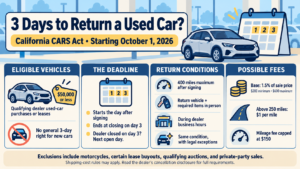
The CARS Act provides a three-day cancellation right for qualifying used vehicles sold or leased at retail by a dealer for $50,000 or less.
It does not create a general three-day return right for new vehicles.
The cancellation period ordinarily begins the calendar day after the purchase or lease agreement is executed. It ends at the dealership’s close of business on the third day.
If the third day falls on a day the dealership is closed to the public, the deadline extends to the next day it is open.
The cancellation right comes with conditions, including:
- The vehicle cannot have been driven more than 400 miles after execution of the agreement.
- The buyer or lessee must personally deliver the vehicle and required items during business hours.
- The vehicle generally must be in the same condition, subject to exceptions for reasonable wear and tear and qualifying problems that appear after delivery and were not caused by the buyer or lessee.
- Applicable restocking fees may be charged.
The base restocking fee is 1.5% of the vehicle’s sale price, with a $200 minimum and $600 maximum. An additional $1 per mile may apply above 250 miles, up to $150. The law also provides a limited alternative allowing the dealer to retain actual shipping costs instead of the base fee.
Exclusions include motorcycles, certain lease buyouts, and qualifying auction sales. Private-party purchases do not receive this dealer-based cancellation right.
Read the dealership’s required cancellation disclosure promptly. Do not assume that calling or emailing the dealership alone satisfies the return requirements.
What to Do If You Notice Dealership Hidden Fees
If the price or paperwork does not match what you expected, keeping clear records can help you understand what happened.
Save the Original Advertisement
Take screenshots showing the vehicle’s advertised price, identifying information, equipment, and any conditions.
Listings can change or disappear after a vehicle is sold.
Keep Emails, Text Messages, and Written Quotes
Save communications discussing the price, financing terms, trade-in value, and optional products.
These records can help you compare what was represented with the final agreement.
Review the Itemized Charges
Check the purchase or lease agreement and any separate add-on contracts.
An unfamiliar charge deserves an explanation. Look at the individual items instead of relying only on the final total or monthly payment.
Ask About Differences in Writing
Identify the specific charge and request an explanation.
For example:
“Your written quote listed the vehicle at $32,000, but the agreement includes an additional protection package. Please explain what this charge covers and whether I can purchase the vehicle without it.”
Seek Help Appropriate to the Issue
California’s Department of Motor Vehicles regulates dealerships and accepts complaints involving dealer disputes. An attorney who handles dealership fraud or consumer sales disputes can evaluate potential legal remedies. oag.ca.gov
If you are considering the three-day cancellation right for a qualifying used vehicle, check the deadline and return requirements immediately.
How the CARS Act Differs From California Lemon Law
The CARS Act addresses dealership transaction practices.
California Lemon Law addresses qualifying vehicle defects and the manufacturer’s repair obligations.
For example, an unexpected protection package on a contract raises a different issue from a vehicle that repeatedly stalls despite warranty repairs.
A vehicle can also have both transaction concerns and mechanical problems. Each issue requires its own evaluation.
For a potential California Lemon Law matter, relevant facts include:
- Whether the problem is covered by an applicable manufacturer’s warranty.
- Whether the defect substantially impairs the vehicle’s use, value, or safety.
- Whether the manufacturer or its authorized repair facility has had a reasonable opportunity to repair it.
- Whether the problem continues after repairs.
- How long the vehicle has been out of service for repairs.
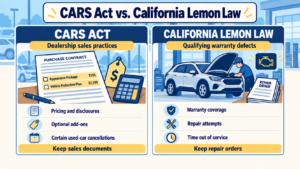
A dealership fee dispute alone does not make a vehicle a lemon. Likewise, a mechanical problem does not automatically create a right to cancel a new-car purchase under the CARS Act.
Keep sales documents for transaction concerns and repair orders for warranty concerns.
Frequently Asked Questions
Are dealership hidden fees illegal in California?
Some undisclosed charges or misleading statements about pricing may violate California law. However, a final price that is higher than the advertised vehicle price does not automatically mean the dealership acted unlawfully.
Certain charges, including taxes, registration fees, and permitted document processing charges, may be excluded from the advertised total price. Other amounts, such as dealer markups and the cost of items already installed on the vehicle, must be included in the total price as required by the CARS Act.
If an unfamiliar charge appears, ask for an itemized explanation and compare it with the advertisement and written quote. The type of charge, how it was disclosed, and what the dealership represented all matter.
Can a dealership charge more than the advertised price?
California law generally requires a dealership to sell an available advertised vehicle at or below its advertised total price, subject to legally permitted exclusions and applicable advertisement time limits.
Your final out-the-door amount may still be higher because of taxes, registration fees, certain other permitted charges, or optional products you separately choose to purchase. However, a dealer markup or the cost of equipment already installed when the vehicle was advertised generally belongs in the disclosed total price.
Save the advertisement and request a written out-the-door quote so you can see why the final amount differs.
Does the CARS Act ban dealer markups?
No. The CARS Act does not prohibit a dealership from charging a dealer markup. It requires dealer price adjustments to be included in the vehicle’s defined total price.
For example, if a dealership adds a $2,000 markup to a specific vehicle, that amount must be reflected in the total price disclosed as required by the law. It should not first appear as an additional charge after the buyer responds to a lower advertised price.
The requirement concerns accurate pricing and disclosure; it does not set a general limit on how much a dealer may mark up a vehicle.
Does the CARS Act prohibit all service contracts or GAP products?
No. Service contracts and GAP products are not automatically prohibited. A dealer may charge for a qualifying optional product that the consumer selects and would benefit from, even if the consumer never needs to use it.
However, the CARS Act prohibits charges for add-ons that would not benefit the purchaser or lessee. Examples include products that do not cover the vehicle or transaction, or a service contract that is void because of preexisting damage or mechanical conditions. GAP agreements must also comply with the California statutory requirements identified in the Act.
Before purchasing an add-on, review its separate price, coverage, exclusions, and cancellation terms. When a dealer makes a written representation about an add-on during covered negotiations, the required written disclosure must explain that it is optional and that the vehicle can be purchased or leased without it.
Does the CARS Act apply to new vehicles?
Yes. Many of the CARS Act’s protections involving misleading sales statements, pricing, and optional add-ons apply to covered transactions involving both new and used vehicles.
However, the three-day cancellation right applies only to qualifying used vehicles sold or leased at retail by a dealer for $50,000 or less. It does not give new-car buyers a general three-day period to return their vehicle because they changed their mind.
The law also has exclusions, including certain commercial transactions and vehicles with a gross vehicle weight rating of 10,000 pounds or more. The protections that apply depend on the vehicle and transaction.
Can I return a defective new car within three days?
The CARS Act does not create an automatic three-day return right for a defective new vehicle. A problem appearing shortly after purchase also does not, by itself, establish that the vehicle qualifies as a lemon.
If your new vehicle develops a problem, report it to an authorized repair facility and keep the repair order. The manufacturer’s warranty and potentially California Lemon Law may be relevant, depending on warranty coverage, the seriousness of the defect, repair opportunities, and the overall repair history.
Other legal grounds or a dealership’s voluntary return policy may also apply in some circumstances. A Lemon Law repurchase is a separate process from returning a vehicle under a dealership cancellation policy.
Having Repeated Problems With a Newly Purchased or Leased Vehicle?
Understanding dealership fees is one part of protecting yourself as a buyer. If your concern involves repeated warning lights, stalling, transmission problems, electrical failures, or other warranty issues, the repair history deserves a separate review.
At Cha Cha Cha Law, we focus on California Lemon Law. Our attorneys can review your warranty repair records and evaluate whether your vehicle may qualify for a claim.
Depending on the circumstances, the resolutions our firm pursues include a manufacturer repurchase or buyback, or a negotiated cash-and-keep settlement. No particular outcome is guaranteed.
Call (213) 351-3513 or submit a website inquiry for a free California Lemon Law consultation.