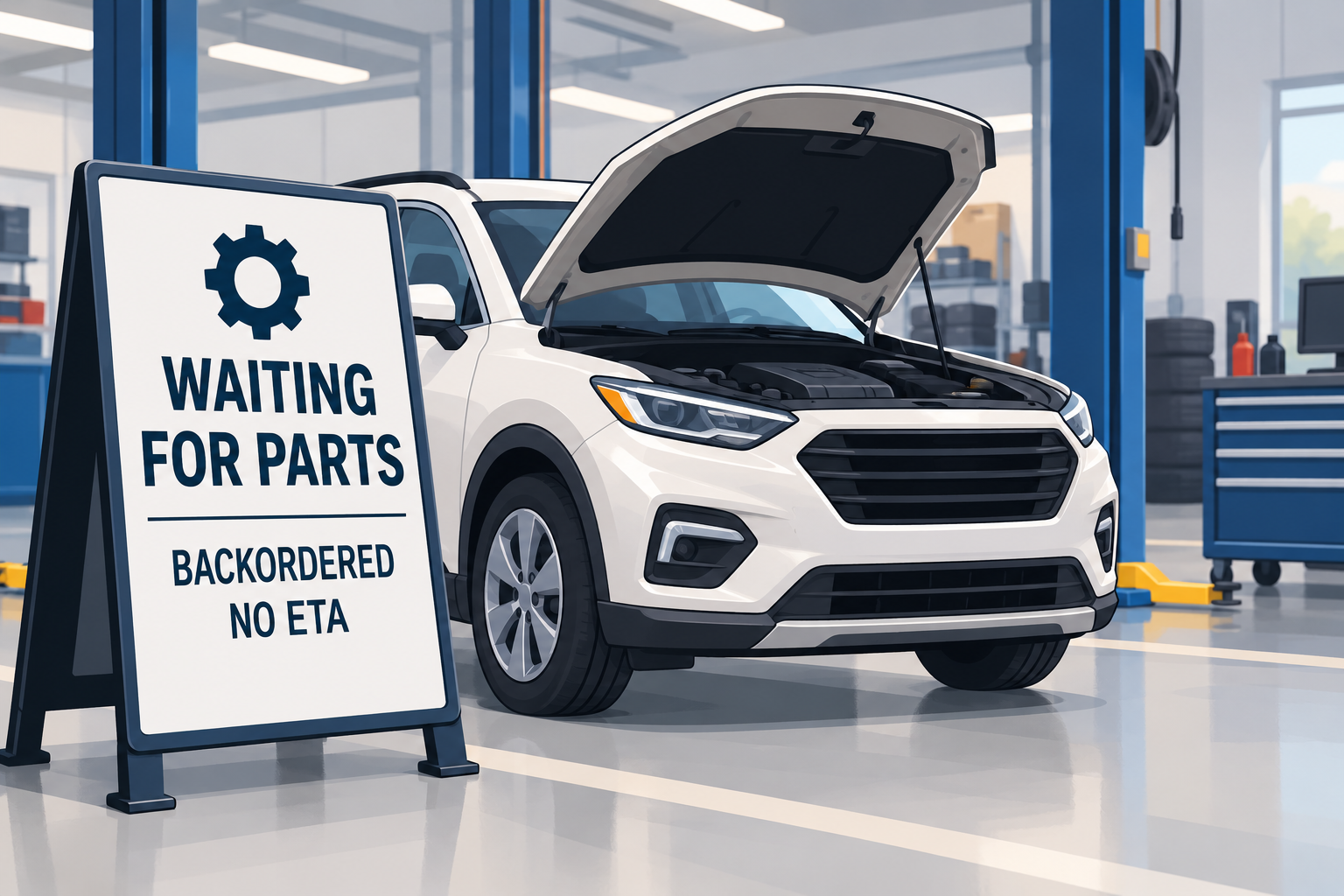
If your car is waiting for parts at a California dealership, a repair that was supposed to take a few days can quickly turn into weeks. Maybe the dealership has already diagnosed the problem, but the replacement part is backordered. Or maybe you keep hearing that there is still no estimated arrival date.
Meanwhile, your vehicle remains at the dealership.
If the repair is being performed under the manufacturer’s warranty, an extended delay may be important under California Lemon Law. Depending on the circumstances, the amount of time your vehicle spends out of service can be one factor in determining whether you may have a potential Lemon Law claim.
Why Is My Car Waiting for Parts?
Parts delays can happen for many reasons. A dealership may be waiting for a transmission, battery component, electronic module, sensor, engine component, or another part needed to complete a warranty repair.
Sometimes a part is simply backordered. In other situations, the dealership may tell you there is no estimated arrival date.
For the vehicle owner, however, the practical problem remains the same: your car is waiting for parts and you may not be able to use it.
That time may become important if the vehicle is undergoing repairs for a problem covered by the manufacturer’s warranty.
Does Time Waiting for Parts Count Toward California Lemon Law?
California Lemon Law generally concerns vehicles with problems covered by the manufacturer’s original warranty that the manufacturer has been unable to repair after a reasonable number of repair opportunities.
The analysis is not limited to how many times you visited the dealership. The amount of time the vehicle has been out of service for warranty repairs can also be important.
California’s Lemon Law includes a legal presumption that may apply in certain circumstances. Among its provisions, the presumption addresses situations in which a vehicle has been out of service because of repairs for a cumulative total of more than 30 calendar days, subject to the law’s requirements.
Importantly, those days do not necessarily have to occur during one continuous repair visit.
However, reaching 30 days does not automatically mean that every vehicle qualifies as a lemon. The facts of the case, warranty coverage, nature of the problem, timing, repair history, and other legal requirements still matter.
What If My Car Is Waiting for a Backordered Part?
A dealership may tell you:
- “The part is backordered.”
- “We don’t have an ETA.”
- “The manufacturer hasn’t released the part yet.”
- “We’re waiting for the part to arrive.”
- “There is a nationwide parts shortage.”
Hearing one of these explanations does not necessarily mean the time your vehicle spends at the dealership is irrelevant.
If your vehicle cannot be returned to you because a warranty repair cannot be completed without the necessary part, the repair history and time out of service may still be important when evaluating a potential California Lemon Law claim.
The specific circumstances matter, which is why you should keep documentation showing when the vehicle was dropped off, why it was brought in, what repair was recommended, and when it was eventually returned.
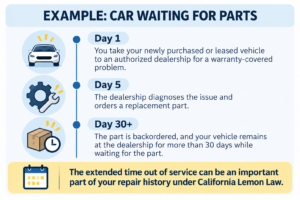
Example: Your Car Has Been Waiting for Parts for Several Weeks
Imagine you purchased or leased a newer vehicle in California that is still covered by the manufacturer’s warranty.
A warning appears on the dashboard and the vehicle begins losing power. You take it to an authorized dealership.
The dealership diagnoses the problem and tells you that a component needs to be replaced under warranty. Unfortunately, the part is backordered.
One week passes.
Then two.
Then three.
Eventually, your vehicle has been at the dealership for more than 30 days while the dealership waits for the part and completes the warranty repair.
That does not automatically establish that the vehicle is a lemon. However, the extended period out of service could be significant when evaluating your repair history under California Lemon Law.
This is why it is important to look at the entire repair history, rather than assuming that a parts delay simply does not count.
Does the 30-Day California Lemon Law Rule Apply to Every Car Waiting for Parts?
No. One of the most common misconceptions about California Lemon Law is that a vehicle automatically becomes a lemon once it has spent 30 days at the dealership.
The 30-day rule is not an automatic qualification rule. Instead, it is one of the guidelines associated with California’s Lemon Law presumption for determining whether a manufacturer has had a reasonable opportunity to repair a vehicle.
Under the presumption, one of the circumstances that may be considered is when a vehicle has been out of service for more than 30 cumulative calendar days because of repairs for problems covered by the manufacturer’s warranty. Those days do not necessarily have to be consecutive.
For example, a vehicle might spend 12 days at the dealership for one warranty repair and later spend another 20 days at the dealership for a different warranty repair. Depending on the circumstances, those periods may be relevant when looking at the vehicle’s total time out of service.
However, simply reaching 30 days does not mean that every vehicle automatically qualifies under California Lemon Law.
Why the 30-Day Rule Is More Complicated Than It Sounds
California’s Lemon Law presumption has specific requirements. The 30-day guideline under the presumption generally concerns problems and repair activity occurring within the first 18 months after delivery or 18,000 miles on the odometer, whichever occurs first.
The presumption also includes other guidelines, such as repeated unsuccessful repair attempts for the same warranty problem and fewer attempts when a problem is serious enough that it could cause death or serious bodily injury.
But the 18-month/18,000-mile period should not be confused with the entire duration of California Lemon Law protection. California’s Department of Consumer Affairs explains that Lemon Law protections can apply throughout the duration of the manufacturer’s original warranty.
In other words, a vehicle that does not fit neatly within the 30-day presumption may still warrant a Lemon Law review.
What Else Matters Besides the Number of Days?
When evaluating a potential California Lemon Law claim, the entire warranty and repair history can matter.
Relevant factors may include:
- Whether the problem is covered by the manufacturer’s original warranty
- How many times the vehicle has been brought in for repairs
- How long the vehicle has been out of service
- Whether the same problem continues after repair attempts
- Whether the problem substantially affects the vehicle’s use, value, or safety
- Whether the manufacturer or its authorized repair facility has had a reasonable opportunity to repair the vehicle
This is why simply counting the number of days your vehicle has been at the dealership does not tell the whole story.
What If My Car Is Waiting for Parts for 30 Days or Longer?
If your car is waiting for parts and remains at the dealership for several weeks, keep track of the entire period that the vehicle is unavailable to you.
For example, suppose your newer purchased or leased vehicle develops a warranty-covered problem. You bring it to an authorized dealership, and the dealer determines that a component must be replaced. The repair cannot be completed because the necessary part is backordered, and your vehicle remains at the dealership for more than 30 days.
The fact that the dealership is waiting for a part does not, by itself, tell you whether the vehicle qualifies under California Lemon Law. However, the extended period out of service can be an important part of the vehicle’s repair history and may be relevant when evaluating a potential claim.
Keep your repair orders and communications from the dealership, including any texts or emails stating that the part is backordered or that there is no estimated arrival date.
More Than 30 Days? Look at the Entire Repair History
If your vehicle has been at the dealership for 30 days or longer, do not assume that it automatically qualifies as a lemon—but do not assume the delay is irrelevant either.
California Lemon Law depends on the specific facts of each vehicle, including its warranty coverage, repair attempts, problems, and total time out of service.
If your car is waiting for parts, has been at the dealership for an extended period, or has repeatedly returned for warranty repairs, having the complete repair history reviewed can help determine whether California Lemon Law may apply.
What Should You Do While Your Car Is Waiting for Parts?
If your car is waiting for parts, documentation can become especially important.
Keep copies of your repair orders and any paperwork you receive from the dealership. You may also want to save text messages, emails, or other communications showing that the dealership is waiting for a part or that the part is backordered.
Pay attention to:
- The date you dropped off the vehicle
- The vehicle’s mileage at drop-off
- The problem you reported
- Whether the repair is being handled under warranty
- What the dealership diagnosed
- What part the dealership says it needs
- Whether the part is backordered
- Any estimated arrival dates you were given
- The date the vehicle is returned to you
- Whether the same problem returns afterward
When you finally pick up the vehicle, obtain the completed repair order and review it for accuracy.
What If the Dealer Gives Me a Loaner Car?
Receiving a loaner or rental vehicle does not necessarily erase the fact that your own vehicle is at the dealership for a warranty repair.
Keep records relating to the loaner or rental as well as your vehicle’s repair documents.
The important question is not simply whether you had transportation while you waited. Your vehicle’s repair history, warranty coverage, defect, and time out of service may all be relevant to a Lemon Law evaluation.
My Car Is Still Waiting for Parts. Should I Wait Until It Is Fixed?
You do not necessarily need to wait indefinitely before learning about your rights.
If your vehicle has already spent a significant amount of time at the dealership, has had repeated warranty repair visits, or continues experiencing the same or related problems, you may want to have the repair history reviewed.
Waiting for a part can sometimes turn what initially seemed like a straightforward warranty repair into weeks of lost use of the vehicle.
Understanding your options earlier can help you keep the right documentation as the situation develops.
What Can Happen If My Vehicle Qualifies Under California Lemon Law?
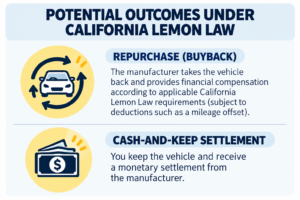
At Cha Cha Cha Law, the two resolutions we pursue in California Lemon Law matters are a repurchase (also called a buyback) or a cash-and-keep settlement.
Repurchase or Buyback
In a repurchase or buyback, the manufacturer takes the vehicle back and the matter is resolved financially according to the applicable California Lemon Law requirements and the circumstances of the claim.
The calculation can involve items such as the vehicle’s purchase or lease payments and other amounts permitted by law, subject to applicable deductions such as a mileage offset.
Cash-and-Keep Settlement
In a cash-and-keep settlement, you keep the vehicle and receive a monetary settlement from the manufacturer.
Whether a repurchase or cash-and-keep resolution may be available depends on the facts of the individual case and how the claim is ultimately resolved.
Your Car Is Waiting for Parts — Don’t Ignore the Repair History
A car waiting for parts may seem like nothing more than an inconvenient dealership delay. But when a vehicle remains out of service for an extended period because the dealership cannot complete a warranty repair, the repair history may become important under California Lemon Law.
Do not assume that a backordered part means you simply have to keep waiting.
Keep your repair orders, document the dates your vehicle is at the dealership, save communications about parts delays, and make sure the concerns you reported are accurately reflected in your service records.
If your vehicle has been sitting at a California dealership waiting for parts, or if it has repeatedly returned for warranty repairs, Cha Cha Cha Law can review your repair history and help you understand whether California Lemon Law may apply to your situation.
Contact Cha Cha Cha Law at (213) 351-3513 or submit a website inquiry for a free consultation regarding your California Lemon Law matter.
Frequently Asked Questions About a Car Waiting for Parts in California
Does waiting for parts count toward California Lemon Law?
If your vehicle remains out of service while an authorized dealer is performing a repair covered by the manufacturer’s warranty, the time out of service may be relevant to a California Lemon Law claim. California’s Lemon Law presumption includes a guideline involving a vehicle being out of service for more than 30 cumulative calendar days for warranty-covered repairs, although specific legal requirements must be met.
How long can a dealership keep my car waiting for parts in California?
There is not a simple rule that automatically makes a vehicle a lemon after a particular number of days at the dealership. However, lengthy warranty repair delays can be important. Under California’s Lemon Law presumption, more than 30 cumulative days out of service for warranty-covered repairs is one of the guidelines used to determine whether a reasonable number of repair opportunities has occurred, subject to the presumption’s requirements.
Is my car automatically a lemon if it has been at the dealership for 30 days?
No. A vehicle does not automatically become a lemon simply because it has been at the dealership for 30 days. California’s 30-day guideline is part of the Lemon Law presumption, and eligibility depends on additional facts and legal requirements, including the vehicle’s warranty and repair history.
Do the 30 days have to be consecutive under California Lemon Law?
No. Under California’s Lemon Law presumption, the vehicle may have been out of service for more than 30 calendar days that are not necessarily consecutive for repairs to warranty-covered problems. Other requirements of the presumption still need to be considered.
What if my car is waiting for a backordered part with no ETA?
If your car is waiting for parts because a warranty repair cannot be completed, keep documentation showing when you dropped off the vehicle, what problem was reported, what part is needed, and what the dealership has told you about the delay. Extended time out of service for warranty repairs can be relevant when evaluating a potential California Lemon Law claim.
Can I have a Lemon Law claim if the dealership gives me a loaner car?
Receiving a loaner vehicle does not, by itself, determine whether your vehicle qualifies under California Lemon Law. The analysis focuses on matters such as the warranty-covered problem, repair opportunities, whether the problem was satisfactorily repaired, and the vehicle’s repair history.
What should I keep if my car is stuck at the dealership waiting for parts?
Keep every repair order, invoice, text message, email, and other communication regarding the repair or parts delay. Make sure your repair documents accurately show the dates your vehicle was dropped off and picked up, the mileage, the problems you reported, and the work performed. These records can help document your vehicle’s repair history and time out of service.
Can I qualify for California Lemon Law if my car is still under warranty?
California Lemon Law applies to qualifying warranty disputes involving vehicles covered by the manufacturer’s original new-vehicle warranty. California DCA states that Lemon Law protection applies throughout the duration of the manufacturer’s original warranty period. Whether a particular vehicle qualifies depends on the individual circumstances.
What can I receive if my car qualifies under California Lemon Law?
California law provides statutory remedies that can include repurchase/refund or replacement when applicable requirements are satisfied. At Cha Cha Cha Law, the two resolutions we pursue are a repurchase (buyback) or a cash-and-keep settlement. With a repurchase, the manufacturer takes the vehicle back and the financial resolution is calculated under applicable law. With cash-and-keep, the consumer keeps the vehicle and receives a negotiated monetary settlement.
Should I Contact a Lemon Law Attorney If My Car Is Waiting for Parts?
If your car has been sitting at the dealership for an extended period because the dealer is waiting for parts, you do not necessarily have to wait until the repair is completed to learn about your options.
This can be especially important if you purchased or leased a newer vehicle and the problem is being addressed under the manufacturer’s warranty. California Lemon Law protections can apply to qualifying purchased and leased vehicles, and the vehicle’s warranty coverage, repair history, and time spent out of service can all be important when evaluating a potential claim.
Even if the dealership tells you that a part is backordered or that there is no estimated arrival date, it may be worth having your repair records reviewed. Keep copies of your repair orders and any texts, emails, or other communications showing how long the vehicle has been at the dealership and what you have been told about the parts delay.
At Cha Cha Cha Law, we help California drivers understand whether repeated warranty repairs or extended time at the dealership may qualify for protection under California Lemon Law. Depending on the circumstances, we pursue repurchase (buyback) or cash-and-keep settlements for our Lemon Law clients.
If your car is waiting for parts and has been sitting at the dealership for weeks, you do not have to guess whether the delay could matter. Contact Cha Cha Cha Law today at (213) 351-3513 or submit a website inquiry for a free consultation. Our team can review your repair history and help you understand your options under California Lemon Law.