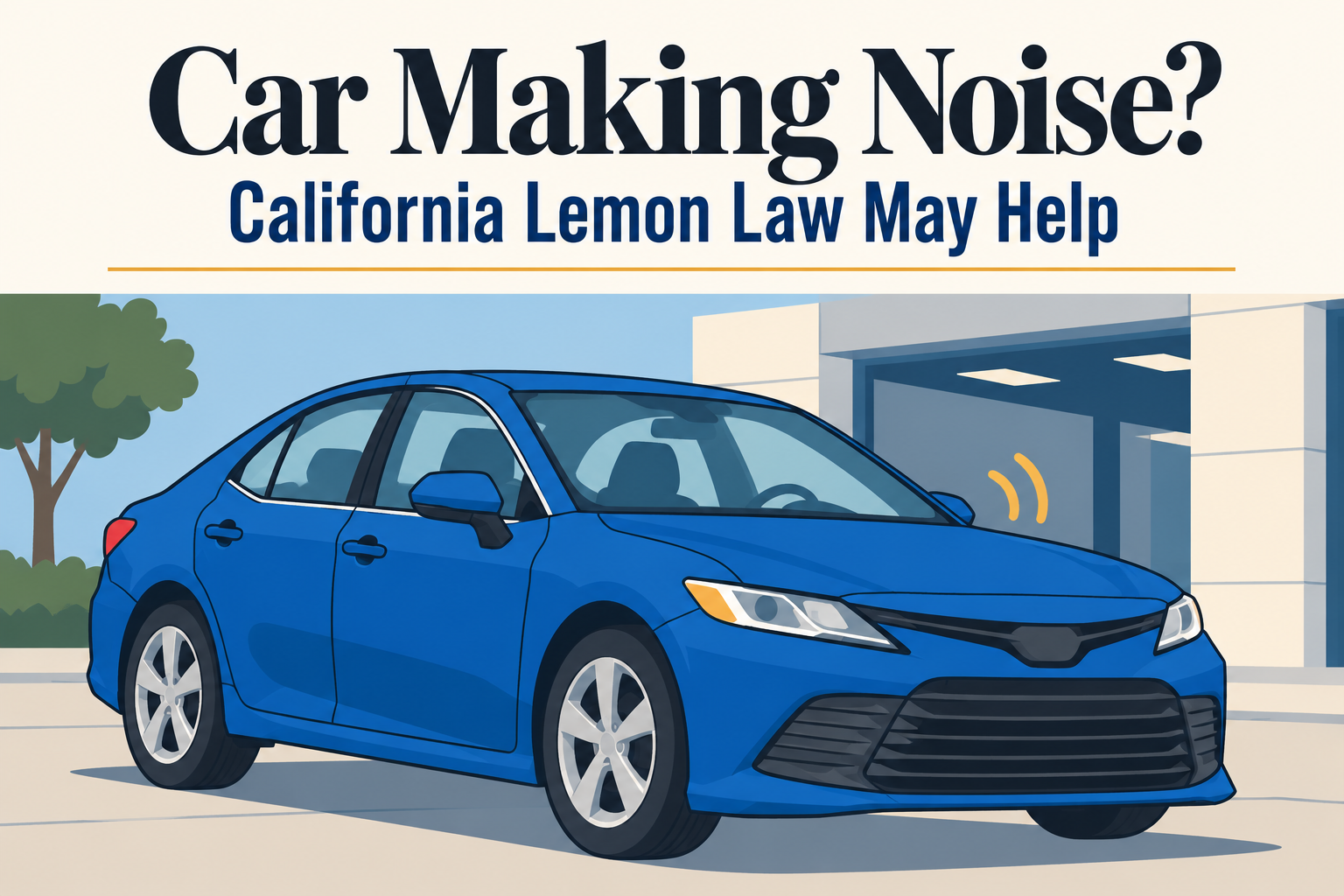
Is your car making noise even after repeated trips to the dealership? Whether you hear rattling on the freeway, grinding when braking, or knocking during acceleration, an unexplained sound can leave you questioning your vehicle’s reliability. That frustration can be especially difficult when you purchased or leased a new car and have already spent time scheduling appointments, arranging transportation, and returning for the same concern.
A recurring noise may support a California lemon law claim when it involves a warranty-covered defect that substantially impairs the vehicle’s use, value, or safety and the manufacturer cannot repair it after a reasonable number of opportunities. An unusual sound alone does not automatically make a vehicle a lemon. The vehicle’s eligibility, the nature of the problem, and its repair history all matter.
At Cha Cha Cha Law, we help California drivers understand their options when vehicle problems keep returning. This guide explains how to document recurring noises, what repair records can show, and when it may be time to have your situation reviewed by a California lemon law attorney.
New Car Making Noise? Start With a Clear Description
You do not need to identify a defective component before reporting a problem. Start by explaining what you hear, when it happens, and whether it comes with other symptoms.
Try to describe the sound consistently. If you first reported a grinding sound while braking, explain whether your next appointment concerns that same sound or a new issue.
Useful details include:
- Where the sound seems to originate.
- Whether the vehicle is moving or stationary.
- Your approximate speed when it happens.
- Whether you are accelerating, braking, turning, or shifting.
- Whether it occurs at startup or after driving for a while.
- How frequently you hear it.
- Whether warning messages or changes in performance occur.
- Whether the sound changed after a previous repair.
For example, “my car sounds strange” gives the dealership less information than:
“The front of the vehicle makes a grinding sound when I brake at low speeds. It happens several times a week and returned two days after the last service visit.”
You can also explain the practical impact:
“I have stopped taking the vehicle on longer trips because the grinding sound keeps returning and I do not understand what is causing it.”
Describe your actual experience without guessing about the cause or overstating the problem.
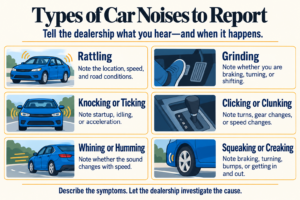
Types of Car Noises to Report to the Dealership
Different conditions can produce similar sounds. These examples describe complaints to report; they are not diagnoses of a particular mechanical failure.
| Type of noise | Details worth documenting |
|---|---|
| Rattling | Where it seems to originate and whether it occurs over bumps, at highway speeds, or while idling. |
| Grinding | Whether it happens when braking, turning, starting the vehicle, or changing gears. |
| Knocking or ticking | Whether it occurs at startup, during acceleration, or while stationary, and whether its frequency changes. |
| Clicking or clunking | Whether it happens during turns, gear changes, or changes in speed. |
| Whining or humming | Whether it changes with vehicle speed or occurs under particular operating conditions. |
| Squeaking or creaking | Whether it happens when braking, turning, driving over uneven surfaces, or entering and exiting the vehicle. |
A sound that is normal for one vehicle may warrant investigation in another. Give the authorized dealership an opportunity to inspect the vehicle and explain its findings rather than relying on an online diagnosis.
Does the noise happen only under certain conditions?
Explain those conditions when scheduling your appointment. A sound that occurs after a longer drive may not appear during a brief test around the dealership.
For example, you might report that the noise happens:
- During the first few minutes after startup.
- After the vehicle has been driven for approximately 30 minutes.
- At a particular speed.
- During low-speed turns.
- When braking downhill.
- On uneven roads.
These details can help the dealership plan its evaluation and create a more accurate record of the complaint.
When Can a Car Making Noise Support a California Lemon Law Claim?
A noise complaint becomes a potential lemon law concern when the evidence supports a qualifying defect and substantial impairment—not simply because the sound is unfamiliar or unpleasant.
The problem must fall within applicable warranty coverage
For the manufacturer buyback claim discussed here, the applicable manufacturer’s warranty is a central consideration.
Keep the warranty booklet and records showing when you first presented the concern for repair. Do not assume that every noise is covered or that a separately purchased service contract provides the same rights as the manufacturer’s new-vehicle warranty.
The defect must substantially affect use, value, or safety
California’s legal standard addresses substantial impairment of the vehicle’s use, value, or safety. A defect does not have to affect all three.
The analysis may consider the nature of the defect, repair time and cost, whether earlier repairs worked, and the extent to which the vehicle could be used while awaiting repair.
When reviewing a recurring noise complaint, an attorney may ask:
- Does the problem interfere with normal driving or another vehicle function?
- Does it accompany vibration, hesitation, or another operating issue?
- What did the dealership find?
- What adjustments, updates, or parts replacements were performed?
- Did the same symptom return afterward?
- How much time has the vehicle been unavailable?
- How has the problem affected your actual use of the vehicle?
A vehicle does not necessarily have to become undrivable to warrant review. However, a minor or insignificant annoyance does not automatically satisfy the legal standard.
The manufacturer must receive reasonable repair opportunities
The repair history should show what opportunities the manufacturer or its authorized repair facility received to investigate and address the concern.
A record of repeated visits is relevant, but the number of appointments alone does not determine eligibility. The reason for each visit, the complaints reported, and the work performed all help explain the history.
What If the Dealership Says the Noise Is Normal?
Hearing “that is normal” can be frustrating when you continue to notice the sound or experience other symptoms.
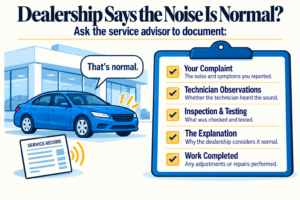
Ask the service advisor to document:
- The complaint you reported.
- Whether the technician heard the sound.
- What inspection or testing was performed.
- Why the dealership considers it normal.
- Whether any adjustment or repair was completed.
If the sound becomes louder, occurs more frequently, or appears with a new symptom, report that change accurately.
You can also ask the dealership to explain its conclusion in plain language. For example, what operating condition produces the sound, and what testing supported the explanation?
The dealership’s position is part of the evidence. A “normal operating characteristic” notation does not, by itself, resolve every question about whether a covered defect exists.
What If the Dealership Cannot Duplicate the Noise?
An intermittent problem may not happen during a service appointment. Your vehicle might make the sound several times during the week and then remain quiet during the technician’s test drive.
“Could not duplicate” does not automatically eliminate a potential lemon law claim.
California’s civil jury instructions explain that presenting a vehicle to the manufacturer or its authorized repair facility for repair can count as a repair opportunity even when no repair work is performed. The circumstances surrounding each visit still matter.
If the noise continues:
- Report it again and reference the earlier appointment.
- Explain the conditions in which it usually happens.
- Provide existing recordings obtained safely.
- Ask that the recurring complaint appear on the new work order.
- Keep both the initial work order and the final repair invoice.
Ask whether the dealership can arrange an appropriate technician ride-along or another safe way to evaluate the complaint. Do not deliberately recreate a dangerous condition to prove that the sound exists.
Car Making Noise After Multiple Repairs? Understanding Repair Counts
There is no single dealership-visit count that decides every California lemon law case.
California has a rebuttable presumption concerning reasonable repair opportunities when specified events occur within the first 18 months after delivery or 18,000 miles, whichever comes first:
- Two or more repair attempts for the same defect that creates a condition likely to cause death or serious bodily injury if the vehicle is driven.
- Four or more repair attempts for the same substantially impairing defect.
- More than 30 cumulative calendar days out of service for repairs of substantially impairing defects.
These thresholds do not automatically establish a right to compensation. Consumers may also establish reasonable repair opportunities without satisfying the presumption.
Additional conditions apply. Direct manufacturer notice may be required. Initially using a qualified dispute-resolution program may also be necessary before asserting the presumption. The 30-day threshold may be extended when repairs cannot be performed because of conditions beyond the manufacturer’s or its agents’ control.
You do not have to wait until the fourth appointment or the 31st day to contact an attorney for a review. Those numbers should not replace an assessment of your specific situation.
How to Organize Your Vehicle’s Noise and Repair History
A simple timeline can make your records easier to understand. It does not need to use technical language.
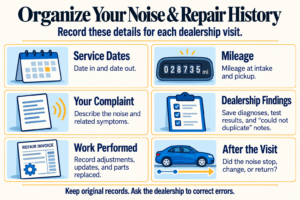
For each service visit, record:
| Information | What to include |
|---|---|
| Service dates | When the dealership received the vehicle and when it was released. |
| Mileage | The mileage recorded at intake and pickup. |
| Complaint | Your description of the sound and related symptoms. |
| Dealership findings | Any diagnosis, testing results, or “could not duplicate” notation. |
| Work performed | Adjustments, software updates, parts replacements, or other work listed on the invoice. |
| What happened afterward | Whether the sound stopped, changed, or returned. |
Keep the original documents along with your timeline. Your notes should supplement the dealership records, not replace them.
If you notice an error, ask the dealership to correct or clarify it. For example, if you reported grinding while braking but the paperwork mentions only a routine inspection, request an accurate description of the concern you presented.
What Documents Should You Keep?
Work orders and final repair invoices
Save paperwork for every relevant appointment, including visits when the dealership found no problem or performed no repair.
Recordings and photographs
Preserve existing dashcam footage, photographs of warning messages, and recordings made safely. Do not handle your phone while driving.
Dealership and manufacturer communications
Keep emails, texts, appointment confirmations, and manufacturer case numbers. Note any promised follow-up.
Purchase, lease, and warranty documents
These help establish the transaction details, vehicle information, and applicable coverage.
Related expense records
Keep relevant towing, rental, and transportation receipts. An attorney can review whether particular expenses may be recoverable; retaining a receipt does not guarantee reimbursement.
If the sound occurs with reduced braking, difficulty steering, smoke, or another immediate safety concern, prioritize safety. Stop driving when safe and arrange appropriate assistance.
Frequently Asked Questions About Car Noise and California Lemon Law
Can a rattling noise qualify my car for California Lemon Law?
Potentially. The relevant questions include whether the rattle reflects a warranty-covered defect, whether it substantially impairs use, value, or safety, and what repair opportunities were provided.
A minor trim rattle and a persistent problem that materially interferes with normal vehicle use may present different circumstances. Neither the word “rattle” nor the number of times you mention it determines eligibility on its own.
Does the noise have to affect safety?
No. The standard includes substantial impairment of use, value, or safety. A qualifying defect may materially affect use or value without creating an immediate danger.
However, frustration or dislike of a sound alone does not automatically establish substantial impairment. The assessment considers what a reasonable person would conclude in the buyer’s circumstances.
Can I have a claim without a warning light or diagnostic code?
The general lemon law standard does not list a warning light or diagnostic code as a separate requirement.
Their absence does not automatically rule out a qualifying defect. Repair records, testimony, recordings, inspections, and other evidence may be relevant. Similarly, a warning light or code alone does not establish every element of a claim.
You should not assume that you need a specific parts diagnosis before requesting a legal review.
Does every dealership appointment count as a repair attempt?
No. An unrelated oil change or maintenance visit does not automatically become a repair opportunity for your noise complaint.
The question is whether the vehicle was presented to the manufacturer or an authorized repair facility to address the concern. The records should identify the complaint and the opportunity provided to investigate it. Completed repair work is not always necessary.
What if the dealership replaced a part, but the noise returned?
Keep the invoice identifying the work performed and record when the sound returned.
Report whether it sounds the same, occurs under the same conditions, or comes with additional symptoms. Avoid assuming that the same sound necessarily proves the same component failed again.
A replacement part does not automatically establish a lemon law claim. It helps document what was attempted and whether your reported concern was resolved.
What if the noise happens only occasionally?
An intermittent complaint can still warrant investigation. Document frequency, conditions, and any related symptoms as accurately as possible.
For example, explain whether it happens once a week, during longer drives, or only when the vehicle is first started. Existing recordings obtained safely may help illustrate the complaint.
Occasional symptoms do not automatically establish or defeat a claim. Their significance and the supporting evidence require review.
What if my vehicle makes several different noises?
Document each concern separately, including when it started and which appointments addressed it.
Different noises do not automatically count as repeated repair attempts for the same defect. An attorney can review the individual complaints, the work performed, and the overall repair history.
A clear timeline helps distinguish a recurring problem from separate issues.
Does being at the dealership for 30 days automatically make my vehicle a lemon?
No. The statutory presumption uses more than 30 cumulative calendar days, and those days must involve repairs of qualifying defects within the applicable presumption window.
Other conditions and exceptions can affect the analysis, and the manufacturer may rebut the presumption. Simply counting every day the vehicle was physically at the dealership can be misleading if some days concerned unrelated work or other circumstances.
Is it too late if my car has more than 18,000 miles?
Not necessarily. The 18-month or 18,000-mile window concerns the statutory presumption; it is not a universal cutoff for every lemon law claim. Reasonable repair opportunities may be established through other evidence.
Applicable filing deadlines require separate review. Your delivery date, warranty, repair history, and the procedures governing your claim may matter. Do not assume that your claim has expired—or that you can wait indefinitely—based only on mileage.
What if my warranty expires after I reported the noise?
Do not assume that warranty expiration automatically resolves the question of whether you have a claim.
Preserve records showing when the concern was first presented, what coverage applied, and what happened afterward. Warranty terms, repair dates, applicable deadlines, and other circumstances require individual review.
Contacting an attorney promptly can help you understand the issues without relying on a general rule about warranty expiration.
Should I contact the manufacturer before speaking with an attorney?
You can speak with an attorney before submitting a buyback request.
Separate manufacturer-notice requirements may apply depending on your claim and the governing procedures. California allows manufacturers to elect into newer lemon law procedures, so the same process should not be assumed for every vehicle.
An ordinary dealership service complaint should not automatically be treated as satisfying every formal manufacturer-notice requirement.
Can I get a buyback or keep my vehicle and receive compensation?
Depending on the facts and negotiations, our office may pursue a manufacturer buyback or a cash-and-keep settlement.
A buyback involves returning the vehicle. A cash-and-keep settlement allows you to retain it under negotiated terms. Neither outcome is guaranteed. Cash-and-keep compensation is a negotiated result, not an automatic entitlement because a vehicle makes noise.
We can discuss your goals after reviewing the vehicle information and repair history.
What should I send a California lemon law attorney?
Start with your purchase or lease agreement and all relevant work orders and repair invoices.
It is also helpful to provide the vehicle’s year, make, model, current mileage, warranty information, manufacturer communications, and safely obtained recordings.
You do not need to create a perfect case summary before reaching out. Organized documents and a brief explanation of the recurring concern give the office a useful starting point.
Car Making Noise After Repairs? Contact Cha Cha Cha Law
Repeated service visits can leave you wondering how much longer you should keep bringing your vehicle back for the same concern. You may have already spent hours explaining the sound, arranging rides, and waiting for a repair that did not resolve the problem.
Cha Cha Cha Law is a California lemon law firm serving drivers in Los Angeles and throughout Southern California. We review vehicle information, warranty documents, and repair histories to assess whether ongoing problems may support a claim.
If your vehicle keeps making unusual noises after dealership visits, contact our office to discuss the next step. We can explain what documents to provide and review your potential options based on your circumstances.
Contact Cha Cha Cha Law at (213) 351-3513 or submit a website inquiry to have your vehicle’s recurring noise and repair history reviewed.
This article provides general information, not legal advice. Contacting our office does not establish an attorney-client relationship. Eligibility, deadlines, and available remedies depend on the facts and applicable law.