




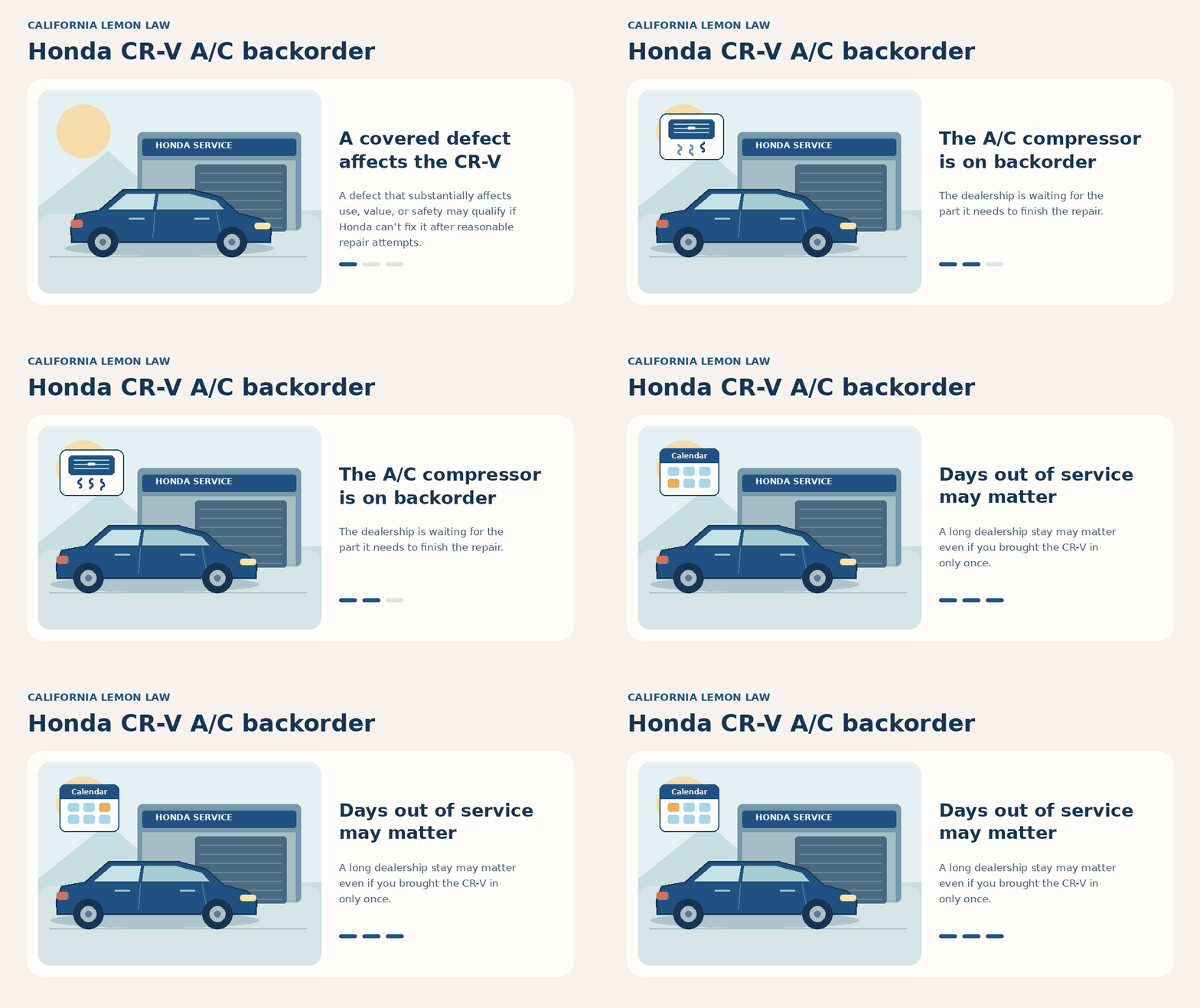
You may have a Honda CR-V lemon law claim in California if a covered defect substantially affects your SUV’s use, value, or safety and Honda can’t fix it after a reasonable number of attempts. If your CR-V is at the dealership waiting for a backordered A/C compressor, the time it spends out of service may matter, even if you’ve brought it in only once.

How does the Honda CR-V lemon law work in California?
If you bought or leased an eligible new CR-V, California’s Song-Beverly Consumer Warranty Act can require Honda to buy back or replace it when a substantial defect covered by the written warranty remains after a reasonable number of repair opportunities. California’s lemon law presumption can help establish that Honda had enough opportunities to repair the vehicle.
Within the first 18 months after delivery or 18,000 miles on the odometer, whichever comes first, the presumption may apply if any of these thresholds is met.
| Repair history | California presumption threshold |
|---|---|
| Same defect likely to cause death or serious bodily injury if the vehicle is driven | Two or more repair attempts |
| Same other qualifying defect | Four or more repair attempts |
| Time out of service for qualifying warranty repairs | More than 30 calendar days total, subject to an extension for qualifying delays |
For the two- and four-attempt thresholds, you may also need to notify Honda directly if Honda properly disclosed that requirement in the warranty or owner’s manual. Claims outside the presumption can still be evaluated under the general reasonable-repair standard.
Does a backordered Honda CR-V A/C compressor count toward lemon law?
Days spent waiting for a part may count if the CR-V is out of service for a qualifying repair. The days can add up across multiple visits. California law extends the presumption’s 30-day threshold if repairs cannot be performed because of conditions beyond Honda’s or its agents’ control. Whether a compressor backorder qualifies for that extension depends on what caused the delay. Keep the initial part estimate, any revised delivery dates, and any written explanation for the delay.
How to track a backorder from the first service visit
Start with the date you delivered the vehicle and the mileage the dealer recorded when it arrived. Then note when the technician diagnosed the problem, when the repair was approved under warranty, and when the dealer ordered the replacement part. If the original estimate changes, record both the original and revised dates. A timeline that distinguishes diagnosis, warranty approval, parts ordering, and pickup helps explain where the delay occurred.
For example, suppose a CR-V arrives on June 3 because the air conditioning stops cooling. The dealership confirms the compressor failure on June 6 and says the replacement will arrive June 20. On June 19, the service advisor moves the estimate to July 12. The owner receives a loaner and the CR-V remains at the dealership. The repair order and the advisor’s messages show why the SUV was there during that period. If the dealer also asks the owner to retrieve the CR-V before the compressor arrives, the date and terms of that request become part of the same timeline. These dates are illustrative.
California also has a separate warranty repair rule under Civil Code section 1793.2(b). It generally calls for covered repairs to start within a reasonable time and be completed within 30 days, subject to the buyer’s written agreement otherwise and an extension for conditions beyond the manufacturer’s or its representatives’ control. The 30-day repair deadline and the more-than-30-days-out-of-service presumption serve different purposes. A repair timeline can help assess both.
What if the Honda dealer tells you to pick up your CR-V before it’s repaired?
Ask the service advisor to confirm in writing whether the repair is complete, why the dealership is asking you to pick up the car, and whether the dealer considers it safe to drive. If the CR-V stays at the dealership, keep a record of the date the dealer asked you to pick it up, whether the repair order stayed open, and why the vehicle remained there.
A pickup request can lead to a dispute over which days count. The repair records can help establish whether the car remained out of service because of the unresolved defect or whether the dealer had made it available for use while waiting for the part. If the dealer closes the repair order and asks you to return later, request a copy showing the original complaint, the diagnosis, and the repair still pending.
What Honda CR-V problems should you document?
An A/C failure that leaves the cabin without cooling, a recurring warning light, a loss of power, or a steering problem can each be worth documenting. The details that matter are what happened to your specific vehicle, how the problem affects you, what your warranty covers, and what the dealership did in response.
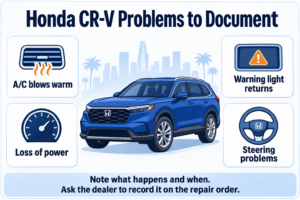
Describe the symptom and when it happens. For example, “The A/C blows warm air after about 15 minutes of driving, even with the temperature set to low.” If it happens only on hot afternoons or at highway speeds, say so. Ask the dealer to record your complaint on the repair order even if the technician could not reproduce it. For safety recalls, check your CR-V’s vehicle identification number (VIN) through Honda’s official recall lookup.
What makes a repair order useful?
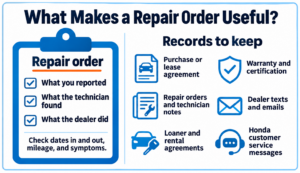
A repair order should tell a reader what you reported, what the technician found, and what the dealership did. Save the paperwork from drop-off and pickup, including orders that show a zero-dollar charge. Check that the dates, mileage, and description of your concern are accurate. When the problem comes and goes, ask the service advisor to note the circumstances in which you experienced it.
| Document | What it can help show |
|---|---|
| Purchase or lease agreement | The transaction date, vehicle, and terms of the purchase or lease |
| Warranty booklet and certification paperwork | The warranty provider, coverage terms, and any warranty issued with the sale |
| Repair orders and technician notes | What you reported, when you brought it in, and what the dealer did |
| Texts and emails from the dealer | Parts estimates, changes in timing, pickup requests, and whether repairs were still pending |
| Loaner and rental agreements | The dates you had substitute transportation and any expenses you paid |
| Honda customer service correspondence | When you contacted Honda and how it responded |
Keep the original documents even if you make a spreadsheet or a handwritten list. When you summarize each visit, note the date in, date out, mileage, symptom, and result. If the dealer prints a closing date that differs from the date you actually picked up the vehicle, record both dates and save any message confirming when the dealer said the car was ready. That distinction can matter when the repair timeline is disputed.
How can you show that an A/C problem affects use or value?
Describe how often the failure occurs and what it changes about using the vehicle. In Los Angeles, for example, an A/C failure may become apparent on a hot afternoon after the SUV has been parked outside. Write down when cooling stops, how long the symptom lasts, and whether it happens again after the vehicle restarts. If the dealer confirms a failed component, keep that diagnosis with your notes. California’s legal standard looks at whether the covered defect substantially impairs use, value, or safety in the circumstances. The severity and frequency of the symptom are more informative than a general complaint that the air conditioning works poorly.
Does the Honda CR-V lemon law apply to certified pre-owned vehicles?
The warranty that came with your purchase matters. In Rodriguez v. FCA US, LLC, the California Supreme Court held that a used vehicle sold with only the remaining balance of its original factory warranty does not qualify as a new motor vehicle for the law’s new-vehicle refund or replacement provision. HondaTrue Certified vehicles may come with separate Honda-backed limited warranty coverage. Whether that coverage supports a claim, and which remedies are available, depends on the warranty and the facts of the sale. If you bought a certified pre-owned CR-V, bring the purchase contract and certification warranty paperwork so an attorney can review what warranty was issued with the sale, what it covers, and what remedies may be available.
Which warranty papers should a used CR-V buyer check?
Look for the date the vehicle was originally put into service, your purchase date and odometer reading, and the name of the company that issued any warranty at your sale. Find the terms for non-powertrain components if the concern is an A/C compressor. Ask the dealer to identify the specific warranty it used to approve the repair. The answer may help distinguish coverage remaining from the original sale, a manufacturer-backed certified pre-owned warranty, a dealer warranty, and a separate service contract.
Keep the paperwork from the day you bought the vehicle, including the certification documents and any warranty disclosure. If all you have is a listing that described the SUV as certified, ask for a copy of the actual warranty. A repair authorization shows how the dealer handled a repair request. The purchase and warranty documents answer the separate question of what coverage came with the sale.
Frequently asked questions
Can one long repair visit be enough?
One visit can matter if an eligible vehicle spends more than 30 qualifying calendar days out of service during the presumption period. Whether those days count depends on the warranty, the reason the vehicle was out of service, and any applicable extension for delays outside the manufacturer’s or its agents’ control.
Does a loaner or rental car affect my claim?
A loaner gives you transportation while your CR-V is at the dealership. The out-of-service question concerns your CR-V and why it was unavailable. Keep the loaner or rental agreement along with your repair orders so you can document the dates.
What compensation could I receive?
For an eligible vehicle, California law can require the manufacturer to repurchase or replace it if the manufacturer or its representatives cannot fix a qualifying defect after a reasonable number of attempts. A repurchase may include a deduction based on the mileage driven before the vehicle was first brought in for the problem. A negotiated cash-and-keep settlement is another possible outcome if both sides agree.
What if the dealership says it could not duplicate the problem?
Ask the advisor to include your exact complaint and any conditions that help reproduce it. For an intermittent A/C failure, useful details include the approximate outside temperature, how long the vehicle was running, and whether the fan kept blowing after the air turned warm. If you have a photo or video taken while the vehicle was parked that shows the settings or a dashboard warning, share it with the service department. Save the repair order and note whether the problem happened again after pickup.
Does a recall mean my Honda CR-V qualifies?
A recall can help you identify a repair campaign for your vehicle. Use your VIN to check whether your CR-V is affected and save any paperwork if the dealer performs the recall repair. Eligibility for a buyback depends on your vehicle’s warranty, defect, and repair history. If the same problem continues after a recall repair, report what you are still experiencing and ask the dealer to document it.
What if Honda fixes the compressor after a long wait?
Save the final repair order showing what was replaced, when the repair was finished, and when the dealership returned the vehicle. That paperwork can help establish the total time the CR-V was out of service and whether the symptom persisted afterward. The completed repair, earlier delays, warranty terms, and prior repair history all matter when evaluating what options are available. If the problem returns, note the date, mileage, and driving conditions and report it to the authorized service department.
What to bring to a Honda CR-V lemon law consultation
Start with the purchase or lease agreement and the repair orders for the problem. If you have several visits, bring each service record, including visits where the advisor said the technician could not reproduce the symptom. Put the paperwork in date order if possible. Include a short note explaining when you first noticed the issue, whether you still have the vehicle, and where it is now.
For a parts backorder, bring any written warranty approval, the dealership’s part estimates, and any message asking you to pick up the vehicle. If you accepted a loaner or paid for a rental, include those agreements and receipts. For a certified pre-owned CR-V, bring the warranty booklet and certification paperwork you received when you bought it. These details help connect the repair delay to the warranty and the vehicle’s actual time out of service.
Talk to a Los Angeles Honda CR-V lemon law attorney
If your Honda CR-V keeps going back to the dealership or is still waiting for a part, the Los Angeles-based Cha Cha Cha Law can review your repair history and warranty paperwork. Have your purchase or lease agreement, repair orders, and any texts or emails about the backorder or pickup request ready for the consultation.
Book a Free Consultation or call (213) 351-3513. Assistance is available in English, Korean, and Spanish.
This article provides general information, not legal advice. Eligibility and available remedies depend on the vehicle, warranty, repair history, and applicable law.