





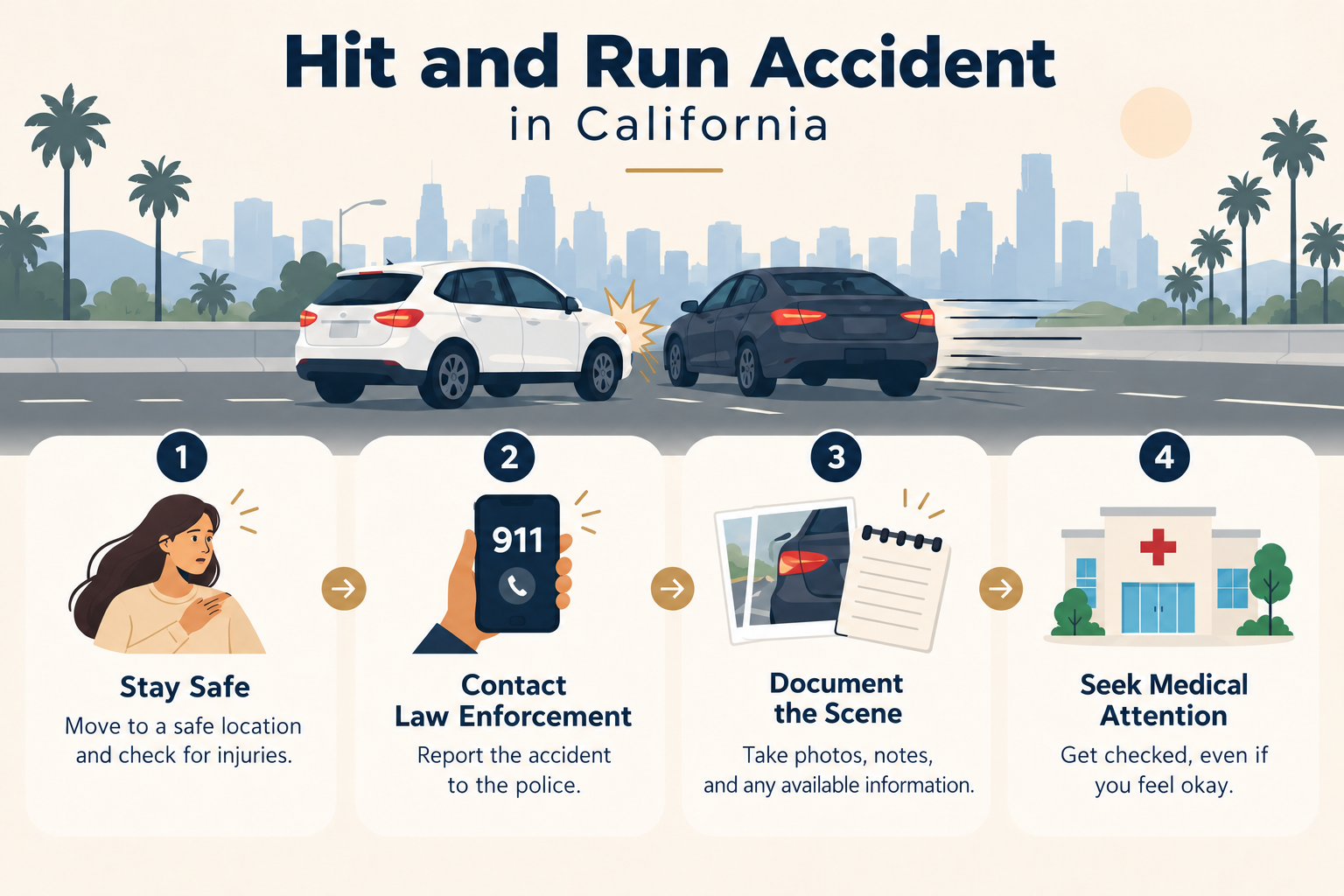
Being involved in a hit and run accident in California can be overwhelming, especially when the other driver leaves the scene before you have a chance to exchange information. You may be left wondering what to do next, how to report the accident, and who will pay for your medical bills or vehicle repairs. Whether you suffered injuries or property damage, knowing what steps to take after a hit and run accident can help protect your rights and preserve important evidence for a potential insurance or personal injury claim.
If you are involved in a hit and run accident, prioritize your safety, contact law enforcement, seek medical attention if needed, and document the scene. Even if the driver who caused the collision is never identified, you may still have insurance options depending on the circumstances and your coverage.
Below, we explain what California drivers should know about hit and run accidents, including reporting requirements, insurance coverage, and potential legal options.
How Common Are Hit and Run Accidents in California?
Hit and run accidents remain a serious traffic safety concern in California and across the United States.
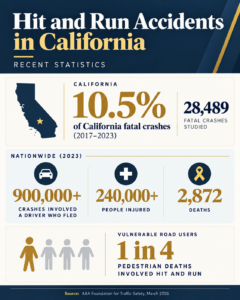
According to research published by the AAA Foundation for Traffic Safety in March 2026, approximately 10.5% of California’s 28,489 fatal traffic crashes between 2017 and 2023 involved a hit and run driver.
The research also examined nationwide collision data. In 2023:
- More than 900,000 police-reported crashes involved a driver who left the scene, accounting for approximately 15% of all police-reported traffic crashes.
- More than 240,000 people were injured in hit and run crashes, representing approximately 10% of traffic crash injuries.
- 2,872 people died in hit and run crashes, accounting for approximately 7% of traffic fatalities.
Pedestrians and bicyclists are particularly vulnerable. AAA also reported that approximately one in four pedestrians killed in traffic crashes in 2023 was struck in a hit and run collision.
These findings highlight why knowing what to do after a hit and run accident is important. When another driver leaves the scene, identifying the vehicle, preserving evidence, and reporting the collision promptly can become especially valuable.
What Is Considered a Hit and Run Accident in California?
A hit and run accident generally occurs when a driver involved in a collision leaves the scene without fulfilling their legal responsibilities.
Under California law, drivers involved in accidents are required to stop and comply with certain duties, including providing identifying information and, when applicable, rendering reasonable assistance.
California Vehicle Code Section 20001 addresses accidents involving injury or death, while Section 20002 addresses accidents involving property damage only.
Common examples of hit and run accidents include:
- A driver rear-ends another vehicle and leaves without stopping.
- A motorist strikes a pedestrian or bicyclist and drives away.
- A driver hits a parked vehicle without providing the required information.
- A motorist involved in a collision leaves before fulfilling their legal duties.
Leaving the scene of an accident unlawfully can result in criminal consequences. However, whether a driver violated California’s hit and run laws and whether that driver was legally responsible for causing the accident are separate questions.
For injured accident victims, understanding what to do next can be especially important.
1. What to Do Immediately After a Hit and Run Accident
When another driver hits your vehicle and speeds away, your first instinct may be to follow them to obtain their license plate number or identify who was driving.
However, chasing a fleeing driver can create additional risks, especially if you are injured or your vehicle has sustained damage.
Your safety should always come first.
If possible, move your vehicle to a safe location away from moving traffic. If someone is injured or there is an immediate danger, call 911 and request emergency assistance.
Do not attempt to chase, confront, or physically stop the fleeing driver.
Instead, if you can safely observe the vehicle, try to remember as much identifying information as possible, including:
- License plate number or partial license plate number
- Vehicle make and model
- Vehicle color
- Approximate size or body type
- Visible damage or distinguishing features
- Direction the vehicle was traveling
Even a partial license plate number or basic vehicle description may help law enforcement investigate the accident.
If you have a passenger, they may be able to safely photograph or record the fleeing vehicle while you focus on driving.
Never risk another collision to obtain evidence.
2. How to Report a Hit and Run Accident in California
Reporting a hit and run accident to law enforcement is one of the most important steps after the collision.
If anyone is injured or emergency assistance is needed, call 911. For a non-emergency collision, contact the appropriate local law enforcement agency to determine how to make a report.
When speaking with law enforcement, provide as much information as possible, including:
- Date, time, and location of the accident
- Description of the fleeing vehicle
- Direction the vehicle traveled
- Details about how the collision occurred
- Whether anyone was injured
- Witness information
- Available photographs or video footage
Ask for the police report or incident number and information about how to obtain a copy of the report.
A police report does not automatically determine who was at fault. However, it may help document the accident and provide information relevant to an insurance investigation.
Why Is Reporting a Hit and Run Accident Quickly So Important?
California has specific requirements that may affect your ability to pursue uninsured motorist benefits when the other driver cannot be identified.
Under California Insurance Code Section 11580.2(b), statutory uninsured motorist bodily injury coverage involving an unidentified driver generally requires:
- Physical contact between the unidentified vehicle and the injured insured or a vehicle occupied by the insured.
- Reporting the accident within 24 hours to the police department of the city where it occurred or, for accidents in unincorporated areas, to the appropriate county sheriff or local California Highway Patrol headquarters.
- Filing a statement under oath with the insurer within 30 days after that report, explaining the basis for a claim against the unidentified driver.
These requirements are specific to certain uninsured motorist bodily injury claims involving unidentified drivers. They should not be confused with the reporting requirements for every type of auto insurance claim.
Your insurance policy may also contain separate notice and cooperation requirements.
3. Collect Evidence After a Hit and Run Accident
When the other driver leaves without providing contact or insurance information, evidence may become particularly important.
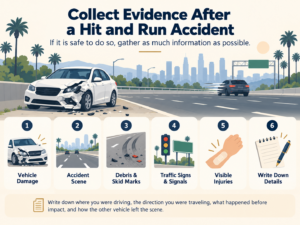
If it is safe to do so, take photographs or videos of:
- Damage to your vehicle
- The accident scene and surrounding roadway
- Vehicle debris left behind
- Skid marks or other roadway evidence
- Traffic signs, signals, and lane markings
- Any visible injuries
You should also write down what you remember about the collision while the details are still fresh.
Include where you were driving, the direction you were traveling, what happened immediately before the impact, and how the other vehicle left the scene.
Check for Dashcam and Surveillance Footage
Video footage may help establish how the collision occurred or identify the fleeing driver.
Possible sources include:
- Your vehicle’s dashcam
- Nearby businesses with security cameras
- Residential security cameras
- Parking garages
- Witnesses who recorded the incident
If your vehicle has a dashcam, save the original recording promptly. Some systems automatically overwrite older recordings.
If you notice security cameras near the accident scene, inform law enforcement or your attorney as soon as possible.
Surveillance footage may only be stored for a limited period before being deleted or overwritten.
An attorney may be able to assist with requesting that potentially relevant evidence be preserved.
4. Seek Medical Attention After a Hit and Run Accident
After a hit and run accident, it can be easy to focus on the fleeing driver, damage to your vehicle, or how to contact law enforcement.
However, your physical health should remain a priority.
Some injuries may not become fully noticeable immediately after a collision.
For example, neck pain, back discomfort, or headaches may develop or become more noticeable in the hours or days following an accident.
Symptoms that may occur after a collision include:
- Neck pain or stiffness
- Back and shoulder pain
- Headaches
- Dizziness
- Bruising or swelling
- Numbness or tingling
- Difficulty moving certain parts of the body
Seek emergency medical attention for serious or potentially life-threatening symptoms. For other new, persistent, or worsening symptoms, obtain an appropriate medical evaluation.
Medical records may help document when your symptoms began, the treatment you received, and how the accident affected your health.
When speaking with healthcare providers, accurately explain what happened and describe the symptoms you are experiencing.
5. Does Insurance Cover a Hit and Run Accident in California?
One of the most common questions after a hit and run accident is whether insurance will cover injuries or vehicle damage when the other driver cannot be found.
The answer depends on your insurance policy, the circumstances of the collision, and whether the other driver can be identified.
Several types of auto insurance coverage may be relevant.
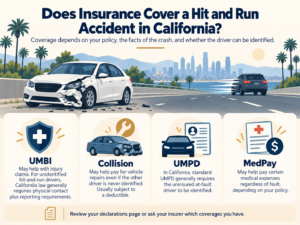
Uninsured Motorist Bodily Injury Coverage (UMBI)
Uninsured motorist bodily injury coverage may help compensate injured individuals when an at-fault driver does not have applicable liability insurance.
In California, certain accidents involving unidentified hit and run drivers may also qualify for uninsured motorist bodily injury coverage.
However, specific statutory requirements apply.
Under California Insurance Code Section 11580.2, statutory coverage involving an unidentified driver generally requires physical contact between the unidentified vehicle and the injured insured or a vehicle occupied by the insured.
The law also includes specific police reporting and sworn-statement requirements.
For example, if another driver rear-ends your vehicle and leaves the scene, uninsured motorist bodily injury coverage may be available if you purchased the applicable coverage and satisfy the relevant requirements.
However, if an unidentified driver causes you to swerve off the road without making physical contact, statutory uninsured motorist hit and run coverage may not apply.
Coverage depends on the circumstances, applicable law, and your policy.
Collision Coverage
Collision coverage may help pay for damage to your vehicle following a covered hit and run accident, even if the other driver is never identified.
This coverage is generally optional and typically subject to a deductible.
For example, if your parked vehicle is struck by an unidentified driver, collision coverage may help pay for repairs according to your policy’s terms.
Coverage limits, deductibles, and exclusions may apply.
Uninsured Motorist Property Damage Coverage (UMPD)
Uninsured motorist property damage coverage is different from uninsured motorist bodily injury coverage.
In California, standard UMPD coverage generally requires the uninsured at-fault driver to be identified.
This means UMPD typically will not cover vehicle damage caused by a completely unidentified hit and run driver.
If the driver cannot be identified, collision coverage may be a more relevant option for vehicle repairs.
Medical Payments Coverage (MedPay)
Medical Payments coverage may help pay certain medical expenses following a covered auto accident, regardless of who caused the collision.
The availability of benefits depends on your policy, coverage limits, and applicable conditions.
If you are unsure which coverages you purchased, review your insurance declarations page or contact your insurer.
6. Can You Get Compensation if the Hit and Run Driver Is Never Found?
It may still be possible to recover compensation after a hit and run accident even if the driver responsible is never identified.
However, compensation is not guaranteed.
If you have applicable uninsured motorist bodily injury coverage, you may be able to pursue benefits for covered injury-related losses.
Depending on the circumstances and available coverage, damages may include:
- Past medical expenses
- Reasonably anticipated future medical treatment
- Lost wages
- Reduced earning capacity
- Pain and suffering
- Other legally recoverable injury-related damages
The availability and amount of compensation depend on factors such as liability, the nature of your injuries, policy limits, and compliance with applicable coverage requirements.
If the fleeing driver is later identified, you may also have options to pursue a claim against that driver or an applicable liability insurer.
A California personal injury attorney can help evaluate the accident and identify potential sources of recovery.
7. Do You Have to Report a Hit and Run Accident to the California DMV?
In certain circumstances, California requires drivers to report traffic accidents to the Department of Motor Vehicles.
Under California Vehicle Code Section 16000, drivers generally must submit a Report of Traffic Accident Occurring in California (Form SR-1) within 10 days if:
- Anyone was injured, even if the injury was minor.
- Someone was killed.
- Property damage exceeded $1,000.
This requirement generally applies regardless of who caused the accident, subject to statutory exceptions.
A police report does not replace a required DMV report.
Likewise, notifying your insurance company does not automatically satisfy the DMV’s reporting requirements.
For more information, visit the California DMV accident reporting page.
8. What Happens if the Hit and Run Driver Is Identified?
Even if the other driver initially leaves the scene, law enforcement may later identify that person through surveillance footage, witness statements, license plate information, or other evidence.
If the driver is identified, you may have additional options for pursuing compensation.
Depending on the circumstances, this could include presenting a claim against the driver’s liability insurance or pursuing legal action against a responsible party.
However, identifying the driver does not automatically establish that they caused the accident.
A personal injury claim generally requires evidence establishing legal responsibility, compensable damages, and a connection between the collision and the claimed injuries.
If the driver is uninsured or has insufficient coverage, other insurance options may need to be evaluated.
9. How Long Do You Have to File a Hit and Run Accident Claim in California?
California generally provides two years from the date of injury to file a personal injury lawsuit under Code of Civil Procedure Section 335.1.
However, different deadlines may apply depending on the circumstances and type of claim.
For example, personal injury claims against government entities may require an administrative claim to be presented within six months, subject to applicable exceptions.
Uninsured motorist claims also have separate statutory requirements.
Under California Insurance Code Section 11580.2(i), an insured person generally must take at least one of the following actions within two years of the accident to preserve a statutory uninsured motorist claim:
- File a bodily injury lawsuit against the uninsured motorist in a court with proper jurisdiction.
- Reach an agreement with the insurer concerning the amount due under the policy.
- Formally initiate arbitration by providing the insurer with the required written notice, sent by certified mail with a return receipt requested.
Additional requirements, exceptions, and potential extensions may apply.
Simply reporting an accident to your insurance company or opening a claim does not necessarily satisfy these statutory requirements.
Because applicable deadlines depend on the circumstances, it is important to seek legal guidance promptly rather than assuming every aspect of a hit and run claim has the same two-year deadline.
10. When Should You Contact a California Hit and Run Accident Lawyer?
Hit and run accidents can create additional challenges because the driver responsible may be difficult or impossible to identify.
Injured individuals may also have questions about medical treatment, insurance coverage, vehicle damage, and how to preserve their claims.
A California personal injury attorney may be able to help by:
- Reviewing the circumstances surrounding the collision
- Identifying potential sources of evidence
- Helping preserve dashcam or surveillance footage
- Reviewing police reports and witness statements
- Evaluating available uninsured motorist coverage
- Communicating with insurance companies
- Assessing potential injury-related damages
- Explaining relevant legal deadlines and options
Not every hit and run accident requires legal representation. However, consulting an attorney may be particularly helpful if you suffered injuries, the responsible driver cannot be identified, or an insurance company disputes your claim.
Frequently Asked Questions About Hit and Run Accidents in California
What should I do immediately after a hit and run accident?
Move to a safe location if possible, check for injuries, and contact law enforcement. Do not chase the fleeing driver. Document the accident scene, collect witness information, and preserve available video footage.
Can I file an insurance claim if the hit and run driver is never found?
Yes, depending on your coverage. Uninsured motorist bodily injury coverage, collision coverage, or Medical Payments coverage may provide benefits after a qualifying accident. Specific coverage requirements depend on your policy and California law.
Does uninsured motorist insurance cover a hit and run accident in California?
Uninsured motorist bodily injury coverage may apply to qualifying accidents involving unidentified drivers. California’s statutory provisions generally include physical-contact and specific reporting requirements.
What if I did not get the hit and run driver’s license plate number?
You should still report the collision. Witness statements, dashcam recordings, nearby surveillance footage, and vehicle descriptions may help investigators identify the fleeing driver.
How long do I have to report a hit and run accident in California?
Report the accident to law enforcement promptly. For statutory uninsured motorist bodily injury claims involving unidentified drivers, California law includes a 24-hour law enforcement reporting requirement and a sworn statement to the insurer within 30 days after the report. A separate DMV SR-1 report is generally required within 10 days for qualifying accidents.
Will insurance cover a hit and run if my car was parked?
Possibly. Collision coverage may help pay for vehicle damage caused by an unidentified driver, subject to your policy’s terms and deductible. Standard California uninsured motorist property damage coverage generally requires the uninsured driver to be identified.
What if another driver caused me to crash but never hit my vehicle?
This situation can create additional insurance complications. California’s statutory uninsured motorist bodily injury coverage for unidentified drivers generally requires physical contact. If no contact occurred, coverage under that provision may not apply, although other insurance or legal options may need to be evaluated.
Can I still recover compensation if the hit and run driver is never caught?
Possibly. Applicable uninsured motorist or other insurance coverage may provide benefits even if the responsible driver is never identified. The availability and amount of compensation depend on the accident, injuries, and coverage requirements.
Should I contact a lawyer after a hit and run accident?
Speaking with a California personal injury lawyer may help if you suffered injuries, have questions about uninsured motorist coverage, or are experiencing difficulties with your insurance claim.
Injured in a Hit and Run Accident in California? Contact Cha Cha Cha Law
A hit and run accident can leave you dealing with injuries, unexpected expenses, and unanswered questions about what happens next.
Even if the driver responsible for the collision is never identified, you may still have insurance or legal options depending on the circumstances.
At Cha Cha Cha Law, we help individuals injured in car accidents throughout Los Angeles and California understand their legal options and navigate personal injury claims.
If you or a loved one has been injured in a hit and run accident, our team can review your situation and discuss potential next steps.
Call (213) 351-3513 or submit a website inquiry for a free consultation.
Disclaimer: This article provides general information about California personal injury law and insurance claims. It is not legal advice and does not establish an attorney-client relationship. Legal rights, deadlines, and insurance coverage depend on the facts of each case.