




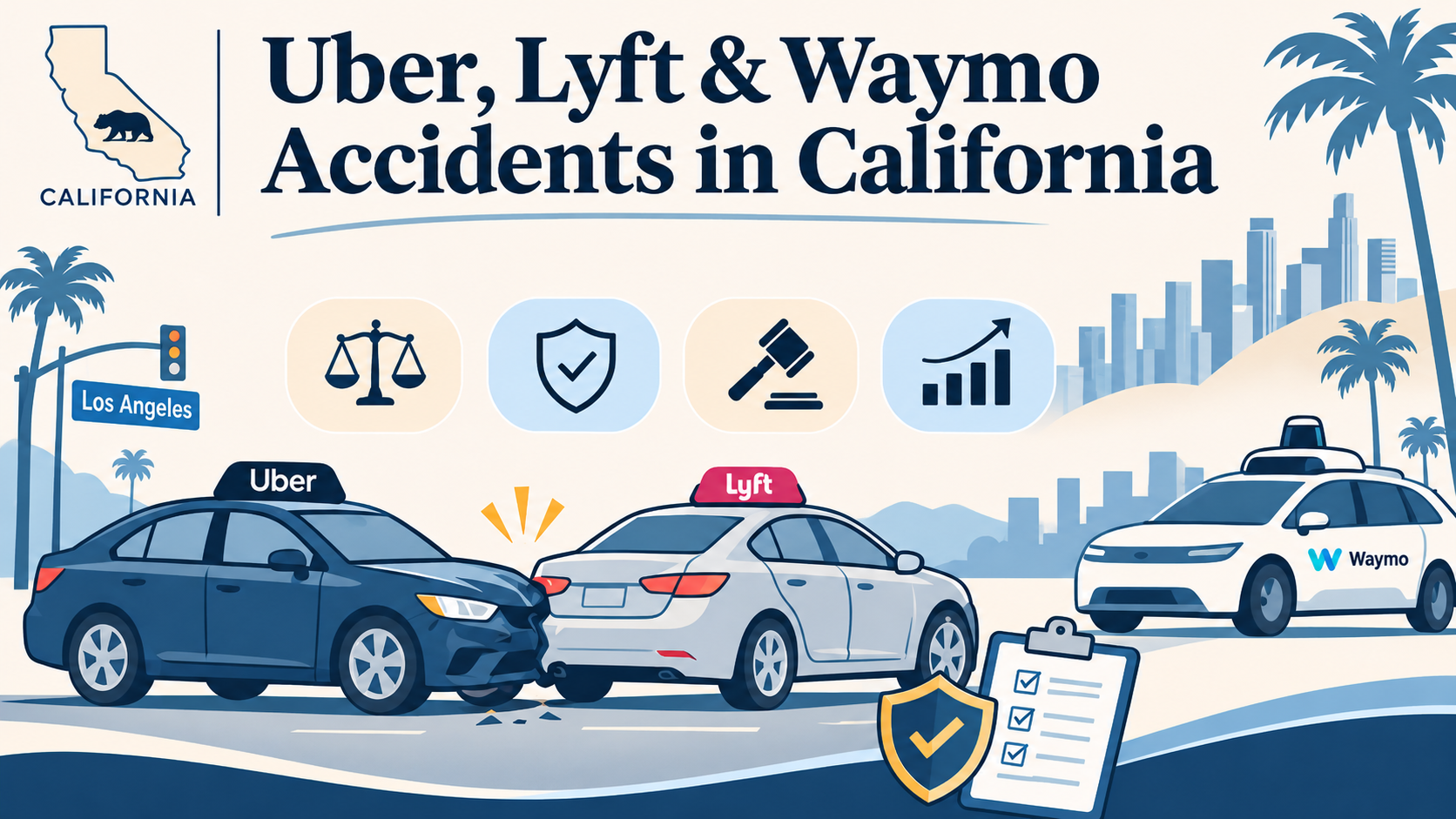
If you were injured in an Uber, Lyft, or Waymo accident in California, an Uber accident lawyer can help you understand your legal rights, determine who may be responsible, and identify applicable insurance coverage. Unlike traditional car accidents, rideshare and self-driving vehicle collisions may involve commercial insurance policies, multiple potentially liable parties, and complex questions about negligence and liability.
With Uber, Lyft, and Waymo operating throughout Los Angeles and California, understanding what happens after a rideshare accident is increasingly important. Whether you were a passenger, rideshare driver, pedestrian, bicyclist, or occupant of another vehicle, you may have the right to seek compensation if another party’s negligence or other legally actionable conduct caused your injuries.
This guide explains the latest available Uber, Lyft, and Waymo accident statistics, California’s updated 2026 rideshare insurance laws, who may be responsible for an accident, and what steps injured individuals can take to protect their rights.
Recent Uber, Lyft, and Waymo Accident Statistics (2026 Update)
Recent safety reports show that crashes involving rideshare and autonomous vehicles continue to occur across the United States, including California.
However, not all transportation companies publish accident statistics for the same years, and not every reported collision is caused by the rideshare driver or autonomous vehicle.
Uber Accident Statistics
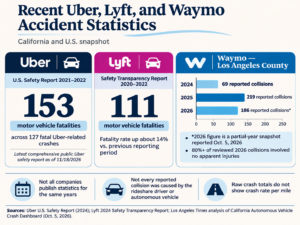
According to Uber’s U.S. Safety Report published in 2024, covering 2021 and 2022:
- 153 motor vehicle fatalities occurred across 127 fatal Uber-related crashes nationwide.
- These figures include fatal crashes connected to the Uber platform, regardless of which involved party was responsible.
- The statistics represent fatal crashes and fatalities, not all accidents or injuries involving Uber.
As of November 18, 2026, the 2021–2022 report remains the latest comprehensive Uber U.S. Safety Report identified in publicly available sources. Uber has indicated that its next report is expected to include updated 2023–2024 data.
These figures should not be interpreted as the number of Uber accidents that occurred in 2026.
Lyft Accident Statistics
Lyft’s 2024 Safety Transparency Report examined incidents occurring from 2020 through 2022.
According to the report:
- 111 motor vehicle fatalities were associated with the Lyft platform during the reporting period.
- The fatality rate per 100 million vehicle miles traveled increased approximately 14% compared with the previous reporting period.
These figures represent nationwide reporting, not California-specific accident totals.
They also do not establish that Lyft drivers were at fault in each fatal incident.
Waymo Accident Statistics in Los Angeles
Waymo’s expanding autonomous vehicle operations have generated considerable attention throughout Southern California.
According to an October 5, 2026, Los Angeles Times analysis of government crash data compiled by the California Autonomous Vehicle Crash Dashboard:
| Year | Reported Waymo Collisions in Los Angeles County |
|---|---|
| 2024 | 69 |
| 2025 | 219 |
| 2026 | 186, as reported October 5, 2026 |
The 2026 figure is a partial-year snapshot published in October, not a final 2026 total.
The same analysis reported that more than 80% of the 2026 collisions reviewed involved no apparent injuries. Many occurred while Waymo vehicles were stopped.
Although the number of reported Waymo collisions increased from 2024 to 2025, the company’s operations and total distance traveled also expanded.
An increase in the raw number of crashes does not necessarily establish an increase in the likelihood of an accident per mile driven.
Are Waymo Self-Driving Cars Safer Than Human Drivers?
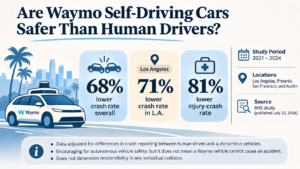
A study published by the Insurance Institute for Highway Safety (IIHS) on July 23, 2026, compared Waymo’s driverless vehicle crash involvement rates with those of human drivers.
Researchers analyzed data from 2021 through 2024 across several cities, including Los Angeles, Phoenix, San Francisco, and Austin.
The study found:
- Waymo’s police-reportable crash involvement rate per mile was 68% lower overall than that of human-driven vehicles in the study.
- In Los Angeles, the corresponding Waymo rate was 71% lower.
- Waymo’s injury-crash involvement rate per mile was 81% lower across the studied locations.
The researchers adjusted the data to account for differences in how human-driven and autonomous vehicle crashes are reported.
These findings are encouraging for autonomous vehicle safety, but they do not establish that a Waymo vehicle cannot cause an accident.
They also do not determine responsibility in any individual collision.
November 2026 Update: Waymo Freeway Operations Suspended
On November 17, 2026, Waymo announced that it had halted its driverless robotaxi operations on U.S. freeways after California regulators barred its vehicles from operating on freeways in the state.
According to Reuters, California’s Department of Motor Vehicles cited incidents involving Waymo vehicles entering active freeway construction zones and determined that the operations presented an imminent public safety hazard.
Waymo stated that it was working with California officials on corrective measures and that its street-level services would continue operating.
This development highlights the continuing regulatory oversight of autonomous vehicles as companies expand their services.
However, the freeway restriction does not mean that Waymo is automatically liable for accidents involving its vehicles.
What Makes Uber, Lyft, and Waymo Accidents Different?
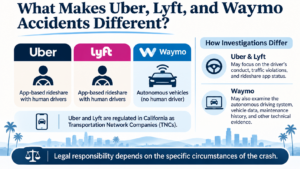
Although all three companies provide app-based transportation, their business models and technology differ.
Uber and Lyft generally connect passengers with human drivers using mobile applications. These services are regulated in California as Transportation Network Companies (TNCs).
Waymo operates autonomous vehicles that can transport passengers without a human driver actively controlling the vehicle.
These differences affect how accidents are investigated.
For Uber and Lyft, an investigation may focus on the driver’s conduct, traffic violations, and rideshare app status.
For Waymo, an investigation may also examine the autonomous driving system’s operation, vehicle data, maintenance history, and other technical evidence.
Regardless of the type of vehicle involved, legal responsibility depends on the specific circumstances of the crash.
When Should You Contact an Uber Accident Lawyer in California?
You may want to contact an Uber accident lawyer in California if you suffered injuries in a collision involving Uber, Lyft, Waymo, or another rideshare service.
Common situations include:
- Being injured while riding as an Uber or Lyft passenger
- Being rear-ended during a rideshare trip
- Being struck by an Uber or Lyft driver
- Being injured while driving for Uber or Lyft
- Being involved in a collision with a Waymo autonomous vehicle
- Being struck by a rideshare vehicle while walking or cycling
- Being injured by an uninsured or underinsured motorist
An attorney can review the circumstances, evaluate liability, identify potentially applicable insurance policies, and discuss available legal options.
Not every accident requires a lawsuit, and not every collision results in a valid personal injury claim. A legal evaluation can help clarify whether there may be grounds for seeking compensation.
Who Is Liable for an Uber or Lyft Accident in California?
Liability for an Uber or Lyft accident generally depends on who caused or contributed to the collision.
Depending on the facts, responsible parties may include the rideshare driver, another motorist, or multiple drivers.
California negligence law generally requires establishing that a party owed a duty of care, breached that duty, and caused legally recognized harm.
When the Uber or Lyft Driver Causes the Accident
Imagine you are riding in an Uber in downtown Los Angeles when the driver becomes distracted and rear-ends another vehicle.
If the driver’s negligence caused the accident, the driver may be legally responsible for your resulting injuries.
Depending on the driver’s rideshare activity, commercial liability insurance may apply.
However, applicable rideshare insurance does not automatically establish that Uber itself is directly liable. Company liability depends on the facts and relevant law.
When Another Driver Causes the Accident
Suppose you are riding in a Lyft when another driver runs a red light and crashes into the vehicle.
The other driver may be responsible for the injuries resulting from the collision.
You may be able to pursue a claim through that driver’s bodily injury liability insurance.
If the driver is uninsured or does not carry sufficient coverage, other potentially applicable insurance may need to be investigated.
What If Both Drivers Share Responsibility?
California follows a pure comparative negligence system.
This means liability may be allocated among multiple responsible parties.
Under the California Supreme Court’s decision in Li v. Yellow Cab Co. (1975), an injured person’s recoverable damages may be reduced according to their own share of fault.
For example, if an injured driver is found 20% responsible for a crash, their recoverable damages may be reduced by 20%.
An innocent rideshare passenger generally would not have their compensation reduced merely because two drivers share fault.
How Does Uber and Lyft Insurance Work in California in 2026?
California law requires rideshare companies and participating drivers to maintain specific insurance coverage based on the driver’s status at the time of the collision.
Under California Public Utilities Code Section 5433, the insurance requirements generally work as follows:
| Rideshare Driver Status | Required Coverage |
|---|---|
| App turned off | Applicable personal auto insurance |
| App on, waiting for a ride request | At least $50,000 per injured person, $100,000 per incident, and $30,000 for property damage, plus $200,000 excess liability coverage |
| Ride accepted, driving to pickup | $1 million in primary liability insurance |
| Passenger inside the vehicle | $1 million in primary liability insurance, plus required passenger-period uninsured/underinsured motorist coverage |
These are statutory coverage requirements, not guaranteed compensation amounts.
Does Uber Have $1 Million in Accident Insurance?
California requires at least $1 million in primary liability insurance from the moment an Uber or Lyft driver accepts a ride request until the transaction is completed or the ride ends, whichever is later.
This requirement can apply even before a passenger enters the rideshare vehicle.
For example, if an Uber driver accepts a ride and causes a collision while traveling to pick up the passenger, the accepted-trip insurance requirement applies.
However, the $1 million figure represents required liability coverage, not an automatic settlement.
Recoverable compensation depends on legal responsibility, the nature of the injuries, available insurance, and other facts.
Important 2026 Change to California Rideshare Insurance
Effective January 1, 2026, California Senate Bill 371 reduced the required uninsured/underinsured motorist (UM/UIM) coverage for rideshare passengers.
Under the updated law, rideshare companies must provide at least:
- $60,000 per person in UM/UIM coverage
- $300,000 per incident in UM/UIM coverage
This coverage applies from the moment a passenger enters the rideshare vehicle until the passenger exits.
The required coverage was previously $1 million during this passenger period.
Uninsured motorist coverage may become relevant when an at-fault driver does not carry liability insurance.
Underinsured motorist coverage may apply when an at-fault driver’s liability insurance is insufficient to compensate qualifying damages, subject to applicable legal and policy requirements.
Importantly, this change does not eliminate California’s separate $1 million primary liability insurance requirement for accepted rides.
How Can an Uber Accident Lawyer Help Injured Passengers?
Passengers may have personal injury claims against drivers or other parties whose negligence caused an accident.
Because rideshare passengers generally do not control the vehicle, their claims often involve determining whether the rideshare driver, another driver, or multiple parties caused the collision.
An Uber accident lawyer can assist by:
- Investigating the cause of the collision
- Obtaining police reports and available evidence
- Identifying potentially responsible parties
- Reviewing applicable insurance coverage
- Evaluating injuries and financial losses
- Communicating with insurance companies
- Pursuing settlement negotiations or litigation when appropriate
What Compensation Can an Injured Uber or Lyft Passenger Recover?
Depending on the circumstances, recoverable damages may include:
- Emergency room expenses
- Hospitalization and medical treatment
- Reasonably necessary future medical expenses
- Physical therapy and rehabilitation
- Lost wages
- Reduced earning capacity
- Physical pain and suffering
- Other legally recoverable losses
The value of a personal injury claim depends on the evidence, the extent of the injuries, and applicable California law.
Example: Uber Passenger Injured in a Rear-End Accident
Imagine a passenger riding in an Uber through Koreatown in Los Angeles.
While stopped at a red light, the Uber is struck from behind by another driver.
After the collision, the passenger develops neck pain, shoulder discomfort, and headaches.
Even if the Uber driver did not cause the accident, the passenger may have a claim against the responsible driver.
Trip records, photographs, witness information, and medical documentation may help establish what happened and the resulting injuries.
This is a hypothetical example, not an actual client case or a guaranteed result.
What If You Are Injured While Driving for Uber or Lyft?
Rideshare drivers may also suffer injuries while working.
For example, an Uber driver may be rear-ended while transporting a passenger or waiting at an intersection.
If another motorist caused the collision, the rideshare driver may have a personal injury claim against that motorist.
However, an injured rideshare driver’s own insurance coverage may differ from the coverage available to passengers and other third parties.
California Business and Professions Code Section 7455 establishes occupational accident insurance requirements for qualifying app-based drivers.
Depending on the circumstances and eligibility requirements, this coverage may provide certain medical expense and disability benefits.
Occupational accident insurance is separate from third-party liability insurance.
Drivers should not assume that a rideshare company’s $1 million primary liability policy automatically compensates them for their own injuries.
Who Is Responsible for a Waymo Self-Driving Car Accident?
Waymo accident claims can involve additional legal considerations because the vehicles operate using autonomous driving technology.
Unlike a traditional Uber or Lyft trip, there may be no human driver inside the Waymo vehicle.
However, the absence of a human driver does not eliminate the possibility of legal liability.
Potentially responsible parties may include the autonomous vehicle operator, another motorist, a vehicle manufacturer or component supplier, or multiple parties.
Can Waymo Be Held Liable for an Accident?
Potentially.
If legally actionable negligence involving autonomous vehicle operations, maintenance, or other conduct contributed to the collision, the responsible operator may face liability.
However, Waymo is not automatically responsible simply because one of its vehicles was involved.
Could a Defective Autonomous Driving System Cause an Accident?
If a defective vehicle component or autonomous driving system caused or contributed to an accident, a product liability claim may be considered.
Such claims require evidence supporting the relevant legal elements, including the defect and its causal relationship to the injuries.
What If Another Driver Hits a Waymo?
Another driver may be responsible if their negligence caused the crash.
For example, if a motorist runs a red light and strikes a lawfully traveling Waymo, the motorist may be legally responsible for the resulting injuries.
The presence of self-driving technology does not automatically establish fault against the autonomous vehicle operator.
Does Waymo Have $5 Million in Insurance?
California’s autonomous vehicle regulatory framework includes a $5 million financial responsibility requirement for qualifying autonomous vehicle operations.
Depending on the applicable permit and regulations, financial responsibility may be demonstrated through insurance, a surety bond, or self-insurance.
This requirement is not the same as a guaranteed $5 million insurance settlement.
The applicable coverage and potential legal recovery depend on the circumstances and governing requirements.
What Evidence Is Important in a Waymo Accident Claim?
Autonomous vehicle collisions may require different types of evidence than traditional car accidents.
Depending on what information exists and is available, relevant evidence may include:
- Vehicle camera recordings
- Autonomous driving system data
- Vehicle speed and braking records
- Sensor and perception-system information
- Maintenance and inspection records
- Relevant software and vehicle operating records
- Traffic camera footage
- Witness statements
- Police reports
- Photographs of the accident scene
Some evidence may be controlled by the autonomous vehicle operator and may require formal legal procedures to obtain.
Preserving available evidence early can be important when investigating the cause of an autonomous vehicle collision.
Can Pedestrians and Cyclists File Uber, Lyft, or Waymo Accident Claims?
Yes. Personal injury claims involving rideshare and autonomous vehicles are not limited to paying passengers.
Pedestrians, bicyclists, motorcyclists, and occupants of other vehicles may also have claims if they are injured due to another party’s negligence or another legally recognized basis for liability.
For example, a pedestrian may be injured when an Uber driver fails to yield while making a turn.
A cyclist may be injured in a collision involving a Waymo autonomous vehicle.
In either situation, the claim depends on the specific evidence establishing legal responsibility and resulting damages.
What Should You Do After an Uber, Lyft, or Waymo Accident in California?
Taking appropriate steps after a rideshare accident can help protect your health and preserve information relevant to a potential personal injury claim.
1. Check for Injuries and Seek Medical Attention
Call 911 if someone is seriously injured or in immediate danger.
If you experience symptoms after an accident, seek an appropriate medical evaluation.
A healthcare professional can assess your condition and recommend treatment.
2. Document the Accident Scene
If it is safe, take photographs of vehicle damage, traffic signals, surrounding roadway conditions, and visible injuries.
Collect witness contact information when possible.
3. Report the Accident
Contact law enforcement when appropriate.
California generally requires drivers involved in a reportable accident to file a DMV SR-1 form within 10 days if someone was injured or killed, or if property damage exceeded $1,000.
The SR-1 requirement is separate from reporting an accident to police or an insurance company.
4. Preserve Your Rideshare Trip Information
If you were a passenger, save your Uber, Lyft, or Waymo trip details, including:
- Trip date and time
- Pickup and destination locations
- Ride receipt
- Vehicle identification
- Driver information, when applicable
- Communications with the rideshare company
5. Keep Medical and Financial Records
Save medical records, bills, receipts, and documentation of missed work or other financial losses related to the accident.
6. Be Careful Before Accepting an Insurance Settlement
Before signing a final settlement agreement, consider whether your injuries, treatment needs, and financial losses have been adequately evaluated.
A settlement release may limit your ability to pursue additional compensation for the same claim.
7. Consider Consulting an Uber Accident Lawyer
An attorney can review the accident, evaluate liability, identify available insurance coverage, and discuss the next steps.
How Long Do You Have to File an Uber, Lyft, or Waymo Accident Claim in California?
Under California Code of Civil Procedure Section 335.1, most personal injury lawsuits must be filed within two years of the date of injury.
However, exceptions may apply.
For example, claims against California public entities generally require presentation of a government claim within six months, subject to applicable exceptions and procedures.
Different deadlines may apply in other circumstances.
Because filing deadlines can depend on the parties and facts involved, it is important to determine which deadlines apply to an individual case.
Frequently Asked Questions About Uber, Lyft, and Waymo Accidents
Can I sue Uber if I am injured as a passenger?
Possibly. Whether Uber itself can be held legally liable depends on the facts and applicable law. An injured passenger may have a claim against the responsible driver or another party, and rideshare insurance may provide applicable coverage.
Does Uber automatically pay $1 million after an accident?
No. California requires $1 million in primary liability insurance during accepted rides, but this is a coverage requirement, not a guaranteed settlement amount.
What if my Lyft driver was not at fault?
You may still have a personal injury claim against the driver or party responsible for the collision. Depending on the circumstances, uninsured or underinsured motorist coverage may also be relevant.
Can I file a claim if I am injured while riding in a Waymo?
Potentially, yes. If a negligent driver, legally actionable vehicle defect, or another legally responsible party caused your injuries, you may have a claim.
Is Waymo automatically at fault if its self-driving car crashes?
No. A collision involving an autonomous vehicle does not automatically establish liability. The available evidence must be evaluated to determine what caused the accident.
Are Waymo vehicles safer than human drivers?
A July 2026 IIHS study found lower police-reportable crash involvement rates per mile for Waymo than for human drivers in the cities studied, including Los Angeles. However, the results apply to the study’s data and methodology and do not establish fault in individual collisions.
What if I had a preexisting neck or back injury?
A preexisting condition does not automatically prevent a personal injury claim. Under California law, an injured person may be able to recover damages for an accident-related aggravation of an existing condition, if supported by the evidence.
Can tourists file Uber or Lyft accident claims in California?
Potentially, yes. A person injured while visiting California may have legal options even if they reside in another state or country. The applicable law, jurisdiction, and facts of the accident determine how the claim may proceed.
Do I need a police report to file a claim?
Not necessarily. Although a police report can provide useful evidence, its absence does not automatically prevent a personal injury claim. Other evidence may help establish the circumstances.
How Much Is an Uber, Lyft, or Waymo Accident Claim Worth?
There is no standard settlement amount.
Potential compensation depends on liability, injury severity, medical expenses, lost income, pain and suffering, available coverage, and other case-specific considerations.
How Can an Uber Accident Lawyer Help With My Claim?
An Uber accident lawyer may investigate the collision, determine which parties may be legally responsible, review insurance coverage, evaluate damages, negotiate with insurers, and pursue litigation when appropriate.
Speak With an Uber Accident Lawyer at Cha Cha Cha Law
If you or a loved one has been injured in an Uber, Lyft, or Waymo accident, you may have questions about medical expenses, insurance coverage, and your legal rights.
At Cha Cha Cha Law, we assist individuals with personal injury matters involving car accidents throughout Los Angeles and California.
Whether you were injured as a rideshare passenger, driver, pedestrian, cyclist, or occupant of another vehicle, our office can review your circumstances and discuss potential legal options.
Contact Cha Cha Cha Law today at 213-351-3513 or submit a website inquiry for a free consultation about your Uber, Lyft, or Waymo accident.
Disclaimer: This article is for general informational purposes only and does not constitute legal advice. Liability, insurance coverage, recoverable damages, and filing deadlines depend on the facts and applicable law. No particular result is guaranteed. Contacting the firm does not automatically create an attorney-client relationship.