



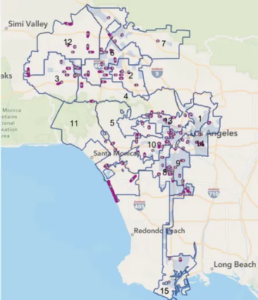
Los Angeles is rolling out automated speed cameras at 125 locations across the city. LADOT has said the first systems are on track to go live by the end of August 2026, with a 60-day warning period at each location before any fines are issued.

If you’ve been hurt by a speeding driver, here’s what the program actually does, and what it means for your claim.
LA Speed Cameras at a Glance
- Cameras will operate at 125 locations across all 15 City Council districts.
- A vehicle must be going at least 11 mph over the limit to trigger a citation.
- Each location gets a 60-day warning period before real fines start.
- Violations are civil only (no points added to your license).
- Cameras photograph the rear license plate, not the driver’s face.
- Cameras are not allowed on state routes, freeways, or highways. They’re limited to city streets.
Why Is LA Doing This?
Speeding is a leading killer on LA streets. LADOT reported that 290 people died in traffic crashes in the City of Los Angeles in 2025, and about one in five fatal crashes in the city is tied to speeding. The cameras are going up on what the city calls Priority Safety Corridors, streets with a history of speed-related crashes, often near schools and senior centers.
This program exists because of California Assembly Bill 645, a state law that lets a small group of cities (Los Angeles, San Francisco, Oakland, San Jose, Glendale, and Long Beach) pilot automated speed enforcement. It is not a statewide program, and no other California city can use it during the pilot.
How LA Speed Cameras Work
When an LA speed camera detects a vehicle going 11+ mph over the posted limit, it photographs the rear plate and mails a notice to the registered owner. Facial recognition is not permitted, and the photo can’t capture the rear window area.
During each location’s first 60 days, drivers get a written warning instead of a fine. After that:
| Speed Over Limit | Fine |
|---|---|
| 11–15 mph | $50 |
| 16–25 mph | $100 |
| 26+ mph | $200 |
| 100 mph or more | $500 |
These are civil penalties. They won’t add points to a California driving record or affect your license status.
Why Speeding Crashes Are So Dangerous
Speed cuts down a driver’s reaction time and lengthens stopping distance, which means crashes happen more often and hit harder. Speed-related collisions are a common cause of traumatic brain injuries, spinal injuries, broken bones, and internal injuries that require long-term care.
Statewide, the numbers back this up. According to the California Office of Traffic Safety, 4,061 people died in California traffic crashes in 2023, including 1,106 pedestrians, 583 motorcyclists, and 145 bicyclists.

Source: LADOT Annual Report 2023-2024
Does a Speed-Camera Ticket Prove Fault in an Accident?
Not on its own. A camera notice shows a specific vehicle was speeding at a specific place and time, but it doesn’t identify who was driving. Proving fault in a crash still requires evidence tying the speeding to the collision itself, such as dashcam or vehicle camera footage, witness statements, police reports, vehicle damage, and roadway evidence.
It’s also worth knowing that speed-camera records are confidential under California law and are only released in limited circumstances, such as a subpoena or court order in a specific case. Don’t assume footage will automatically be available for your claim.
Can You File a Claim Without a Speeding Ticket?
Yes. A driver doesn’t need to have received a citation, camera-issued or otherwise, for you to pursue a personal injury claim. Insurance companies and courts look at all the available evidence, including video, witness accounts, and vehicle data, to determine whether a driver was going too fast and caused the crash.
What Compensation Might Be Available?
Depending on your injuries and the facts of the crash, a claim may cover:
- Medical bills, current and future
- Lost income or reduced earning capacity
- Vehicle costs
- Pain and suffering
The amount depends on your injuries, available insurance coverage, and how fault is divided. A speeding citation alone doesn’t guarantee a payout.
After a Speeding Accident: What to Do
- Call 911 if anyone is hurt or the vehicles are blocking traffic.
- Recommend getting checked out, even if you feel okay. Some injuries may take time to show up.
- Exchange information with the other driver and photograph the scene, damage, and road conditions.
- Look for cameras and witnesses. Nearby businesses, homes, and other vehicles may have footage. It can be deleted or overwritten quickly, so it needs to be identified fast.
- Keep your records, including medical bills, repair estimates, and any documentation of missed work.
- Consult a personal injury attorney, especially before accepting any settlement or giving a recorded statement. Cha Cha Cha Law can help you deal with insurance adjusters and understand what your claim may be worth before you sign anything.
Frequently Asked Questions
Does a speed-camera ticket prove the other driver caused my accident?
Not by itself. A camera notice shows a specific vehicle was traveling above the speed limit at a certain place and time. It doesn’t establish who was driving, how the crash unfolded, or that the speeding actually caused your injuries. To build a personal injury claim, that speeding evidence typically needs to be connected to the crash itself through additional proof, such as witness statements, dashcam or vehicle camera footage, the police report, vehicle damage patterns, and roadway evidence.
What if I was partly at fault for the accident?
California follows a comparative-fault rule, meaning responsibility can be divided between everyone involved in a crash. You can generally still recover compensation even if you share some fault, though your award may be reduced by your percentage of responsibility. If a speed-camera notice shows the other driver was speeding at the time and place of your crash, that can be one piece of evidence supporting how fault gets divided.
What compensation can I recover in a speeding accident claim?
Depending on your injuries and the facts of the crash, a claim may cover medical bills (both past and future), lost income or reduced earning capacity, vehicle costs, and pain and suffering. The amount depends on the severity of your injuries, the available insurance coverage, how fault is divided, and the strength of your supporting evidence.
The other driver only got a warning notice, not a fine. Does that hurt my claim?
No. Warning notices are issued automatically during a camera location’s first 60 days of operation, regardless of the severity of the speeding or whether a crash occurred. Whether the other driver received a warning or a fine has no bearing on your right to pursue compensation. What matters for your claim is the evidence that speeding contributed to your accident and injuries, not the administrative outcome of the camera notice itself.
How does speeding affect what my case is worth?
Speeding evidence can strengthen a personal injury claim by helping establish that a driver breached their duty to drive safely. It can also be relevant to the severity of your injuries, since crashes at higher speeds tend to cause more serious harm, which can factor into how medical damages and pain and suffering are calculated. That said, every case depends on the full picture of evidence, not speed alone.
Should I talk to the insurance company before speaking with a lawyer?
Be cautious. Insurance adjusters may ask you to describe the crash, including your estimate of speeds or distances. Avoid guessing about speed, fault, or the extent of your injuries, since early statements can be used against you later. It’s generally advisable to document everything you can (photos, witness contact info, medical records) and consult an attorney before giving a recorded statement.
What if the other driver fled the scene or can’t be identified?
If a speeding driver leaves the scene, your own uninsured/underinsured motorist coverage may apply, and any available camera or witness evidence (including footage from nearby businesses, homes, or other drivers) becomes especially important to identify and preserve quickly, since it can be deleted or recorded over.
Does it matter if my accident happened somewhere without a speed camera?
No. Most streets in Los Angeles are not covered by this pilot program, and that doesn’t limit your ability to bring a claim. Fault and speeding can be established through the evidence described above regardless of whether a camera happened to be present at that location.
Injured in a Los Angeles Speeding Accident?
A speeding accident can leave you juggling medical care, missed work, and insurance calls all at once. Cha Cha Cha Law represents people injured in car, pedestrian, bicycle, motorcycle, and rideshare accidents throughout Los Angeles and Southern California.
Call (213) 351-3513 or submit a website inquiry for a free consultation in English, Korean (한국어), or Spanish (Español).
Contact our office to speak with a Los Angeles speeding accident lawyer about your potential claim.