
When your new vehicle spends more time in the repair shop than on the road, you may have a lemon on your hands. Every state has a version of the lemon law that gives consumers the right to demand a replacement or refund when a vehicle has chronic, unfixable defects. Determining whether your vehicle qualifies often comes down to data – the number of defects reported, the types of problems and whether the manufacturer has issued recalls for those issues. This article looks at public recall and complaint information to highlight the vehicles and manufacturers most often associated with lemon law claims in 2026.
Need immediate help? If you believe your car is a lemon, call our attorneys at Cha Cha Cha Law for a free consultation at (213) 351–3513.
Understanding NHTSA Complaints and Lemon Law
- What is a “complaint”? A complaint is a report filed by a vehicle owner or lessee describing a safety‑related problem. The NHTSA collects these reports and assigns each a reference number. Investigators use the data to spot patterns and initiate recalls.
- Not every complaint equals a lemon. Many problems are minor or isolated. A vehicle generally qualifies as a lemon when it has a substantial defect that persists after a reasonable number of repair attempts and the problem significantly impairs use, value or safety.
- Why complaints matter. High complaint volume can signal systemic problems. When combined with recall campaigns and investigations, complaints provide insight into which models are most likely to trigger lemon‑law claims.
Cars with the Most Lemon Law Complaints (2015‑2024 Data)
Researchers at Tire Easy analyzed more than 600,000 complaints from NHTSA from 2015‑2024 and identified the models that generated the most gripes. According to AAA’s summary of the study, Ford dominated the list, occupying seven of the top ten positions.
The table below summarises the findings. |
||
|---|---|---|
| Rank | Vehicle (make & model) | NHTSA complaints (2015‑2024) |
| 1 | Ford Fusion | 16 335 |
| 2 | Ford F‑150 | 15 378 |
| 3 | Ford Escape | 14 940 |
| 4 | Jeep Grand Cherokee | 12 248 |
| 5 | Ford Explorer | 11 037 |
| 6 | Hyundai Sonata | 10 170 |
| 7 | Honda CR‑V | 10 016 |
| 8 | Ford Edge | 9 871 |
| 9 | Chevy Malibu | 9 273 |
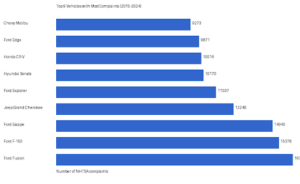
Ford’s dominance doesn’t necessarily mean its vehicles are the most unreliable; Ford also sells more vehicles than most competitors. However, high complaint counts are a red flag that certain models might be prone to recurring defects. Many of these models – particularly the Ford Fusion, F‑150 and Explorer – have been the subject of repeated lemon‑law lawsuits and recall campaigns.
The same study ranked automakers by total complaints: Ford accounted for 110,011 complaints (17.6 % of all filings), Chevrolet 61,307 (9.8 %) and Toyota 41,465 (6.6 %).
Lemon Law Hot Spots in 2025
While long‑term complaint data shows which vehicles accumulate the most grievances, lemon law claims are often filed on newer vehicles that exhibit defects in their first year. A 2026 study highlights seven 2025 model‑year vehicles that generated unusually high complaint and recall activity.
- Hyundai Tucson (87 complaints, 3 recalls) – Owners reported transmission failures, fuel pump problems and brake malfunctions.
- Tesla Model 3 (67 complaints, 3 recalls & 3 investigations) – Defects included steering and suspension problems; some vehicles displayed software glitches.
- Tesla Model Y (49 complaints, 2 recalls & 3 investigations) – Complaints centred on steering control, autopilot issues and electrical failures.
- Ford Explorer (44 complaints, 13 recalls) – Reports highlighted power‑train failures, engine stalling and electronic door latch problems.
- Jeep Wrangler (24 complaints, 2 recalls) – Engine stalling and steering “shimmy” issues plagued owners.
- Ford F‑150 (31 complaints, 10 recalls) – Ford’s best‑selling truck faced complaints about faulty brakes, engine knocking and airbag malfunctions.
- Jeep Grand Cherokee (10 complaints) – Although complaint numbers were lower, recurring transmission and electrical issues triggered litigation.
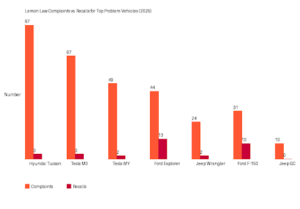
Vehicles with high complaint counts and multiple recalls within their first year are prime candidates for lemon‑law claims. If your 2025 or 2026 vehicle appears in the chart above, you should monitor recall notices and document every repair attempt. Under many state laws, a vehicle is presumed to be a lemon if the manufacturer has tried to fix the same defect four times without success or if it has been out of service for 30 days or more.
Recall Campaigns by Manufacturer
NHTSA’s recall dashboard shows which manufacturers initiated the most safety campaigns in 2025.
The top twelve manufacturers are listed below. |
|
|---|---|
| Manufacturer | Number of recall campaigns (2025) |
| Ford | 153 |
| Chrysler | 53 |
| Forest River Inc. | 36 |
| General Motors | 28 |
| Volkswagen | 26 |
| International Motors | 26 |
| Honda | 24 |
| BMW | 23 |
| Hyundai | 21 |
| Mercedes‑Benz | 21 |
| Altec Industries | 17 |
| Mack Trucks | 17 |
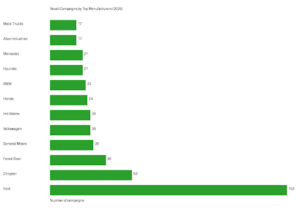
What types of defects? Ford’s recalls spanned 12 different categories; electrical problems were the most common (27 campaigns), and equipment issues were the least common (4 campaigns). NHTSA also issued 19 “Do Not Drive” warnings and 16 “Park Outside” advisories in 2025, illustrating the severity of some defects.
Vehicles Affected by Recalls
Recalls vary in size. Some target a handful of vehicles while others affect entire model lines. According to NHTSA data, Ford recalled 12.93 million vehicles in 2025, dwarfing other manufacturers. Toyota and Chrysler followed with 3.22 million and 2.78 million vehicles, respectively. The chart below visualizes the 10 brands with the most vehicles affected.
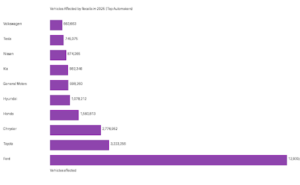
Key observations:
- Ford’s recall volume reflects both the size of its product line and ongoing quality‑control challenges. Many 2025 Ford recalls involved electrical system failures, back‑over prevention malfunctions, power‑train defects and brake issues.
- Toyota issued fewer campaigns, but its recalls were large, affecting more than three million vehicles.
- Chrysler (FCA US) recalled roughly 2.78 million vehicles, while Honda, Hyundai and General Motors each recalled about 1–1.6 million.
Automakers with the Most Consumer Complaints
Ford accounted for 17.6 % of all complaints filed with NHTSA between 2015 and 2024, with 110,011 complaints. Chevrolet logged 61,307 complaints (9.8 %) and Toyota 41,465 (6.6 %). These figures reinforce Ford’s position at the top of the complaint and recall charts and suggest that consumers frequently report problems with Ford vehicles. However, large market share also influences complaint volume, so consumers should consider complaint rates relative to sales.
Why Lemon‑Law Claims Are Filed
Most lemon‑law cases involve recurring issues that seriously impair a vehicle’s use, value or safety. Common themes include:
- Electrical system failures – The most common source of recall campaigns. Problems ranged from fire risks to back‑up camera failures.
- Power‑train defects – Transmission failure, engine stalling and defective crankshaft or connecting rod components were behind many Ford and GM recalls.
- Brake and steering problems – Faulty hydraulic service brakes and steering “shimmy” issues surfaced on models such as the Ford F‑150, Jeep Wrangler and Ram 1500.
- Software and sensor glitches – Tesla’s Model 3 and Model Y were recalled for software‑related fixes affecting autopilot systems, door latches and warning lights.
- Safety‑critical warnings – NHTSA issued 19 Do Not Drive and 16 Park Outside notices in 2025 due to fire risks and other severe hazards.
If your new car exhibits similar problems and the manufacturer can’t repair them within a reasonable number of attempts, it may qualify as a lemon. Document every repair visit, keep copies of work orders and contact a lemon‑law attorney as soon as possible.
Get Help with Your Lemon Law Claim
If your new car, truck or SUV keeps failing despite repeated repairs, you don’t have to fight the manufacturer alone. Our experienced attorneys specialize in lemon‑law claims and can help you obtain a replacement vehicle or refund.
Call us today at (213) 351-3513, and a member of our team will assist you promptly.
Frequently Asked Questions About Lemon Law Claim Statistics
Lemon Law Frequently Asked Questions
-
What qualifies a vehicle as a lemon?
A vehicle may qualify as a lemon when a serious defect cannot be repaired after a reasonable number of attempts while the vehicle is under the manufacturer’s warranty.
Most state lemon laws require three key elements:
- The vehicle has a substantial defect affecting safety, use, or value
• The manufacturer or dealership had multiple opportunities to repair the defect
• The problem continues despite repair attempts or the vehicle spends extended time in the repair shop
Common examples of defects that may lead to lemon law claims include engine failures, transmission problems, electrical malfunctions, braking system failures, battery issues in electric vehicles, or software problems that affect vehicle operation.
Many states also consider a vehicle a lemon if it has been out of service for an extended number of days due to warranty repairs.
-
Does the lemon law cover used cars?
Yes, in some situations lemon laws can apply to used vehicles.
Many states extend lemon law protections to certified pre-owned vehicles or used cars that are still covered by the manufacturer’s original warranty. If a defect occurs while the vehicle is still under warranty and cannot be repaired after reasonable attempts, the owner may still have a lemon law claim.
However, lemon law protections for used vehicles are often more limited than those for new vehicles. For example:
- The warranty coverage period may be shorter
• Vehicles sold “as-is” without warranty coverage may not qualify
• Some states impose additional requirements for used vehicle claims
Because used vehicle situations vary widely, it is often helpful to have an attorney review the warranty status and repair history.
-
How long do I have to file a lemon law claim?
The deadline to file a lemon law claim depends on the state’s statute of limitations.
In many states, including California, lemon law claims must generally be filed within four years from when the owner first discovers the defect or breach of warranty. However, the defect itself typically must occur while the vehicle is covered by the manufacturer’s warranty.
Even if the deadline has not passed, it is usually best to act quickly because:
- Repair records can become harder to obtain over time
• Vehicle history documentation may become incomplete
• Manufacturers may dispute older claims more aggressively
Consulting with an attorney early can help determine whether a claim is still valid.
-
Which vehicles are most likely to generate lemon law complaints?
Any vehicle can develop defects, but certain models may generate higher complaint levels due to mechanical, electrical, or design issues.
In recent years, vehicles with complex electronics, advanced driver-assistance systems, or new electric-vehicle technology have produced increased complaint activity. Some reports have highlighted elevated complaint levels involving certain Ford trucks and SUVs, Tesla electric vehicles, and some Hyundai, Kia, and Jeep models.
Common problem categories reported by consumers include:
- Battery system failures in electric vehicles
• Transmission defects
• Engine performance issues
• Electrical system malfunctions
• Infotainment or software problems
However, the presence of complaints about a particular model does not automatically mean every vehicle of that model is defective.
-
Do high complaint numbers mean my vehicle is automatically a lemon?
No. High complaint numbers do not automatically make a vehicle a lemon.
Complaint databases simply reflect that other owners have reported issues. Lemon law eligibility depends on what happens with your specific vehicle, including:
- The severity of the defect
• The number of repair attempts
• How long the vehicle was out of service
Even if a vehicle model has thousands of complaints, a lemon law claim typically requires proof that your vehicle has a persistent defect that cannot be repaired after reasonable attempts.
-
Does a recall automatically qualify my vehicle under lemon law?
Not necessarily.
A recall means a manufacturer or safety regulator identified a defect related to safety or regulatory compliance and is requiring the manufacturer to repair the issue. If the recall repair successfully fixes the problem, the vehicle usually would not qualify as a lemon.
However, a vehicle may still qualify for lemon law protection if:
- The recall repair does not fix the defect
• The same issue continues after repair attempts
• The vehicle remains out of service for an extended time
Repeated unsuccessful recall repairs may strengthen a lemon law claim depending on the circumstances.
Disclaimer
The information provided on this page is for general informational purposes only and does not constitute legal advice. The data and statistics referenced are drawn from NHTSA complaint and recall databases and third‑party analyses. While we strive to keep the information current, recall data can change rapidly. Please contact us to discuss the specific facts of your case.